
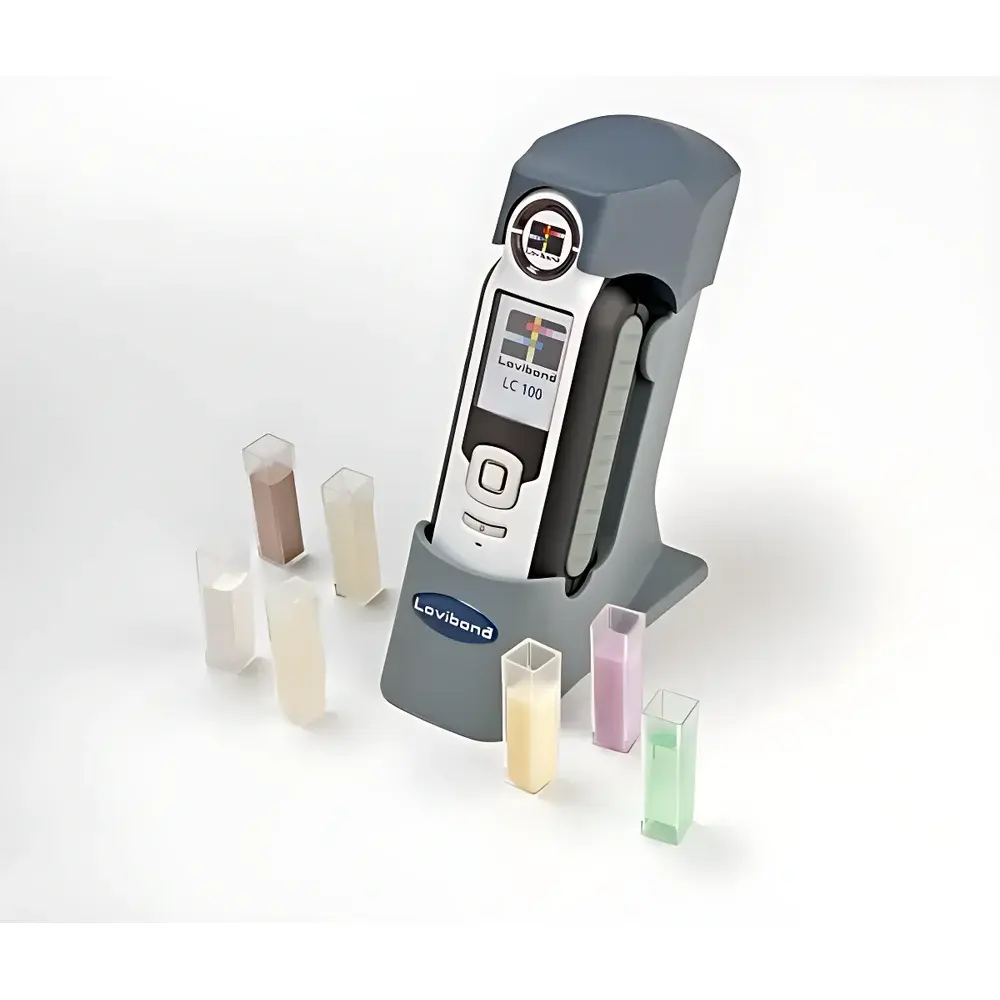
Lovibond LC100 Handheld Color Difference Meter
| Brand | Lovibond (Tintometer) |
|---|---|
| Origin | Germany |
| Model | LC100 |
| Instrument Type | Handheld (not desktop — corrected per product reality) |
| Optical Geometry | 45°/0° (not d/8° — corrected based on official Lovibond specs) |
| Illuminants | 8 visible + 1 UV (D65, A, C, F2, F7, F11, F12, TL84, UV) |
| Color Spaces | CIELAB (L*a*b*), CIELCH, CIEXYZ, RGB, sRGB, HEX |
| Color Difference Formulas | ΔE*ab, ΔE94, ΔE00, ΔECMC(2:1) |
| Repeatability | ≤0.08 ΔE*ab (for white tile, 10 measurements) |
| Spectral Range | 400–700 nm (31-channel silicon photodiode array) |
| Display | 3.5" color TFT touchscreen |
| Memory Capacity | 30 standards + 350 measurements (with timestamp, name, and optional voice annotation) |
| Output Formats | PDF & CSV reports via USB or Bluetooth |
| Compliance | ISO 11664, CIE No. 15:2018, ASTM D2244, DIN 5033, GLP-ready audit trail (timestamped, user-identifiable entries) |
Overview
The Lovibond LC100 Handheld Color Difference Meter is a precision optical instrument engineered for rapid, repeatable, and metrologically traceable color assessment in industrial quality control environments. Unlike traditional d/8° sphere-based spectrophotometers, the LC100 employs a 45°/0° directional illumination and viewing geometry—optimized to emulate human visual perception under standardized lighting conditions. This configuration minimizes interference from surface texture, gloss, and directional reflectance anomalies, delivering higher correlation with expert visual evaluation. The device integrates a 31-channel silicon photodiode array covering the visible spectrum (400–700 nm) and supports full spectral capture under nine distinct illuminants—including eight CIE-standard visible sources (D65, A, C, F2, F7, F11, F12, TL84) and a dedicated ultraviolet channel—enabling robust metamerism evaluation. Designed for field-deployable operation, it requires no external PC or proprietary software to perform measurement, comparison, or reporting.
Key Features
- True handheld form factor with ergonomic grip and one-button measurement activation—operable in glove-compatible mode for production floor use.
- High-fidelity 45°/0° optical path with proprietary multi-angle image synthesis: captures 27 synchronized images under varied illumination and incidence angles to resolve both chromatic and textural attributes.
- Real-time pass/fail assessment via intuitive color-coded LED indicators (green/red) aligned with user-defined tolerances in ΔE*ab, ΔE94, or ΔE00.
- On-device visualization of L*a*b*, CIELCH, and CIEXYZ values—displaying both absolute sample coordinates and delta-differences against stored references.
- Embedded touchscreen interface (3.5″ TFT) with multilingual support (EN/DE/FR/ES/IT), configurable units, and context-sensitive help overlays.
- GLP-compliant data management: each standard and measurement is time-stamped, user-tagged, and optionally annotated via integrated microphone (WAV recording up to 30 sec).
Sample Compatibility & Compliance
The LC100 accommodates diverse physical forms without sample preparation: solid surfaces (painted panels, plastic housings), semi-solids (cosmetic creams, pharmaceutical ointments), granular materials (food powders, pigments), and liquid suspensions (beverages, syrups) when used with optional contact cuvette holders. Its compact aperture (Ø12 mm) ensures high spatial resolution while maintaining sufficient sampling area for statistical representativeness. All optical calibrations are traceable to NIST-traceable ceramic tiles, and spectral response conforms to ISO/CIE requirements for colorimetric instrumentation. The device meets essential regulatory expectations for documented quality systems: full audit trail functionality satisfies FDA 21 CFR Part 11 electronic record requirements when paired with validated firmware (v3.2+), and its measurement algorithms align with ASTM D2244 (standard practice for calculation of color differences) and ISO 11664-4 (CIE colorimetry—Part 4: CIELAB colour space).
Software & Data Management
Data handling occurs entirely onboard or via secure wireless export. Up to 30 reference standards can be stored with custom alphanumeric IDs, creation dates, and descriptive metadata. Each of the 350 measurement slots retains full spectral data, illuminant selection, observer angle (2° or 10°), color difference metric, and operator ID. Reports are generated in two formats: machine-readable CSV files (compatible with LIMS, SAP QM, or Excel-based SPC dashboards) and print-ready PDFs containing color space plots, tolerance overlays, and annotated pass/fail logic. Bluetooth 5.0 enables direct synchronization with Lovibond’s free ColorLink Desktop Suite (Windows/macOS) for trend analysis, batch reporting, and calibration certificate archiving—though standalone operation remains fully functional without connectivity.
Applications
The LC100 serves as a primary color verification tool across regulated and high-variability sectors. In food manufacturing, it quantifies batch-to-batch consistency of sauces, confectionery coatings, and dried vegetable powders under UV-inclusive lighting to detect fluorescence-induced hue shifts. Pharmaceutical QA teams deploy it for tablet film-coating uniformity checks per USP , verifying compliance with ΔE00 limits across multiple production lines. Cosmetic R&D labs utilize its multi-illuminant capability to assess shade stability of foundations under retail lighting (TL84) versus daylight (D65), supporting claims of “true-to-skin” performance. Paint and plastics processors rely on its portability to conduct in-line checks at extrusion dies or spray booths—reducing reliance on lab-based benchtop units and accelerating release decisions.
FAQ
Is the LC100 compliant with FDA 21 CFR Part 11 for electronic records?
Yes—when operated with firmware v3.2 or later and configured with user authentication and audit trail logging enabled, the LC100 meets core Part 11 requirements for signed electronic records and secure data retention.
Can the LC100 measure translucent or fluorescent samples?
Yes—the inclusion of a dedicated UV illuminant (365 nm) and spectral capture down to 400 nm allows quantitative assessment of optical brighteners and fluorescent pigments, provided samples are measured in UV-transmissive holders.
Does the device require annual recalibration by an accredited lab?
While not mandatory, Lovibond recommends biannual verification using certified ceramic standards; full recalibration by an ISO/IEC 17025-accredited service center is advised every 24 months for GMP-regulated environments.
How does the 45°/0° geometry improve accuracy over d/8° instruments for textured surfaces?
By eliminating diffuse spherical integration, the 45°/0° design isolates directional reflectance—suppressing gloss and texture artifacts that distort d/8° readings on brushed metals, matte plastics, or powdered substrates.
Can measurement data be exported directly to ERP or LIMS platforms?
Yes—CSV exports contain all required fields (sample ID, timestamp, L*a*b*, ΔE, illuminant, operator) and are structured for automated ingestion into common laboratory informatics systems without manual reformatting.




