
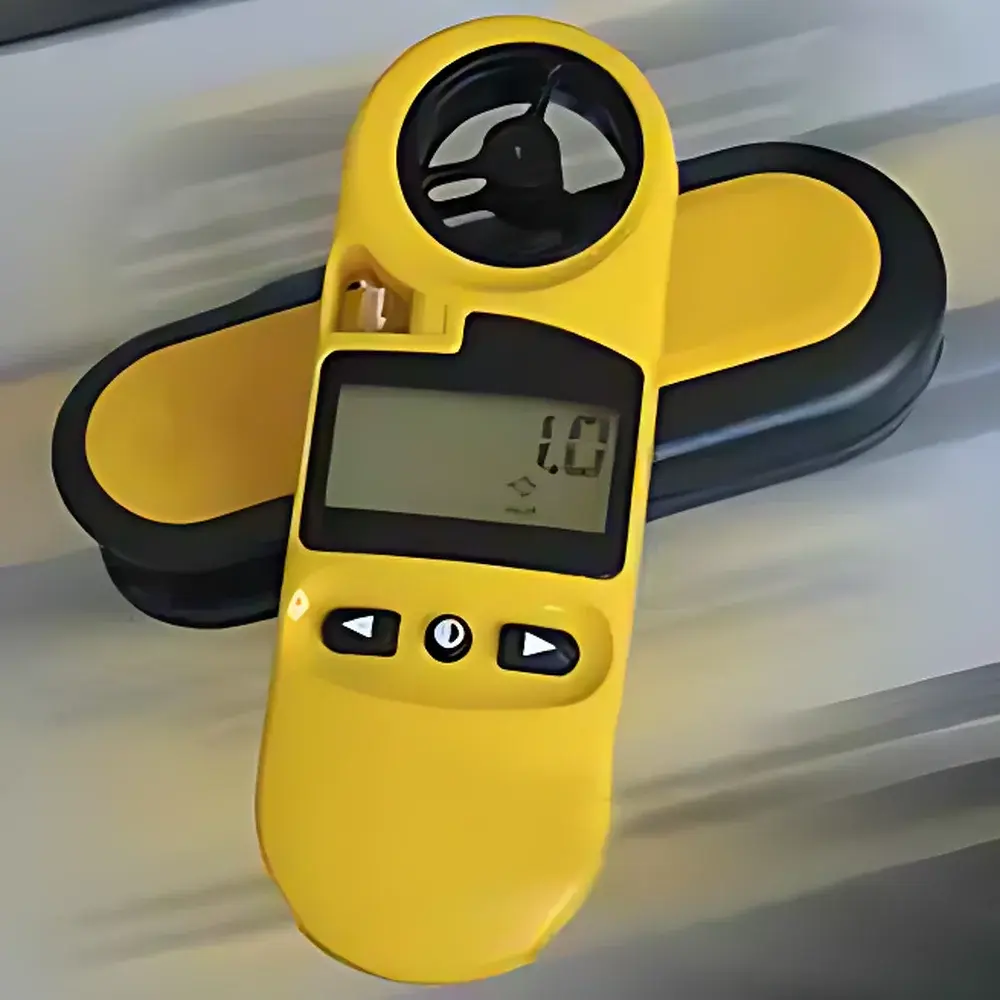
Lovibond NK5920 Waterproof Portable Anemometer & Environmental Meter
| Brand | Lovibond (Tintometer) |
|---|---|
| Origin | United Kingdom |
| Model | NK5920 |
| IP Rating | IP67 |
| Display | 4-digit LCD with green backlight |
| Power | CR2032 battery (≈300 h typical life) |
| Dimensions | 122 × 42 × 18 mm |
| Weight | 65 g |
| Compliance | CE, NIST-traceable calibration support available |
Overview
The Lovibond NK5920 is a rugged, field-deployable environmental meter engineered for high-reliability measurement of wind speed and multiple meteorological parameters under demanding outdoor conditions. Designed around a precision-crafted 1-inch anemometer cup assembly featuring sapphire jewel bearings and hardened steel axle geometry, the instrument adheres to established aerodynamic calibration standards for cup-type anemometers per IEC 61400-12-1 and ISO 12207. Its core measurement architecture integrates a single-chip microprocessor with proprietary signal conditioning firmware—optimized to minimize thermal drift and mechanical hysteresis across temperature gradients. The NK5920 operates as a self-contained, handheld unit with no external probes or cables required, enabling immediate deployment in emergency response, environmental site assessment, HVAC commissioning, agricultural microclimate monitoring, and industrial safety audits. Its IP67-rated enclosure ensures operational integrity after full immersion in 1 m of water for up to 30 minutes and resistance to dust ingress—critical for use in coastal, desert, or post-disaster environments where instrument survivability directly impacts data continuity.
Key Features
- True multi-parameter capability: simultaneous real-time measurement of wind speed (m/s, ft/min, km/h, mph, knots, Beaufort), ambient temperature (°C/°F), relative humidity (%RH), barometric pressure (hPa, inHg, PSI), altitude (ft/m), wind chill index, heat stress index, dew point, and wet-bulb temperature.
- High-stability cup anemometer with ±1% calibration accuracy at 5° yaw angle, verified per manufacturer’s traceable test protocol; long-term drift <1% after 100 h at 7 m/s (16 mph).
- Integrated dual-compensated silicon piezoresistive pressure sensor with on-board temperature correction algorithm—ensuring <±0.09 inHg (±3.0 hPa) total error across operating range.
- Patented polymer capacitive RH sensor (US Patent 6,257,074) with thermal isolation housing—achieving ±3.0 %RH accuracy over 5–95 %RH (non-condensing), with ≤±2% annual calibration drift.
- Green-backlit 4-digit LCD (0.36″ character height) with 1-second update rate and user-configurable auto-off (45 min default).
- On-device memory retains last measured value; time/date stamping enabled via internal real-time clock.
- CE-marked; supports NIST-traceable recalibration using Lovibond-certified tools (e.g., humidity calibrator NI30824, pressure reference standard).
Sample Compatibility & Compliance
The NK5920 is validated for direct atmospheric sampling only—suitable for ambient air, light snowfall, and surface water vapor profiling (not submersible for liquid flow measurement). It meets EN 61326-1:2013 for electromagnetic compatibility in industrial environments and conforms to RoHS 2011/65/EU. While not certified for Class I Div 1 hazardous locations, its sealed construction permits safe operation in non-explosive outdoor zones per ATEX Zone 3 guidelines. For regulated applications—including occupational health monitoring under OSHA 1910.120 or EPA Method TO-15 support—the device provides raw parameter outputs compatible with GLP-compliant data logging when paired with NK PN-0830 PC interface software (RS-232 + USB adapter included separately). All factory calibrations are documented against UKAS-accredited reference standards.
Software & Data Management
Data export is supported exclusively via the optional NK PN-0830 interface module, which connects to Windows-based PCs through RS-232 serial communication (USB-to-serial adapter provided). The companion software enables timestamped CSV export, trend visualization, pressure trend analysis (3-hour rolling history), and comparative parameter overlays. Audit trail functionality includes operator ID tagging, calibration event logging, and firmware version tracking—aligning with basic FDA 21 CFR Part 11 readiness requirements when deployed in GxP-aligned environmental qualification studies. No cloud connectivity or mobile app integration is provided; all data handling remains local and user-controlled to preserve chain-of-custody integrity.
Applications
- Emergency response teams assessing ventilation rates during hazmat incidents or structural collapse scenarios.
- Environmental consultants conducting baseline meteorological surveys for EIA reporting (ISO 14001 Annex A.4.2).
- Renewable energy technicians verifying site wind resource consistency prior to small-scale turbine installation.
- Industrial hygienists evaluating thermal stress exposure (WBGT-equivalent indices) in outdoor worksites per ISO 7243.
- Educational laboratories performing atmospheric physics experiments requiring portable, multi-sensor validation.
- Building services engineers validating HVAC system airflow balance and outdoor air intake performance per ASHRAE Standard 62.1.
FAQ
What is the recommended recalibration interval for the NK5920?
Annual recalibration is advised for critical applications; however, field verification using Lovibond’s NI30824 humidity calibrator or certified pressure reference is recommended before each major deployment.
Can the NK5920 measure wind speed underwater or inside ducts?
No—it is designed exclusively for open-air atmospheric measurement. Submersion beyond IP67 limits or insertion into confined ductwork voids calibration validity and risks mechanical damage.
Does the device support data logging without a PC connection?
No internal datalogging memory is present; only the most recent single reading is retained in volatile memory until power cycle.
What is the maximum sustained wind speed the anemometer can withstand without degradation?
Continuous operation above 27 m/s (60 mph) accelerates bearing wear and compromises long-term accuracy—use is restricted to intermittent sampling under such conditions.
Is the temperature sensor suitable for immersion in liquids?
No—the thermistor is optimized for ambient air; direct contact with water or ice will affect thermal response time and may breach the IP67 seal if forced.







