
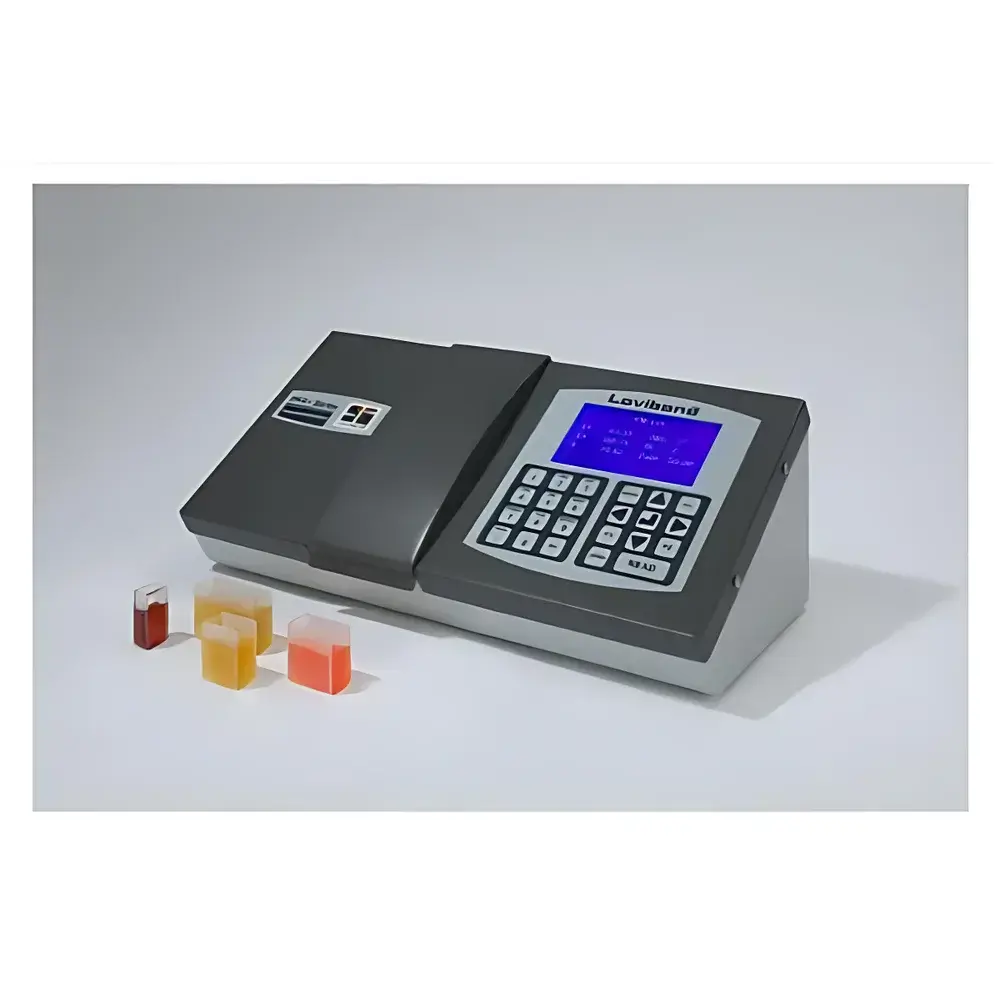
Lovibond PFXi195/2 Automated Colorimeter
| Brand | Lovibond (Tintometer) |
|---|---|
| Origin | United Kingdom |
| Model | PFXi195/2 |
| Measurement Principles | Tristimulus colorimetry (CIE 1931 XYZ), spectral reflectance (31-wavelength LED array) |
| Standards Supported | ASTM D1500 (Petroleum), ASTM D156 (Saybolt), ASTM D5386 (Color by Instrument), ISO 2764 (Pt-Co/Hazen/APHA), ISO 4630 (Gardner), CIE L*a*b*, CIE Yxy, ΔE*ab |
| Display | 7-inch TFT LCD with multi-language UI (including English, Chinese, Spanish, French, German) |
| Interface | USB 2.0, 10/100 Mbps Ethernet (LAN), RS-232 optional |
| Data Storage | Internal memory for ≥10,000 results with GLP-compliant audit trail (date, time, operator ID, sample ID, method ID) |
| Sample Compartment | Removable stainless-steel cell holder, compatible with 10–50 mm pathlength cuvettes (glass, quartz, disposable plastic) |
| Calibration | Factory-calibrated with NIST-traceable liquid standards |
| Enclosure | IP54-rated stainless-steel chassis with chemical-resistant coating |
| Software | Lovibond ColorControl v5.x (Windows), supports CIE chromaticity diagrams, spectral curve overlay, deviation analysis (ΔL*, Δa*, Δb*, ΔE*ab), custom standard creation, and 21 CFR Part 11–compliant user access control |
Overview
The Lovibond PFXi195/2 Automated Colorimeter is a precision-engineered tristimulus color measurement instrument designed for objective, repeatable color assessment in quality control laboratories and industrial production environments. Operating on the CIE 1931 standard observer model, it employs a stable 31-channel LED light source array covering the visible spectrum (400–700 nm) to capture full spectral reflectance data at high photometric resolution. Unlike visual comparison methods or single-wavelength photometers, the PFXi195/2 delivers metrologically traceable color coordinates—including CIE L*a*b*, L*C*h*, Yxy, and XYZ—as well as industry-specific indices such as ASTM D1500 (petroleum color), Saybolt, Pt-Co/Hazen/APHA, Gardner, and ICUMSA. Its optical architecture eliminates observer bias, ambient lighting influence, and inter-operator variability, ensuring compliance with ISO/IEC 17025 accreditation requirements for color testing laboratories.
Key Features
- Automated measurement cycle completed in ≤20 seconds—no manual alignment, zero adjustment, or operator interpretation required
- Removable stainless-steel sample compartment engineered for resistance to hydrocarbons, acids, alkalis, and solvents; facilitates rapid cleaning and validation
- RCMSi (Remote Calibration Management System interface) enables secure, auditable remote verification of photometric performance against certified reference standards
- Multi-standard methodology library preloaded with >25 internationally recognized color scales; customizable method templates support internal SOPs
- Full-spectrum data acquisition (31 discrete wavelengths) enables advanced deviation analysis, including hue angle shift, chroma difference, and total color difference (ΔE*ab)
- IP54-rated enclosure with corrosion-resistant surface finish suitable for use in refinery labs, petrochemical QC areas, and manufacturing cleanrooms
- Integrated GLP functionality: automatic timestamping, operator authentication, sample ID logging, and electronic signature support per 21 CFR Part 11 Annex 11 guidelines
Sample Compatibility & Compliance
The PFXi195/2 accepts standard rectangular or round cuvettes with optical path lengths from 10 mm to 50 mm, accommodating both transparent and semi-transparent liquid samples—including crude oil fractions, lubricants, diesel fuels, edible oils, pharmaceutical solvents, and wastewater effluents. It complies with ASTM D1500, D156, D5386, ISO 2764, ISO 4630, and ICUMSA Method GS7. All factory calibrations are traceable to NIST SRM 2035 (liquid color standards) and UKAS-accredited reference materials. The instrument’s measurement uncertainty budget meets ISO 9001 and ISO/IEC 17025 requirements for routine color testing, and its firmware architecture supports periodic revalidation under GMP/GLP audit protocols.
Software & Data Management
Lovibond ColorControl v5.x software provides comprehensive post-acquisition analysis: interactive CIE 1931 chromaticity diagrams with user-defined tolerance ellipses, spectral reflectance curve overlay for batch-to-batch comparison, and automated deviation reporting (ΔL*, Δa*, Δb*, ΔC*, ΔH*, ΔE*ab). Data export supports CSV, PDF, XML, and proprietary .ccf formats. Network deployment allows centralized instrument monitoring across multiple sites via LAN or secure HTTPS tunnel. Audit trails record all method changes, calibration events, and user logins with immutable timestamps—fully compliant with FDA 21 CFR Part 11 and EU Annex 11 electronic record requirements.
Applications
- Petroleum refining: ASTM D1500 color grading of naphthas, kerosenes, and distillates
- Fuel quality assurance: Saybolt color evaluation of aviation turbine fuels per ASTM D156
- Edible oil processing: APHA/Pt-Co index monitoring during bleaching and deodorization
- Pharmaceutical excipient release testing: Hazen color conformity per USP
- Chemical manufacturing: Gardner scale assessment of resins, coatings, and intermediates
- Environmental labs: Visual clarity and color quantification of treated effluents per ISO 7887
FAQ
Does the PFXi195/2 require annual recalibration by an external service provider?
No—routine verification can be performed in-house using certified Lovibond liquid standards or NIST-traceable filter kits. Full recalibration is recommended every 24 months or after major optical component replacement.
Can the instrument measure opaque or turbid samples?
It is optimized for transparent to translucent liquids. For highly scattering or particulate-laden samples, centrifugation or filtration prior to analysis is advised to ensure valid tristimulus integration.
Is spectral data export supported for third-party chemometric modeling?
Yes—full 31-point spectral reflectance values (400–700 nm, 10 nm intervals) are exportable in CSV format for PCA, PLS, or other multivariate analysis workflows.
How does RCMSi enhance measurement integrity?
RCMSi performs automated photometric stability checks against embedded reference channels and logs deviations exceeding ±0.2% transmittance—triggering configurable alerts and audit-ready reports.
What security controls are available for regulated environments?
Role-based access (administrator, analyst, viewer), password complexity enforcement, session timeout, and electronic signature capture—all configurable to meet 21 CFR Part 11 Subpart B requirements.





