
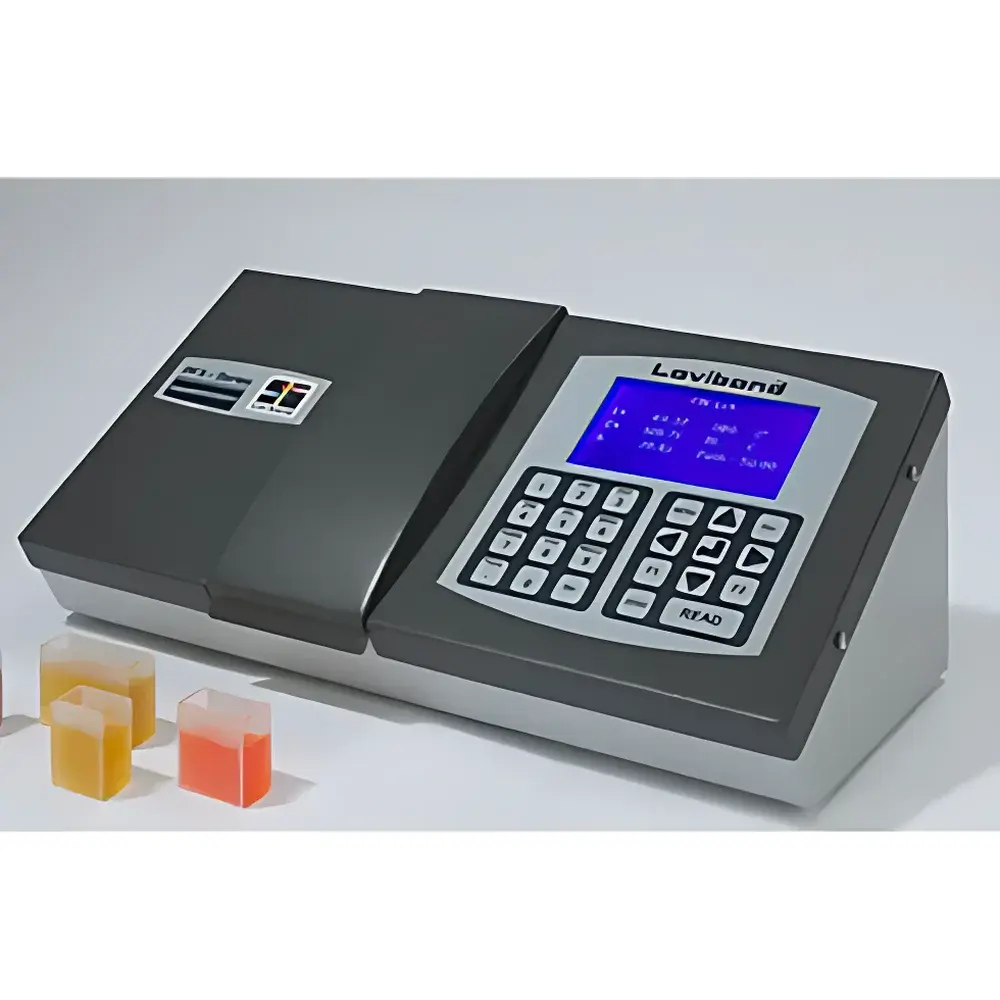
Lovibond PFXi195/3 Automated Colorimeter
| Brand | Lovibond |
|---|---|
| Origin | United Kingdom |
| Model | PFXi195/3 |
| Spectral Range | 420–710 nm |
| Spectral Bandwidth | 10 nm |
| Repeatability (CIE x,y) | ±0.0004 |
| Measurement Time | <30 s |
| Light Source | 5 V, 10 W Tungsten-Halogen Lamp |
| CIE Illuminants | A, B, C, D65 |
| Observer Angles | 2°, 10° |
| Path Length Range | 0.1–50 mm |
| Data Interfaces | USB, LAN, RS232 |
| Data Storage Capacity | 100,000 measurements |
| Display | 240 × 128 pixel backlit LCD |
| Keypad | 23 tactile polyester membrane keys with audible feedback |
| Housing Material | Steel enclosure with textured epoxy coating |
| Dimensions (W×H×D) | 435 × 195 × 170 mm |
| Weight | 6.8 kg |
| Compliance | CE, RoHS, WEEE |
Overview
The Lovibond® PFXi195/3 Automated Colorimeter is a precision optical measurement instrument engineered for high-reproducibility color assessment of transparent and semi-transparent liquid samples—particularly those with medium-to-deep coloration, such as edible oils, lubricants, resins, waxes, and industrial fats. It operates on the principle of fixed-wavelength photometry using nine interference filter-based optical channels, each aligned to standardized spectral bands across the visible spectrum (420–710 nm). Unlike spectrophotometers, the PFXi195/3 delivers rapid, repeatable results without requiring full spectral acquisition, making it ideal for routine QC laboratories where throughput, robustness, and traceable compliance are prioritized over spectral modeling. Its optical architecture conforms to CIE 1931 and CIE 1964 standard observer functions and supports both 2° and 10° viewing angles, enabling accurate correlation with human visual perception under controlled illumination conditions (CIE Illuminants A, B, C, and D65).
Key Features
- Fixed-filter photometric design with nine precisely calibrated interference filters for stable long-term performance and minimal drift
- Automated baseline calibration via single-button initiation—no external standards required for daily verification
- Integrated path-length adjustment mechanism (0.1–50 mm) accommodates diverse sample viscosities and absorbance ranges without manual cuvette substitution
- Steel enclosure with textured epoxy coating provides mechanical durability and resistance to chemical exposure in industrial lab environments
- Large backlit monochrome LCD (240 × 128 pixels) with intuitive icon-driven navigation and real-time graphical display of chromaticity coordinates
- Multi-language interface supporting English, Chinese, French, German, Italian, and Portuguese—configured at system startup without firmware reload
- Remote firmware and color scale updates via secure LAN connection, ensuring alignment with evolving industry-standard references (e.g., FAC, Gardner, CIE L*a*b*, CIE XYZ)
- Dedicated ΔE and deviation reporting engine for quantitative bias evaluation against master standards or batch specifications
Sample Compatibility & Compliance
The PFXi195/3 is validated for use with clear to moderately hazy liquids within ISO 4630 (Gardner color), ASTM D1500 (Petroleum Products), and AOCS Cd 13b-97 (Edible Oils) method frameworks. Its optical path design minimizes scattering artifacts in low-turbidity samples while maintaining linearity up to absorbance values typical of dark vegetable oils and hydrogenated fats. The instrument complies with EU regulatory directives CE, RoHS, and WEEE, and its electrical safety architecture meets IEC 61010-1 requirements for laboratory equipment. All measurement data—including timestamps, operator IDs, path length settings, and calibration logs—are structured to support GLP and GMP documentation workflows. Audit trails are exportable in CSV format and may be integrated into LIMS environments via TCP/IP protocols.
Software & Data Management
Data capture and analysis are managed through embedded firmware with no dependency on host PC software. All 100,000 measurement records include metadata: date/time stamp, CIE coordinates (x,y,Y; L*,a*,b*), illuminant/observer selection, path length, and user-defined sample ID. Export is supported via USB mass storage mode (FAT32 formatted drive) or direct LAN transfer using FTP or HTTP POST. For enterprise integration, the device exposes a RESTful API endpoint for remote status polling, configuration push, and result retrieval—enabling automated synchronization with MES or ERP systems. Raw spectral transmittance data (as interpolated from filter responses) is not stored; however, full CIE tristimulus values and derived indices (e.g., Yellowness Index, Whiteness Index per ASTM E313) are retained and exportable.
Applications
- Quality control of refined sunflower, soybean, palm, and coconut oils per FAC and Gardner color scales
- In-process monitoring of hydrogenation and deodorization steps in edible oil refining
- Stability assessment of lubricating oils and transformer fluids under thermal aging protocols
- Batch release testing of synthetic esters, polyol fluids, and bio-based hydraulic media
- Raw material acceptance of rosin derivatives, tall oil fractions, and bituminous solutions
- Regulatory submission support for FDA, EFSA, and JECFA dossiers requiring objective color quantification
FAQ
Does the PFXi195/3 support custom color scales beyond the built-in FAC and Gardner references?
Yes—users may import proprietary scale definitions via CSV templates specifying wavelength-weighted coefficients and tolerance limits. These are stored in non-volatile memory and persist across power cycles.
Is the halogen lamp field-replaceable, and what is its rated service life?
The 5 V / 10 W tungsten-halogen lamp is user-serviceable with standard tools. Rated lifetime is ≥2,000 hours under typical intermittent usage patterns (≤100 measurements/day).
Can measurement data be exported in real time during continuous operation?
Yes—when configured in streaming mode over LAN, the instrument transmits JSON-formatted results at sub-second intervals to a designated IP endpoint, compatible with SCADA and IIoT platforms.
How does the PFXi195/3 handle samples with suspended particulates or emulsions?
It is not designed for turbid or heterogeneous samples. Results may lack reproducibility if particles exceed ~1 µm in diameter or if phase separation occurs during measurement. Centrifugation or filtration is recommended prior to analysis.
Is FDA 21 CFR Part 11 compliance available?
The base firmware does not include electronic signature or role-based access control features. However, third-party validation packages and SOP-aligned configuration templates are available upon request for regulated pharmaceutical and food manufacturing environments.



