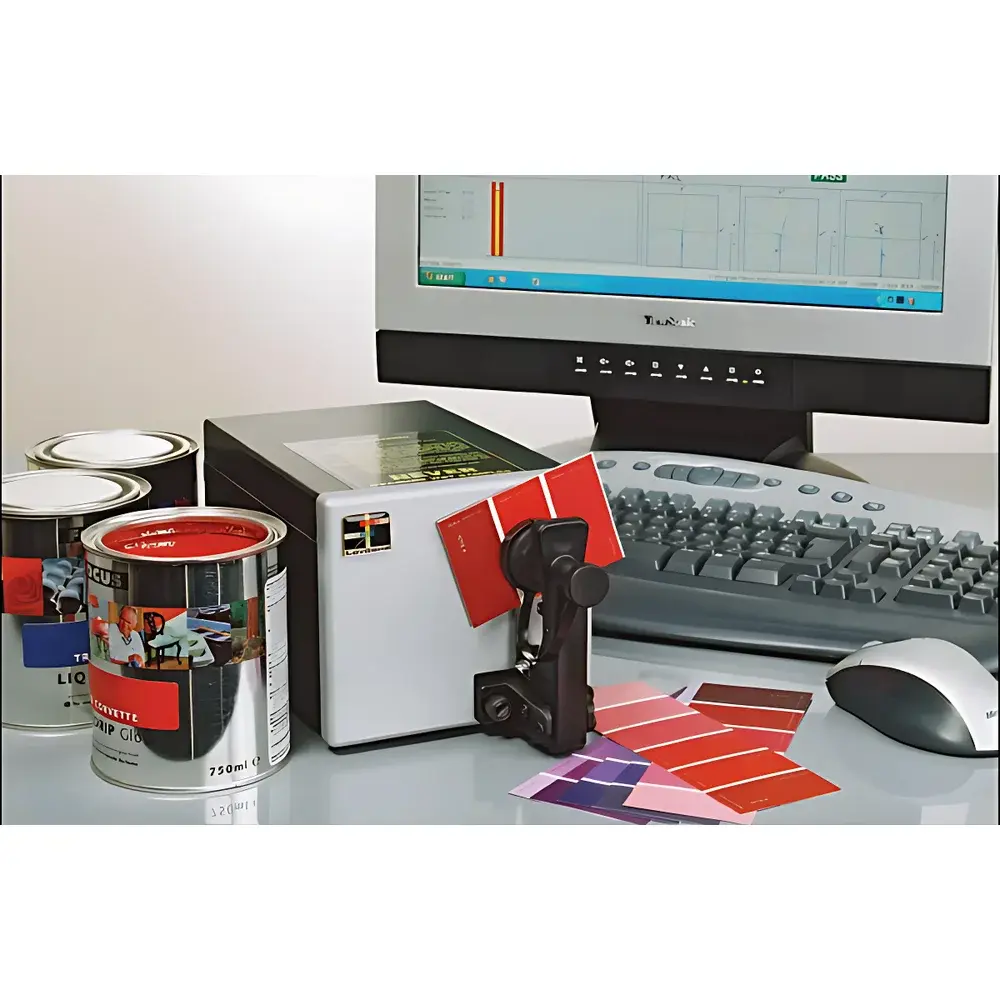
Lovibond RT850i Desktop Spectrophotometric Color Difference Meter
| Brand | Lovibond (Tintometer) |
|---|---|
| Origin | Germany |
| Model | RT850i |
| Instrument Type | Benchtop |
| Optical Geometry | d/8° integrating sphere |
| Sample Port Options | 3 selectable apertures |
| UV Filter | Optional |
| Preview Imaging System | Built-in real-time sample positioning camera |
| Connectivity | USB 2.0 |
| Software | OnColor™ PC software suite |
| Compliance | Designed for ISO 7724, ASTM E308, CIE No. 15, DIN 5033, and ISO 11664 colorimetric standards |
| Sample Compatibility | Opaque solids, translucent plastics, liquids (in cuvettes), powders (with accessory holders), textiles, coatings, glass, petroleum products |
Overview
The Lovibond RT850i is a benchtop spectrophotometric color difference meter engineered for high-precision, repeatable color measurement across diverse industrial materials. Based on d/8° geometry with a high-reflectance integrating sphere, the instrument employs tristimulus spectral analysis over the visible range (typically 400–700 nm, per CIE 1931 standard observer) to deliver CIELAB (L*a*b*), CIELCH, ΔE00, and other standardized colorimetric values. Its optical architecture complies with ISO 7724-1 and ASTM E308 for reflectance and transmittance measurements, ensuring traceability to international colorimetry frameworks. Unlike handheld devices, the RT850i’s fixed optical path, temperature-stabilized detector array, and motorized aperture selection minimize inter-operator variability—critical for QC labs operating under GLP or ISO/IEC 17025 requirements.
Key Features
- Real-time preview positioning system: Integrated CMOS imaging module enables visual confirmation of measurement area prior to acquisition—eliminating misalignment errors common in textured, irregular, or multi-zone samples.
- Triple-aperture configuration: Selectable 3 mm, 8 mm, and 25 mm measurement ports accommodate granular powders, small textile swatches, and large-area painted panels without repositioning or averaging artifacts.
- UV-filter compatibility: Optional removable UV-cut filter allows controlled exclusion of ultraviolet radiation (<400 nm), essential for evaluating fluorescent whitening agents (FWAs) in detergents, paper, or optical brighteners in polymers per ISO 105-J03.
- Corrosion-resistant integrating sphere: Coated with Spectralon®-grade PTFE material (≥99% diffuse reflectance at 400–700 nm), ensuring long-term photometric stability and minimizing spectral drift during extended calibration cycles.
- Benchtop flexibility: Adjustable base permits vertical or horizontal orientation—optimized for integration into production line stations, fume hood environments, or confined lab workspaces.
- USB 2.0 direct interface: Enables rapid data export without proprietary dongles; supports mass storage mode for firmware updates and batch calibration file transfers.
Sample Compatibility & Compliance
The RT850i accommodates heterogeneous sample forms via optional accessories: liquid cuvettes (10 mm pathlength), powder cups with compression plates, textile clamps, and non-contact holders for fragile or heat-sensitive substrates. It meets ASTM D2244 (color difference calculation), ISO 11664-4 (CIE colorimetric observers), and DIN 6174 (ΔE evaluation methods). For regulated industries, OnColor™ software supports audit-trail logging, user access levels, and electronic signatures compliant with FDA 21 CFR Part 11 when deployed on validated Windows systems. All factory calibrations are traceable to NIST-traceable standards.
Software & Data Management
OnColor™ software provides full spectral data visualization (380–780 nm reflectance/transmittance curves), batch statistical reporting (mean, SD, CPK), tolerance mapping against master standards, and export to CSV, XML, or industry-specific formats (e.g., .qtx for Q-Lab). The software includes built-in pass/fail logic engines configurable per L*a*b*, Yellowness Index (ASTM E313), Whiteness Index (CIE/ISO 1147), and custom formulae. Raw spectral files retain metadata (date/time, operator ID, aperture used, UV filter status), supporting retrospective analysis and method validation per ISO/IEC 17025 clause 7.7.
Applications
- Plastics & Polymers: Quantifying yellowness index shift in polypropylene after thermal aging; monitoring batch-to-batch consistency in injection-molded automotive trim.
- Coatings & Paints: Verifying color match between spray-applied primer and final topcoat under D65 illumination; assessing metamerism using multiple illuminants (A, C, D65, F2).
- Liquids & Petrochemicals: Measuring APHA/Pt-Co color in pharmaceutical solvents or ASTM D1209 clarity in glycols; detecting oxidation-induced browning in edible oils.
- Textiles & Apparel: Validating dye lot uniformity across woven fabrics; grading natural fiber yellowness in cotton ginning QA.
- Glass & Ceramics: Evaluating tint consistency in architectural float glass; measuring transmission color in laminated safety glazing per EN 1096.
FAQ
What spectral range does the RT850i cover?
The instrument operates across the visible spectrum from 400 nm to 700 nm at 10 nm intervals, aligned with CIE 1931 standard observer functions.
Is the RT850i suitable for measuring transparent films?
Yes—when used with the optional transmission fixture and matched cuvettes, it measures transmittance color per ISO 13655 for clear polymer films and coated lenses.
Can measurement data be exported to LIMS systems?
Yes—OnColor™ supports ODBC-compliant database connectivity and structured XML exports compatible with major laboratory information management systems.
How often must the instrument be calibrated?
Daily verification with supplied white ceramic tile is recommended; full recalibration using factory-certified standards is advised every 12 months or after physical shock or environmental relocation.
Does the RT850i support Good Manufacturing Practice (GMP) workflows?
With OnColor™ configured in 21 CFR Part 11 mode—including electronic signatures, audit trails, and role-based permissions—the system supports GMP-aligned color release testing in pharmaceutical and medical device manufacturing.