
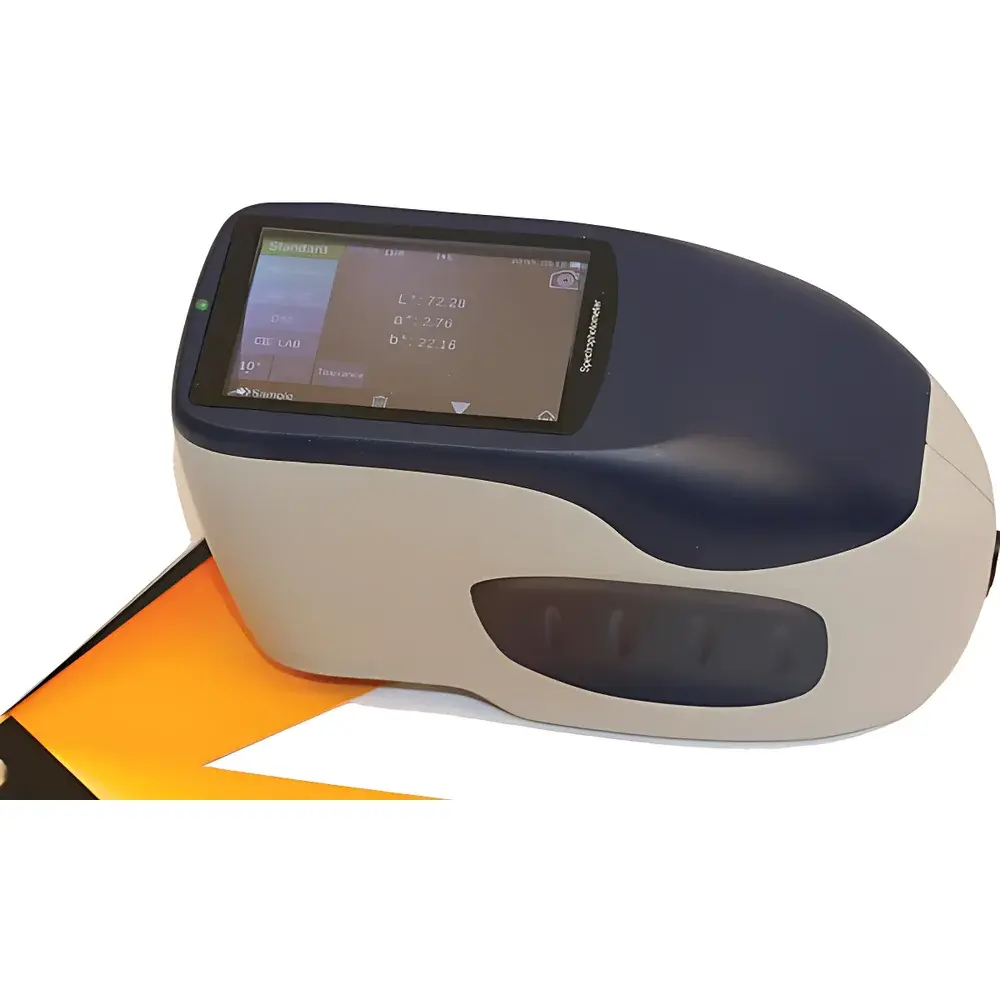
Lovibond TR520/500 Handheld Color Difference Meter
| Brand | Lovibond (Tintometer) |
|---|---|
| Origin | United Kingdom |
| Model | TR520 / TR500 |
| Instrument Type | Handheld Colorimeter |
| Optical Geometry | d/8° integrating sphere |
| Light Source | LED with UV |
| Spectral Range | 400–700 nm |
| Wavelength Interval | 10 nm |
| FWHM | 10 nm |
| Aperture Options | Dual (10 mm / 8 mm & 5 mm / 4 mm) |
| Observer Angle | 2° / 10° |
| Illuminants | D65, A, C, D50, D55, D75, F1–F12 |
| Color Spaces | CIE Lab, XYZ, Yxy, LCh, CIE LUV, Hunter Lab |
| Color Difference Formulas | ΔE*ab, ΔE*uv, ΔE*94, ΔE*CMC (2:1), ΔE*CMC (1:1), ΔE*00, ΔE (Hunter) |
| Whiteness Index (WI) | ASTM E313, CIE/ISO, AATCC, Hunter |
| Yellowness Index (YI) | ASTM D1925, ASTM E313 |
| Tint Index (TI) | ASTM E313, CIE/ISO |
| Repeatability (MAV/SCI) | ΔE* ≤ 0.03 (TR520), ΔE* ≤ 0.05 (TR500) |
| Inter-instrument Agreement (MAV/SCI) | ΔE* ≤ 0.15 (TR520), ΔE* ≤ 0.20 (TR500) |
| Measurement Time | 2.6 s |
| Display | 3.5″ color TFT-LCD touchscreen |
| Battery Life | Up to 5,000 measurements or 8 h continuous use |
| Dimensions | 184 × 77 × 105 mm |
| Weight | 600 g |
| Operating Environment | 0–40 °C, 0–85 % RH (non-condensing), < 2000 m altitude |
| Storage | −20–50 °C, 0–85 % RH (non-condensing) |
| Data Storage | 2,000 standards + 20,000 samples |
| Interface | USB |
| Software | Included (color analysis, SPC, spectral visualization, pass/fail reporting) |
Overview
The Lovibond TR520/500 Handheld Color Difference Meter is a precision spectrophotometric instrument engineered for high-accuracy color measurement across diverse material forms—including powders, liquids, gels, pastes, granules, and solid surfaces. Based on the d/8° integrating sphere optical geometry, it conforms to ISO 7724-1, CIE No. 15, and ASTM D2244 standards for diffuse illumination and viewing, ensuring metrological traceability in industrial quality control environments. Its dual-array CMOS sensor (256 pixels per channel) coupled with a concave holographic grating delivers stable spectral acquisition from 400 to 700 nm at 10 nm intervals (FWHM = 10 nm), enabling robust discrimination of subtle chromatic deviations. The integrated camera-based targeting system provides real-time visual confirmation of measurement area alignment—critical for minimizing operator-induced variability and achieving repeatability of ΔE* ≤ 0.03 (TR520) under MAV/SCI mode. Designed and manufactured in the UK by Tintometer Ltd—a company with over 130 years of color science heritage—the TR520/500 meets stringent requirements for GLP-compliant laboratories and regulated manufacturing settings where inter-instrument agreement and long-term stability are essential.
Key Features
- Integrated high-resolution camera viewfinder ensures precise positioning over heterogeneous or irregularly shaped samples—eliminating parallax error and enhancing measurement reproducibility.
- Dual-aperture configuration (standard: 10 mm / 8 mm and 5 mm / 4 mm; optional: 8 mm / 4 mm and 1×3 mm slits) supports flexible sampling strategies—from large-area batch verification to micro-area defect analysis.
- UV-enabled LED illumination allows controlled assessment of fluorescent whitening agents (FWAs) and optical brighteners; UV output can be toggled on/off to isolate fluorescence contribution per ISO 11475 and ASTM E308 Annex A5.
- Full CIE-compliant illuminant library (D65, A, C, D50–D75, F1–F12) and observer functions (2° and 10°) enable cross-standard evaluation required in global supply chains and regulatory submissions.
- Onboard color difference calculation supports all major industrial formulas: ΔE*ab, ΔE*94, ΔE*CMC (1:1 and 2:1), ΔE*00, and Hunter ΔE—ensuring compatibility with legacy QC protocols and modern perceptual tolerancing.
- Comprehensive index computation includes Whiteness (ASTM E313, CIE/ISO, AATCC, Hunter), Yellowness (ASTM D1925, E313), Tint (ASTM E313), Metamerism Index (MI), opacity, 8° gloss, color strength, and fastness metrics—reducing need for secondary instrumentation.
Sample Compatibility & Compliance
The TR520/500 accommodates broad physical sample types via interchangeable accessories: liquid cuvette holders, powder test boxes (optional), gel containment cells, and solid-sample cradles. Its d/8° sphere design inherently compensates for surface texture and directional reflectance, making it suitable for matte, glossy, and textured substrates without requiring separate SCE/SCI mode switching. All measurements comply with ISO 7724-1 (colorimetry), ISO 11475 (fluorescent materials), ASTM D2244 (color difference), and ASTM E308 (computing color coordinates from spectral data). Instrument calibration adheres to NIST-traceable standards, and built-in diagnostics support routine verification per ISO 17025 clause 5.5. For regulated industries—including pharmaceuticals, food packaging, and automotive coatings—the device supports audit-ready data export with timestamped metadata, satisfying FDA 21 CFR Part 11 requirements when used with validated software configurations.
Software & Data Management
The included PC software provides full spectral data visualization, statistical process control (SPC) charting (X-bar/R, Cp/Cpk), tolerance zone mapping, and automated pass/fail classification against user-defined limits. Raw spectral curves, tristimulus values, chromaticity coordinates, and derived indices are exportable in CSV, XML, and PDF formats for integration into LIMS or MES platforms. Audit trails record all user actions—including calibration events, parameter changes, and result modifications—with electronic signatures enabled for GMP/GLP workflows. Data encryption and role-based access control align with ISO/IEC 27001 principles. Firmware updates are delivered via secure HTTPS channels, maintaining version integrity and cybersecurity compliance throughout the instrument lifecycle.
Applications
- Quality assurance in paint, ink, and coating production—monitoring batch-to-batch consistency and detecting metamerism in multi-pigment formulations.
- Food and beverage processing—verifying color stability of dairy products, confectionery, beverages, and spices under varying lighting conditions.
- Plastics and polymer extrusion—assessing thermal degradation effects, pigment dispersion uniformity, and UV stabilizer efficacy.
- Textile dyeing and finishing—evaluating shade matching accuracy, wash-fastness, and light-fastness according to AATCC TM16 and ISO 105-B02.
- Pharmaceutical solid dosage forms—quantifying tablet film-coat color variation and detecting excipient-related discoloration during stability studies.
- Recycled material sorting—differentiating polymer grades based on spectral fingerprinting and yellowing index trends.
FAQ
What is the difference between TR520 and TR500 models?
The TR520 offers higher repeatability (ΔE* ≤ 0.03) and tighter inter-instrument agreement (ΔE* ≤ 0.15), making it suitable for R&D labs and tier-1 supplier QA. The TR500 provides cost-optimized performance (ΔE* ≤ 0.05 / ≤ 0.20) for routine in-line inspection and second-tier quality control.
Can the TR520/500 measure transparent or translucent liquids?
Yes—when used with the optional 10 mm pathlength cuvette holder and appropriate background (e.g., white tile or air reference), it complies with ASTM D1209 and ISO 4630 for APHA/Pt-Co/Hazen color measurement.
Is UV calibration traceable to national standards?
UV irradiance output is factory-characterized against NIST-traceable photodiode standards; annual recalibration services include spectral irradiance verification across 365–400 nm.
Does the software support multilingual user interfaces?
Yes—the embedded instrument UI and desktop software support English, Chinese, French, German, Spanish, and Portuguese, with locale-specific number formatting and unit conventions.
How is data integrity maintained during transfer from device to PC?
All USB transfers use CRC-32 checksum validation; exported files include digital signatures and embedded hash values to prevent tampering or corruption during archival or regulatory submission.





