
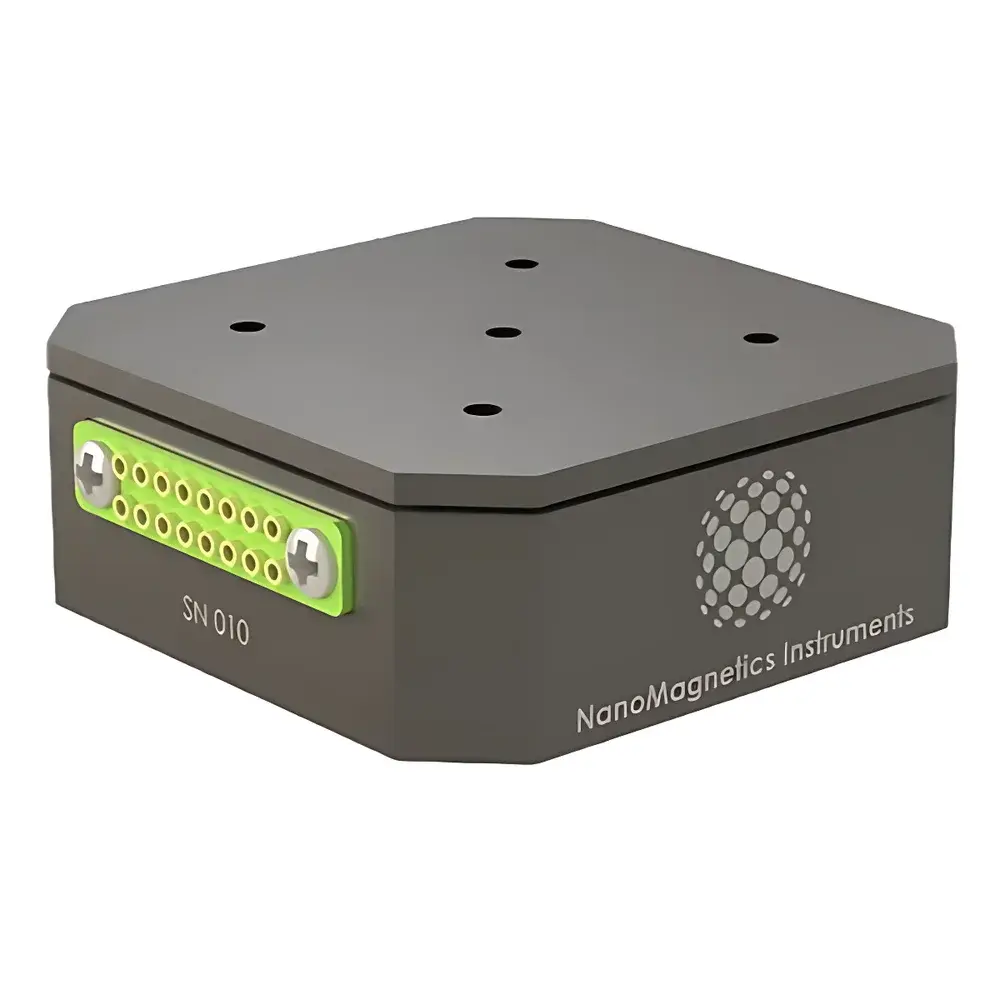
LOW TEMPERATURE XYZ PIEZO SCANNER by 3i
| Brand | 3i |
|---|---|
| Origin | Germany |
| Model | LOW TEMPERATURE XYZ PIEZO SCANNER |
| Scanning Range | 50 × 50 × 24 µm @ 300 K, 30 × 30 × 15 µm @ <4 K |
| Operating Temperature Range | 10 mK – 300 K |
| Maximum Magnetic Field Tolerance | 40 T |
| Actuator Material | Piezoceramic stack integrated with titanium and alumina ceramic housing |
| Structural Components | Stainless steel screws, oxygen-free copper wiring, FR4 PCB substrate |
| Feedback Option | Closed-loop operation available per axis with heterodyne fiber interferometry (1–10 µW optical power per axis) |
| Mass | 16 g |
| Dimensions | 24 × 24 × 9.2 mm |
Overview
The LOW TEMPERATURE XYZ PIEZO SCANNER by 3i is a high-precision, ultra-compact piezoelectric positioning stage engineered for integration into cryogenic scanning probe microscopy (SPM), quantum transport measurement setups, and low-temperature optical nanomanipulation systems. Designed to operate reliably across an extreme thermal range—from dilution refrigerator base temperatures (10 mK) up to ambient (300 K)—this scanner employs a monolithic, low-outgassing mechanical architecture that minimizes thermal drift and hysteresis while preserving mechanical resonance stability under high magnetic fields. Its core actuation principle relies on stacked piezoceramic elements with optimized poling orientation and electrode geometry, delivering sub-nanometer step resolution and repeatable displacement in all three orthogonal axes. The scanner’s performance is fundamentally governed by piezoelectric strain response under controlled voltage input, calibrated for both open-loop linearity and closed-loop positional fidelity via integrated heterodyne fiber interferometry.
Key Features
- Ultra-low mass (16 g) and compact footprint (24 × 24 × 9.2 mm) enable direct mounting inside confined cryostat chambers and scanning heads without compromising thermal anchoring or vibration isolation.
- Dual-mode operation: supports both open-loop voltage-driven positioning and closed-loop feedback control—configurable independently for X, Y, or Z axis—using heterodyne fiber interferometry with optical power consumption of only 1–10 µW per axis, minimizing heat load at millikelvin stages.
- Cryogenic-grade materials: structural housing combines grade-5 titanium, high-purity alumina ceramic, and oxygen-free copper wiring; all adhesives and coatings are vacuum-compatible and certified for <10⁻⁹ mbar outgassing rates per ASTM E595.
- High magnetic field resilience: validated for stable operation up to 40 T in superconducting magnet environments, with no measurable degradation in piezo response or positional noise floor.
- Thermally symmetric design mitigates differential contraction effects between piezo stacks and frame, ensuring consistent scan linearity from 300 K down to 10 mK.
Sample Compatibility & Compliance
This scanner is compatible with standard SPM cantilever holders, custom-fabricated tip carriers, and optical fiber alignment mounts used in cryogenic near-field microscopy. It complies with ISO 14644-1 Class 5 cleanroom handling protocols during assembly and is certified for use in UHV (≤10⁻¹⁰ mbar) and dry helium exchange gas environments. Mechanical interfaces conform to standard M2.5 and M3 threaded mounting patterns. All electrical connections utilize miniature coaxial feedthroughs rated for 4 K operation, with shielding integrity verified per IEC 61000-4-3 for electromagnetic immunity in high-field laboratories.
Software & Data Management
The scanner interfaces via analog ±10 V input channels (for open-loop) or digital EtherCAT/USB-C outputs (for closed-loop systems). Driver firmware supports real-time position streaming at ≥10 kHz sampling rate with timestamped data packets. When integrated with third-party SPM control platforms (e.g., RHK, Scienta Omicron, or home-built LabVIEW-based systems), it enables full traceability of positional metadata—including temperature, magnetic field, and voltage history—in accordance with GLP-compliant audit trails. Optional firmware modules support 21 CFR Part 11–compliant electronic signatures and secure parameter locking for regulated QC/QA workflows.
Applications
- Atomic-resolution scanning tunneling microscopy (STM) and spectroscopy (STS) at sub-Kelvin temperatures.
- In situ nanofabrication and atomic manipulation in high-field quantum Hall regimes.
- Low-temperature photoluminescence mapping of 2D materials using confocal excitation coupled to interferometric Z-control.
- Quantum dot charge sensing and gate-defined nanostructures requiring nm-scale XY repositioning synchronized with RF reflectometry.
- Calibration reference stage for cryogenic optical interferometers and displacement metrology standards.
FAQ
What is the maximum scan speed achievable in closed-loop mode?
Closed-loop bandwidth is limited by the heterodyne interferometer’s signal processing latency and piezo mechanical resonance; typical small-signal step response settles within 2–5 ms, supporting raster scan rates up to 5 Hz at full 30 × 30 µm range.
Can this scanner be used in a wet (liquid helium) cryostat?
Yes—it has been tested in pumped liquid helium environments with proper thermal anchoring; however, direct immersion requires optional epoxy-sealed feedthroughs and verification of FR4 substrate compatibility with prolonged condensation cycles.
Is factory calibration data provided with each unit?
Each scanner ships with individual NIST-traceable calibration certificates documenting axis cross-talk (<0.15%), nonlinearity (<0.8% F.S.), and thermal drift coefficients (nm/K) measured across 10 mK–300 K.
Does the scanner support bidirectional communication with external DAQ systems?
Yes—via EtherCAT slave interface or USB-C virtual COM port, enabling synchronous acquisition of position, temperature, and applied voltage with sub-microsecond timestamp alignment.



