
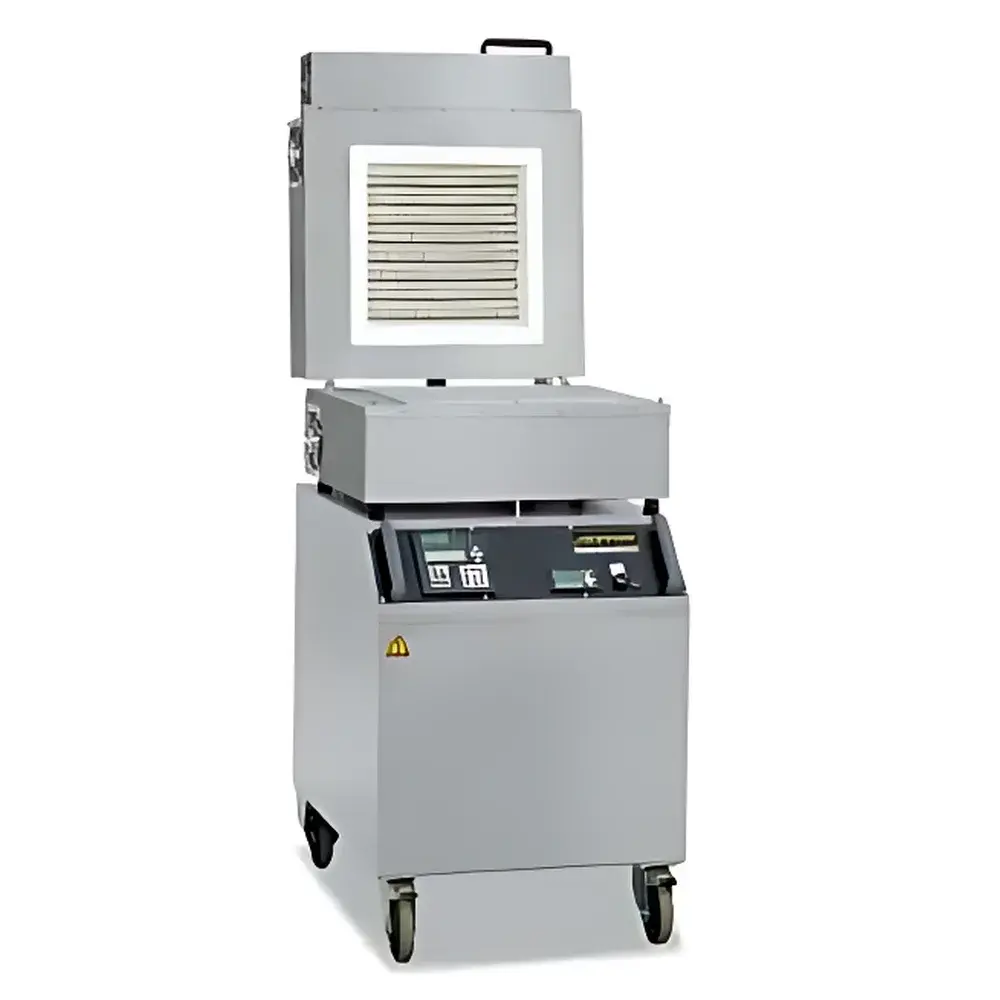
LS 12/13 and LS 25/13 Rapid-Firing Muffle Furnaces (Nabertherm)
| Origin | Germany |
|---|---|
| Manufacturer Type | Authorized Distributor |
| Origin Category | Imported |
| Model | LS 12/13 and LS 25/13 |
| Quotation | Upon Request |
| Max Temperature | 1300 °C |
| Internal Dimensions (W×D×H) | LS 12/13: 350 × 350 × 40 mm |
| LS 25/13 | 500 × 500 × 100 mm |
| Chamber Volume | 12 L and 25 L |
| External Dimensions (W×D×H) | LS 12/13: 600 × 800 × 985 mm |
| LS 25/13 | 750 × 985 × 1150 mm |
| Power Connection | 3-phase |
| Rated Power | 15 kW (LS 12/13), 22 kW (LS 25/13) |
| Net Weight | 130 kg (LS 12/13), 160 kg (LS 25/13) |
| Heating Zones | Dual-zone (bottom + top) |
| Thermocouple Type | Integrated S-type PtRh10%–Pt |
| Cooling | Built-in programmable axial fan + motorized lid lift (~20 mm) |
Overview
The LS 12/13 and LS 25/13 rapid-firing muffle furnaces are precision-engineered thermal processing systems developed by Nabertherm for laboratories and R&D facilities requiring high-reproducibility ceramic sintering, frit melting, glaze testing, and fast-cycle thermal treatment protocols. Designed specifically to emulate industrial fast-fire ceramic production lines, these furnaces operate on a robust dual-zone resistive heating architecture—featuring independent heating elements in both the furnace base and ceiling—to ensure uniform vertical temperature distribution across the chamber during dynamic ramp-hold-cool cycles. With a maximum operating temperature of 1300 °C and certified thermal stability of ±1 °C at setpoint under steady-state conditions, they comply with ISO 9001 calibration traceability requirements and support GLP-compliant process documentation when integrated with optional data logging modules.
Key Features
- Dual-zone temperature control: Independent PID-regulated heating circuits for bottom and top zones enable precise thermal gradient management—critical for minimizing warpage in thin ceramic substrates and optimizing densification kinetics.
- Programmable rapid cooling system: Integrated high-volume axial cooling fan operates under full TCU (Temperature Control Unit) logic, activated automatically after dwell completion; fan speed and duration are fully configurable via the controller interface.
- Motorized lid lift mechanism: Programmable 20 mm lid elevation allows convective heat dissipation without fan activation—reducing mechanical wear and enabling silent, low-turbulence cooldown for thermally sensitive samples.
- S-type platinum-rhodium thermocouples (PtRh10%–Pt): Two certified Class 1 thermocouples—one embedded in the base plate, one in the roof—provide redundant, drift-compensated temperature measurement per IEC 60584-2.
- Mobility-ready construction: Heavy-duty casters with locking brakes facilitate safe repositioning within shared lab environments without requiring floor anchoring or permanent utility relocation.
- Ceramic tube support configuration: Standard sample placement on high-purity Al₂O₃ support tubes ensures minimal thermal mass interference and enables consistent radiant exposure for small-batch testing.
Sample Compatibility & Compliance
These furnaces accommodate standard crucibles (Al₂O₃, ZrO₂, Pt), ceramic tiles (up to 300 × 300 mm for LS 25/13), and powdered specimens in controlled-atmosphere-compatible boats. The muffle design isolates samples from heating element emissions, ensuring contamination-free processing suitable for ASTM C373 (water absorption), ISO 10545-3 (thermal shock resistance), and EN 14411 (ceramic tile sintering validation). Electrical safety conforms to IEC 61000-6-4 (EMC) and IEC 61000-6-2 (immunity); thermal insulation meets EN 60519-1 for laboratory furnace safety. Optional inert gas purging kits (N₂ or Ar) support reducing/oxidizing atmosphere studies per ISO 8501-1 pre-treatment standards.
Software & Data Management
Equipped with Nabertherm’s THERMOCOMFORT 3.0 controller, both models support up to 20 user-defined multi-step programs with ramp rates from 0.1 to 60 °C/min, hold times from 1 s to 99 h 59 min, and automatic cycle termination logic. Real-time temperature curves, power consumption logs, and event timestamps (e.g., lid lift, fan start) are exportable via USB or RS485 to CSV or XML. When paired with Nabertherm’s optional COMET software suite, the system satisfies FDA 21 CFR Part 11 requirements—including electronic signatures, audit trails, and role-based access control—for regulated QC/QA workflows in ISO 17025-accredited labs.
Applications
- Rapid optimization of firing schedules for sanitaryware, wall/floor tiles, and technical ceramics
- Thermal expansion coefficient (CTE) determination via dilatometry-compatible sample holders
- Pre-sintering of LTCC (low-temperature co-fired ceramic) green tapes
- Heat treatment validation for dental porcelain and bioceramic implants (ISO 6872, ISO 13356)
- Residue ash content analysis per AOAC 942.05 and EPA Method 1690
- Calibration reference furnace service for secondary thermocouple verification (ASTM E230/E230M)
FAQ
What is the typical cold-to-cold cycle time for a full sintering profile?
For a standard 1200 °C/30-min dwell profile, the total cycle—including ramp-up, hold, and forced cooldown to <100 °C—is ≤35 minutes under optimal ambient conditions (≤25 °C, unobstructed airflow).
Can the furnace be operated under inert or reducing atmospheres?
Yes—optional gas inlet/outlet ports and quartz-sealed feedthroughs allow integration with mass flow controllers for N₂, Ar, or forming gas (N₂/H₂); consult Nabertherm Application Note AN-LS-07 for pressure and flow specifications.
Is dual-zone control available as a retrofit for legacy LS-series units?
No—dual-zone hardware (separate heating circuits, thermocouple inputs, and zone-specific SSRs) is factory-integrated and not field-upgradable.
What maintenance intervals are recommended for the cooling fan and thermal insulation?
Fan bearings require inspection every 1,000 operational hours; ceramic fiber insulation integrity should be verified annually using visual and thermal imaging checks per Nabertherm Maintenance Directive MD-LS-2023.
Does the system support remote monitoring via Ethernet or Wi-Fi?
Ethernet connectivity (TCP/IP) is available via the optional COMET Gateway module; Wi-Fi is not supported due to electromagnetic interference constraints in high-power thermal environments.



