
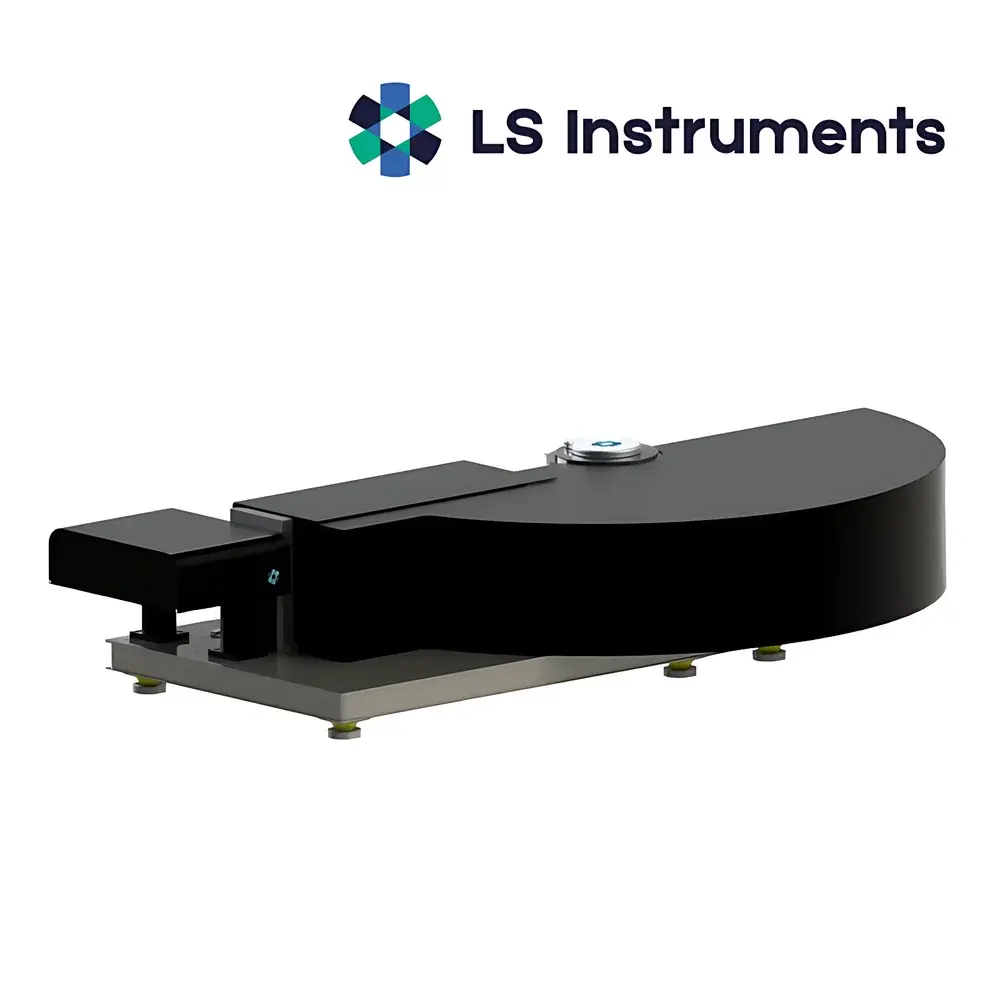
LS Instruments LS Spectrometer Variable-Angle Multi-Angle Light Scattering Instrument
| Brand | LS Instruments |
|---|---|
| Origin | Switzerland |
| Model | LS Spectrometer |
| Particle Size Range | 0.15 nm – 5 µm |
| Temperature Control | Up to 90 °C |
| Measurement Principles | Dynamic Light Scattering (DLS) and Static Light Scattering (SLS), upgradable to 3D and Modulated 3D techniques |
| Sample Volume | 50 µL – 4 mL |
Overview
The LS Instruments LS Spectrometer is a high-precision, variable-angle multi-angle light scattering (V-MALS) instrument engineered for comprehensive nanoparticle and macromolecular characterization in solution. Unlike conventional fixed-angle MALS systems, the LS Spectrometer features a motorized detector arm that rotates continuously around the sample cell—enabling precise angular positioning from 10° to 150° in 0.1° increments. This mechanical flexibility supports rigorous angular-dependent analysis essential for extracting intrinsic molecular parameters including radius of gyration (Rg), hydrodynamic radius (Rh), second virial coefficient (A2), conformational asymmetry, and absolute molar mass—without reliance on calibration standards. The system operates on first-principles optical scattering theory (Rayleigh–Gans–Debye and Zimm formalisms), with integrated temperature-controlled cuvette holders and real-time refractive index compensation. Its architecture conforms to ISO 22412:2017 (DLS) and ISO 13321:2022 (SLS) measurement standards, ensuring traceable, reproducible data for regulatory submissions.
Key Features
- Variable-angle detection (10°–150°) with sub-degree angular resolution for optimized signal-to-noise ratio and angular extrapolation fidelity
- Modulated 3D technology: dual-beam, cross-correlated DLS/SLS acquisition that suppresses multiple scattering artifacts without sample dilution—validated for concentrations up to 100 mg/mL
- CORENN algorithm: a physics-informed machine learning inversion method trained on synthetic and empirical DLS decay libraries; delivers robust, bias-corrected particle size distributions (PSD) even for highly polydisperse or bimodal systems (e.g., 4 nm + 45 nm mixtures)
- Depolarized DLS module: optional polarizer/analyzer pair enabling rotational diffusion analysis and aspect ratio estimation for anisotropic particles (rods, platelets, fibrils)
- Integrated thermostatic circulation: Peltier-based temperature control (5–90 °C) with ±0.1 °C stability and <3 min ramp time between setpoints; programmable via LsLab software
- Sample rotator accessory: mitigates non-ergodicity in gels and viscous media by controlled rotation (0.1–10 rpm); also enables off-center square-cell positioning to reduce optical path length (<200 µm), minimizing volume-scattering contributions
Sample Compatibility & Compliance
The LS Spectrometer accommodates aqueous and organic solvents across a broad refractive index range (1.33–1.55). It accepts standard quartz or sapphire cuvettes (10 mm path, 50 µL–4 mL volume), as well as custom microcells for low-volume or high-throughput screening. All optical components comply with IEC 61000-4 electromagnetic compatibility requirements. Data acquisition and reporting modules support audit trails, electronic signatures, and 21 CFR Part 11–compliant user access controls when deployed in GLP/GMP environments. The instrument meets ISO/IEC 17025:2017 criteria for testing laboratories and is routinely used in support of USP , , and ASTM E2490–22 validation protocols.
Software & Data Management
LsLab software provides unified control of hardware, experiment sequencing, and advanced data reduction. It includes built-in Zimm and Debye plot generators, A2 fitting tools, and conformational analysis (e.g., Rg/Rh ratio mapping). Raw correlation functions and intensity-weighted PSDs are exportable in ASCII, CSV, or HDF5 formats. Batch processing supports automated temperature ramps, angle sweeps, and concentration series. For regulated environments, the software supports role-based permissions, change logs, and encrypted database storage compliant with ALCOA+ principles (Attributable, Legible, Contemporaneous, Original, Accurate, Complete, Consistent, Enduring, Available).
Applications
- Characterization of therapeutic proteins, monoclonal antibodies, and viral vectors under native conditions
- Stability assessment of lipid nanoparticles (LNPs), polymeric micelles, and exosomes during formulation development
- Aggregation kinetics monitoring under thermal or chemical stress (e.g., accelerated stability studies per ICH Q5C)
- Molecular weight determination of synthetic polymers without column calibration (absolute molar mass via SLS)
- Conformational analysis of intrinsically disordered proteins (IDPs) and protein–polymer conjugates
- Quality-by-Design (QbD) support for nanomedicine process validation and comparability studies
FAQ
What distinguishes V-MALS from conventional fixed-angle MALS?
V-MALS enables angular scanning at user-defined intervals, allowing direct measurement of angular dependence in scattered intensity—critical for separating Rg and A2 without extrapolation assumptions.
Can the LS Spectrometer measure samples without dilution?
Yes—Modulated 3D technology eliminates multiple scattering bias, permitting accurate DLS/SLS measurements at native concentrations where traditional instruments fail.
Is CORENN compatible with legacy DLS data?
CORENN requires raw autocorrelation function files (.acf) acquired on LS Instruments hardware; it is not retrofittable to third-party instruments due to proprietary noise modeling and beam geometry constraints.
Does the system support GMP-compliant reporting?
When configured with LsLab’s validated software suite and networked authentication, the system fully supports 21 CFR Part 11 compliance—including electronic records, audit trails, and signature verification.
What sample preparation is required for depolarized DLS?
No special labeling or modification is needed; only standard DLS-grade filtration (0.1 µm) and refractive index matching of solvent to cuvette material are recommended.



