
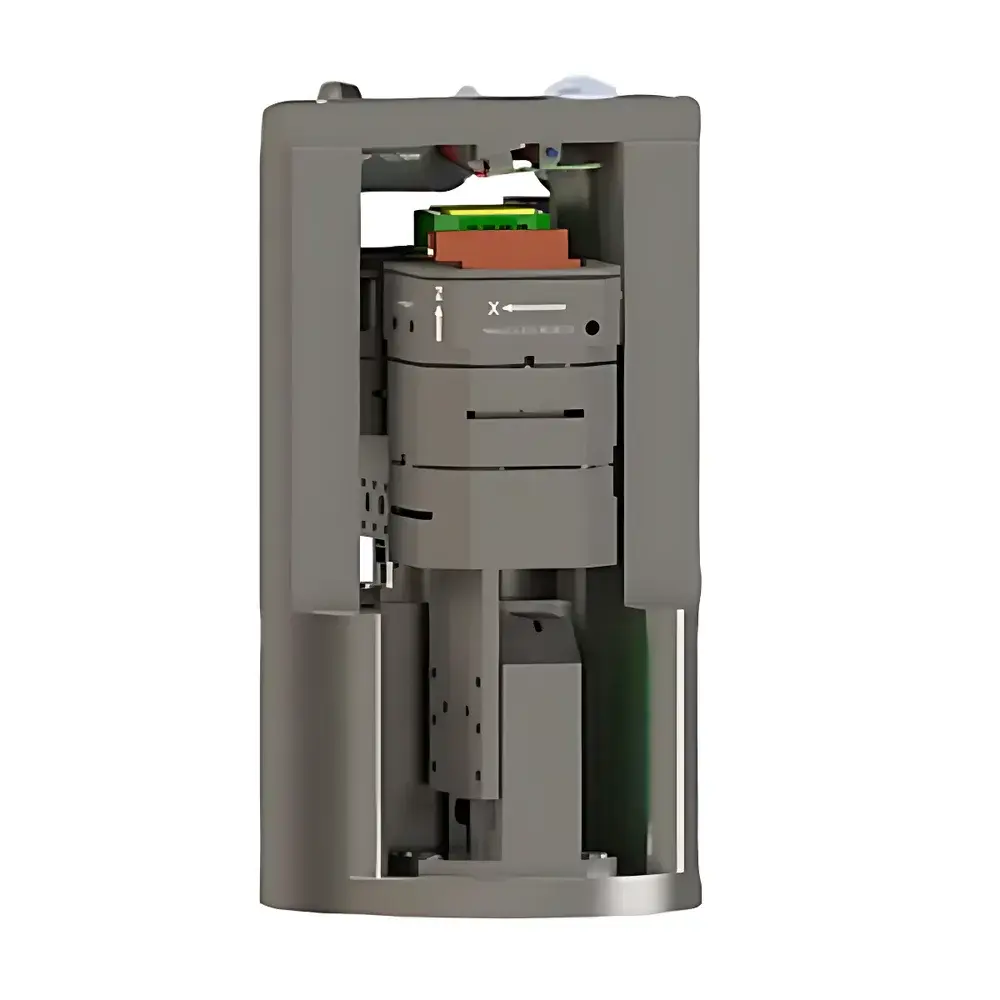
LT-sSNOM Low-Temperature Scattering-Type Scanning Near-Field Optical Microscope
| Brand | 3i |
|---|---|
| Origin | Germany |
| Manufacturer Type | Authorized Distributor |
| Import Status | Imported |
| Model | LT-sSNOM |
| Price | Upon Request |
| Wavelength Range | 532 nm – 20 µm (with metallic reflective optics) |
| AFM Scanner | Fiber-interferometer-equipped piezoelectric stage, scan range 30 × 30 × 15 µm (@ 4 K) |
| XYZ Sample Nanopositioner | 6 × 6 × 12 mm travel |
| Off-Axis Parabolic Mirror Nanopositioner | 4 × 4 × 6 mm travel |
| Position Sensor Resolution | 200 nm (resistive) |
| Outer Diameter | 49 mm |
| Temperature Range | 10 mK – 300 K |
| Maximum Magnetic Field | 31 T |
| Electrical Contacts | 8-point feedthrough on sample stage |
| Supported AFM Modes | Contact, Dynamic, Non-Contact (ncAFM), Magnetic Force Microscopy (MFM), Conductive AFM (cAFM), Kelvin Probe Force Microscopy (KPFM), Photoinduced Force Microscopy (PRFM), Electrostatic Force Microscopy (EFM) |
Overview
The LT-sSNOM is a cryogenic scattering-type scanning near-field optical microscope engineered for nanoscale correlative topography and optical spectroscopy under extreme environmental conditions. It operates on the principle of scattering-type near-field scanning optical microscopy (s-SNOM), where a sharp metallic AFM tip acts as an optical antenna, locally enhancing and scattering incident infrared or visible light beyond the diffraction limit. The scattered field is extracted via pseudo-heterodyne interferometric detection—enabled by a fiber-coupled interferometer synchronized with AFM tip oscillation—to isolate near-field signals from far-field background with high fidelity. Integrated into a dilution refrigerator platform, the system supports operation from 10 mK to 300 K and in magnetic fields up to 31 T, making it suitable for probing quantum materials, low-dimensional semiconductors, topological insulators, and strongly correlated electron systems where thermal noise and electromagnetic perturbations must be minimized.
Key Features
- Simultaneous acquisition of nanoscale topographic and optical contrast maps with spatial resolution down to ~20 nm—limited primarily by tip apex radius rather than wavelength.
- Dual-stage nanopositioning architecture: a high-stability piezoelectric AFM scanner (30 × 30 × 15 µm range at 4 K) co-integrated with coarse XYZ sample and off-axis parabolic mirror positioners (6 × 6 × 12 mm and 4 × 4 × 6 mm respectively) for precise optical alignment and multi-scale navigation.
- Optical path optimized for broadband operation: reflective off-axis parabolic mirrors enable achromatic illumination and collection across 532 nm – 20 µm, compatible with tunable quantum cascade lasers, synchrotron IR beamlines, and supercontinuum sources.
- Eight-electrode vacuum feedthrough enables in situ electrical transport measurements (e.g., local conductivity mapping, I–V spectroscopy) during s-SNOM imaging—fully compatible with cAFM and KPFM modalities.
- Resistive position sensors (200 nm resolution) provide closed-loop feedback for long-term thermal drift compensation and reproducible raster scanning under cryogenic conditions.
- Modular AFM head supports contact, dynamic, non-contact (ncAFM), MFM, cAFM, KPFM, PRFM, and EFM—allowing concurrent mechanical, electromagnetic, and optoelectronic property mapping.
Sample Compatibility & Compliance
The LT-sSNOM accommodates standard 10 mm × 10 mm chip-based samples mounted on electrically isolated copper or sapphire stages. Its ultra-high vacuum (UHV)-compatible design meets ISO 14644-1 Class 5 cleanroom requirements for sample loading, and all internal optics are bakeable to ≤150 °C. The system complies with international safety standards for cryogenic and high-field operation (IEC 61000-6-4, IEC 61000-6-2) and supports GLP/GMP-aligned experimental workflows through hardware timestamping and metadata tagging per scan. Optional integration with LabVIEW-based control frameworks allows validation per FDA 21 CFR Part 11 when configured with electronic signature and audit trail modules.
Software & Data Management
Control and data acquisition are managed via a real-time Linux-based platform interfacing with proprietary Python APIs and MATLAB toolboxes. All raw interferometric signals, AFM deflection traces, and photodetector outputs are recorded with 16-bit resolution at ≥100 kHz sampling rate. Spectral data cubes (x, y, λ) are stored in HDF5 format with embedded calibration metadata—including tip oscillation phase, laser power, lock-in harmonics, and temperature logs—for traceable post-processing. Batch processing pipelines support Fourier-transform infrared (FTIR) deconvolution, near-field phase retrieval, and vectorial field reconstruction using established models (e.g., dipole approximation, finite-element simulations). Export formats include TIFF (for publication-ready images), CSV (for quantitative line profiles), and MTEX-compatible .ctf files for crystallographic correlation.
Applications
- Nanoscale phonon-polariton imaging in hexagonal boron nitride and α-MoO₃ at cryogenic temperatures.
- Local dielectric function mapping of twisted bilayer graphene heterostructures under magnetic field-induced quantum Hall regimes.
- Photoinduced carrier dynamics and exciton diffusion lengths in perovskite nanocrystals and 2D transition metal dichalcogenides.
- Correlative KPFM/s-SNOM studies of domain wall electrostatics and plasmonic response in ferroelectric oxides.
- In situ magneto-optical characterization of skyrmion lattices and chiral spin textures in MnSi and FeGe thin films.
- Quantitative IR absorption spectroscopy of single-molecule vibrational modes on gated graphene substrates.
FAQ
What is the minimum resolvable feature size in s-SNOM mode?
The practical spatial resolution is determined by the tip apex radius and typically ranges between 15–30 nm under optimal conditions; it is independent of illumination wavelength.
Can the system operate in ultra-high vacuum (UHV)?
Yes—the sample chamber and AFM head are UHV-rated (base pressure <1×10⁻⁹ mbar) and compatible with standard UHV interlocks and residual gas analyzers.
Is synchronization with external pulsed lasers supported?
Yes—TTL and LVDS triggers are provided for pump-probe s-SNOM experiments, with jitter <100 ps relative to AFM oscillation zero-crossing.
How is thermal drift compensated during long acquisitions?
Closed-loop positioning with resistive sensors, combined with real-time tip-sample distance feedback and adaptive scan speed modulation, reduces drift to <0.5 nm/min at 4 K.
Are third-party AFM controllers compatible?
The system provides analog I/O and Ethernet API access, enabling integration with commercial controllers (e.g., Nanonis, RHK) for advanced spectroscopy sequences.



