
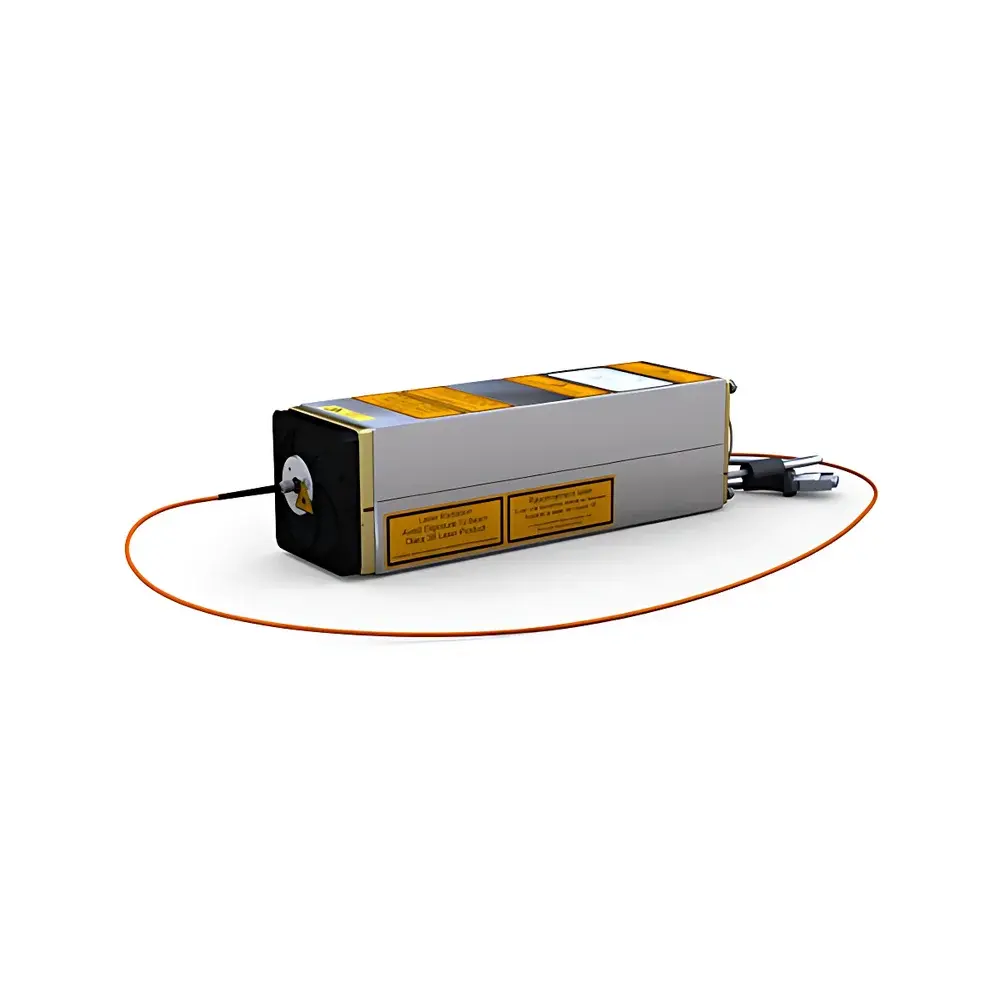
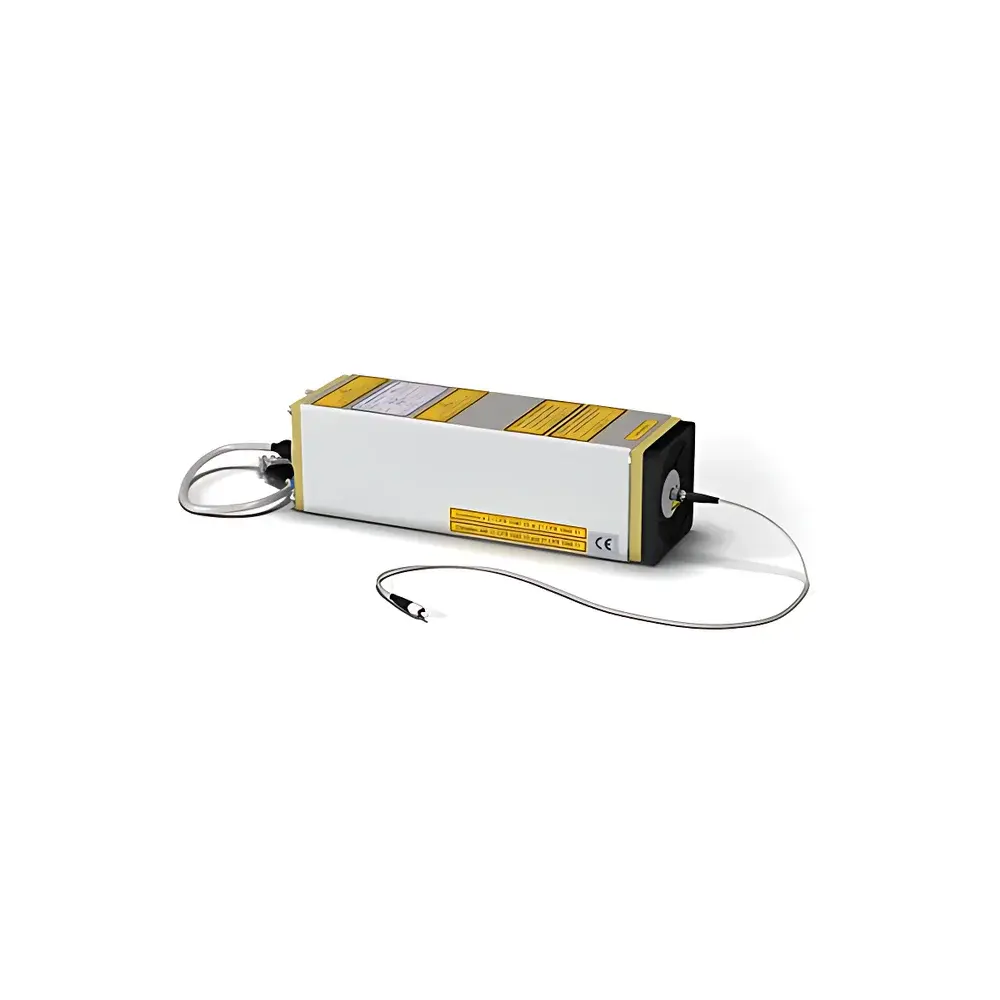
LTB MNL330 Industrial-Grade Pulsed Nitrogen Laser
| Brand | LTB |
|---|---|
| Origin | Germany |
| Model | MNL330 |
| Laser Type | Pulsed UV Gas Laser (N₂) |
| Wavelength | 337.1 nm |
| Pulse Energy | up to 40 µJ (typ. 15 µJ @ 300 Hz) |
| Repetition Rate | up to 300 Hz |
| Pulse Width | 3 ns (FWHM) |
| Spectral Bandwidth | ≤ 0.1 nm |
| Beam Dimensions | 1.5 × 2 mm |
| Beam Divergence | ≤ 3.5 × 3.5 mrad |
| Energy Stability | ≤ ±2% (RMS, over 8 hrs) |
| Timing Jitter (Ext. Trigger → Pulse) | ±5 ns |
| Pulse Delay (Ext. Trigger → Pulse) | 1600 ns ±10% |
| Sync Output Jitter (Optional) | < 0.2 ns |
| Power Supply | 24 V DC, 60 W (with optional 100–240 V AC, 50–60 Hz adapter) |
| Cooling | Air-cooled |
| Laser Class | 3B (IEC 60825-1) |
| Lifetime | ≥ 200 million pulses or 2 years (whichever occurs first) |
| extended warranty option | 120 million pulses / 3 years |
| Dimensions (L×W×H) | 300 × 87 × 87 mm |
| Net Volume | 2.2 L |
| Compliance | CE, RoHS, EN 60825-1, EN 61000-6-3/6-4 |
Overview
The LTB MNL330 is a compact, air-cooled, pulsed nitrogen laser engineered for high-reliability integration into analytical and life science instrumentation. Operating at the fundamental molecular transition of nitrogen gas (337.1 nm), it delivers short-duration ultraviolet pulses via superradiant amplification in a sealed metal-ceramic discharge cavity—eliminating gas replenishment and enabling long-term stability without active maintenance. Its design adheres to the physical principles of transverse electrical discharge in nitrogen (TEA-N₂), optimized for low temporal jitter, narrow spectral bandwidth (< 0.1 nm), and consistent pulse-to-pulse energy delivery. Unlike flashlamp-pumped dye lasers or solid-state frequency-tripled systems, the MNL330 provides direct 337 nm output with no afterglow, sub-3 ns pulse width, and intrinsic compatibility with fiber coupling—making it a preferred excitation source for time-resolved fluorescence, MALDI ionization, and pump-probe configurations where timing fidelity and spectral purity are critical.
Key Features
- Ultra-compact footprint (300 × 87 × 87 mm) and lightweight construction (2.2 L total volume), facilitating OEM integration into space-constrained platforms such as benchtop mass spectrometers and microfluidic bio-readers.
- Sealed metal-ceramic laser cavity with proprietary electrode geometry, ensuring >200 million shot lifetime and minimal energy drift (<0.1% per 10⁶ pulses under nominal operation).
- Direct solid-state switching power supply enables precise TTL- or optical-triggered operation with <±5 ns timing jitter relative to external sync signals—critical for gated detection in LIF and LIBS applications.
- Optimized beam profile (1.5 × 2 mm rectangular near-field, ≤3.5 × 3.5 mrad divergence) supports efficient coupling into multimode fibers (e.g., 400–600 µm core) or free-space optical trains without complex collimation optics.
- Low peak power consumption (≤72 W) and 24 V DC input simplify system-level power architecture; optional universal AC adapter (100–240 V, 50–60 Hz) enables global deployment without hardware modification.
- Optional synchronization output with <0.2 ns jitter enables precise triggering of ICCD cameras, photomultiplier modules, or time-of-flight electronics in synchronized acquisition workflows.
Sample Compatibility & Compliance
The MNL330 is compatible with standard UV-grade fused silica optics, quartz cuvettes, and nitrogen-purged sample chambers. Its 337.1 nm output efficiently excites common fluorophores (e.g., tryptophan, NADH, quantum dots), matrix compounds in MALDI (e.g., α-cyano-4-hydroxycinnamic acid), and atomic species in LIBS plasmas (e.g., Na, Ca, Mg). The laser conforms to IEC 60825-1:2014 (Class 3B), EN 61000-6-3 (emissions) and EN 61000-6-4 (immunity), and carries CE marking for use in EU-based laboratory and industrial environments. All units undergo factory calibration traceable to PTB (Physikalisch-Technische Bundesanstalt) standards. For regulated environments, the device supports audit-ready documentation packages aligned with GLP and ISO/IEC 17025 requirements—including calibration certificates, test reports, and lifetime pulse logs.
Software & Data Management
While the MNL330 operates as a hardware-triggered peripheral (no embedded firmware or USB interface), its timing characteristics are fully compatible with industry-standard data acquisition ecosystems. It integrates seamlessly with National Instruments DAQmx, Becker & Hickl SPC-150, or Hamamatsu MCP series controllers via TTL/CMOS-compatible trigger inputs and optional sync outputs. Pulse count tracking is supported through external photodiode monitoring or integrated counters in host software (e.g., LabVIEW, Python with PyVISA). Optional RS-232 or analog monitor outputs (upon request) enable real-time pulse energy logging and predictive maintenance alerts based on cumulative shot count and energy drift trends—facilitating compliance with FDA 21 CFR Part 11 when paired with validated acquisition software.
Applications
- Laser-Induced Fluorescence (LIF) Spectroscopy: High-repetition-rate excitation (up to 300 Hz) enables rapid scanning of biological samples with sub-millisecond temporal resolution; narrow linewidth ensures selective excitation without spectral bleed-through.
- MALDI-TOF Mass Spectrometry: Delivers consistent ablation threshold control across heterogeneous tissue sections and synthetic polymer films; low pulse jitter improves mass accuracy in reflectron-mode instruments.
- Dye Laser Pumping: Efficiently pumps coumarin and rhodamine-based dyes across the visible spectrum; optional tunable module extends coverage from 400–700 nm with <0.5 nm resolution.
- Micro-LIBS (Laser-Induced Breakdown Spectroscopy): Enables spatially resolved elemental mapping on conductive/non-conductive substrates (e.g., battery cathodes, semiconductor wafers) with minimal thermal load due to nanosecond-scale energy deposition.
- Time-Resolved Fluorescence Lifetime Imaging (FLIM): Sub-3 ns pulse width and <5 ns jitter support TCSPC (time-correlated single-photon counting) with picosecond-level instrument response function (IRF) deconvolution.
FAQ
What is the typical pulse energy stability over an 8-hour continuous run?
Energy stability remains within ±2% RMS when operated at 300 Hz with ambient temperature maintained between 15–30°C and adequate airflow.
Can the MNL330 be fiber-coupled without external optics?
Yes—the beam profile and divergence are optimized for direct coupling into 400–600 µm core multimode UV fibers using standard SMA905 or FC/PC connectors; coupling efficiency exceeds 65% without active alignment.
Is the laser compliant with FDA or ISO 13485 requirements for medical device integration?
While the MNL330 itself is not a medical device, its CE marking, traceable calibration, and documented lifetime performance meet foundational requirements for Class I/IIa system integration; full regulatory support documentation is available under NDA.
Does the unit include built-in pulse counting or diagnostics?
No internal counter is included, but the laser features a TTL-compatible pulse monitor output and optional analog voltage signal proportional to pulse energy—enabling external logging and failure prediction.
What is the recommended operating environment for maximum lifetime?
Ambient temperature: 15–30°C; relative humidity: <60% non-condensing; vibration isolation recommended for applications requiring <1 ps timing precision in interferometric setups.




