
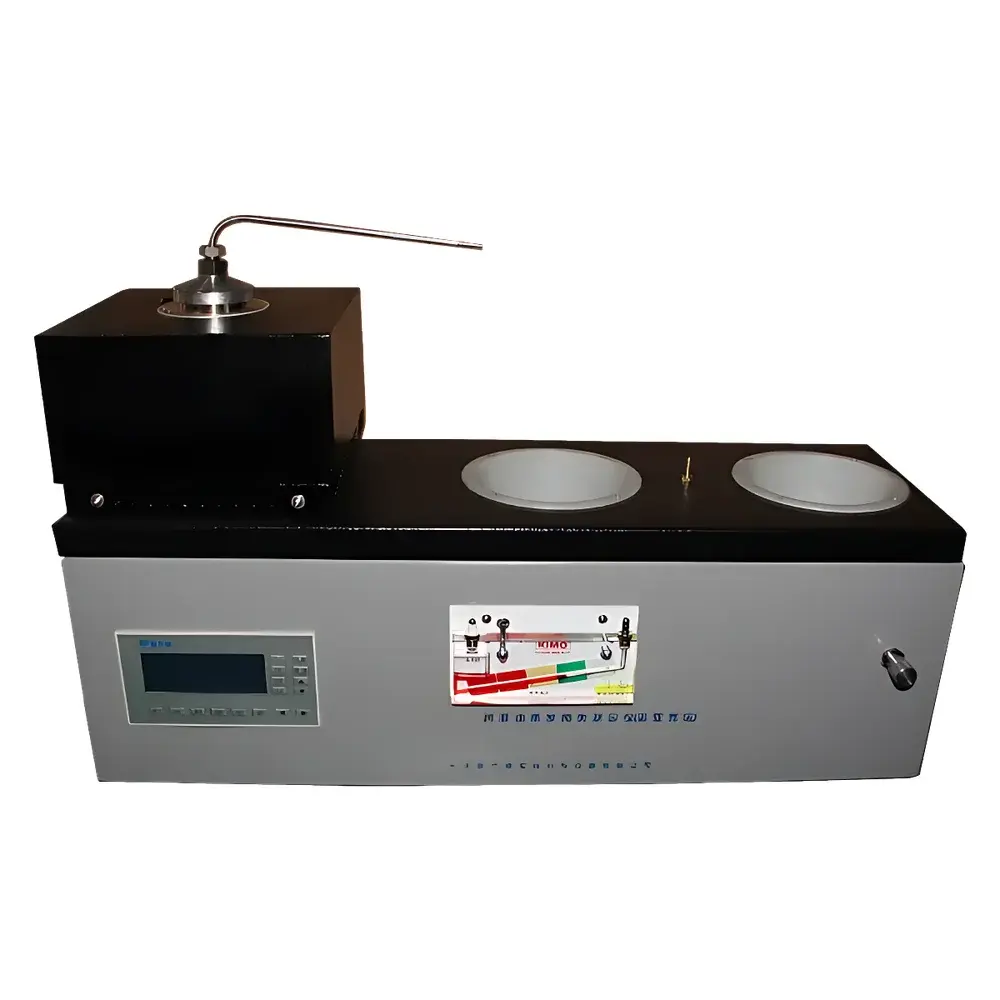
Lubricating Oil Evaporation Loss Tester FDH-1702
| Brand | csfriend (Fulande) |
|---|---|
| Origin | Hunan, China |
| Model | FDH-1702 |
| Standard Compliance | SH/T 0059 |
| Sample Mass | 65 g |
| Heating Method | Metal Bath |
| Temperature Control | 250 ± 0.5 °C |
| Timer Accuracy | 3600 s ± 0.1 s |
| Pressure Measurement | 20 mm H₂O ± 0.2 mm H₂O |
| Power Supply | AC 220 V ± 10 %, 50 Hz |
| Input Power | 1.4 kVA |
| Operating Ambient | 15–35 °C |
| Temperature Controller | Intelligent Programmable PID Controller |
| Heating Time to Setpoint | ~60 min |
| Sensor Type | Pt100 Resistance Thermometer |
| Vacuum System | Integrated Low-Noise Self-Developed Vacuum Module |
Overview
The FDH-1702 Lubricating Oil Evaporation Loss Tester is a precision laboratory instrument engineered for the quantitative determination of evaporation loss in lubricating oils under controlled thermal and vacuum conditions. It operates in strict accordance with the Chinese petroleum industry standard SH/T 0059—“Test Method for Evaporation Loss of Lubricating Oils (Noack Method)”, which aligns functionally with ASTM D5800 and ISO 2592 for comparative international applicability. The instrument employs a metal bath heating system to maintain a stable, uniform temperature of 250 °C ± 0.5 °C across the sample chamber, eliminating variability introduced by water bath evaporation or level fluctuations. Evaporation is conducted under regulated vacuum conditions generated by an integrated, low-noise vacuum module, ensuring reproducible vapor-phase removal without mechanical interference. Mass loss is determined gravimetrically before and after the 60-minute test period, with final results expressed as mass percentage loss relative to the initial 65 g sample weight.
Key Features
- Metal bath heating architecture ensures rapid thermal equilibration (~60 min to setpoint), superior temperature uniformity, and zero maintenance associated with water replenishment or corrosion.
- High-stability intelligent PID temperature controller (Omrón-sourced) delivers precise, drift-free regulation at 250 °C ± 0.5 °C—critical for inter-laboratory reproducibility per SH/T 0059 requirements.
- Digital pressure transducer with mechanical zero-adjustment knob enables accurate, repeatable vacuum calibration to 20 mm H₂O ± 0.2 mm H₂O—essential for consistent vapor pressure differential during evaporation.
- Independent high-accuracy timer (3600 s ± 0.1 s) with audible end-of-test alarm guarantees strict adherence to standardized exposure duration, minimizing operator-dependent timing errors.
- Self-developed vacuum generation system operates silently and reliably, avoiding oil contamination or pulsation artifacts common in external pump configurations.
- Pt100 platinum resistance thermometer provides traceable, NIST-compatible temperature sensing with long-term stability and minimal hysteresis.
Sample Compatibility & Compliance
The FDH-1702 is validated for use with mineral-based, synthetic, and semi-synthetic lubricating oils—including engine oils, gear oils, hydraulic fluids, and greases (after solvent dilution and homogenization). Its design conforms fully to SH/T 0059 procedural specifications, including sample mass (65 g ± 0.1 g), test temperature (250 °C), duration (60 min), and vacuum level (20 mm H₂O). While not certified to ISO/IEC 17025 for accredited testing, the instrument supports GLP-compliant workflows when paired with calibrated analytical balances, documented SOPs, and audit-ready recordkeeping. Its electrical safety design meets GB 4793.1 (equivalent to IEC 61010-1) for laboratory equipment.
Software & Data Management
The FDH-1702 operates as a standalone hardware platform with no embedded software or connectivity interfaces. All operational parameters—including temperature setpoint, timer activation, and pressure verification—are configured manually via front-panel controls. This architecture prioritizes functional reliability, electromagnetic immunity, and long-term serviceability over digital integration. Users are expected to document pre-test and post-test masses using certified analytical balances and calculate evaporation loss (%) manually or within validated LIMS or Excel-based templates compliant with internal QA/QC protocols. For laboratories requiring electronic records, the device supports 21 CFR Part 11 readiness when used in conjunction with validated third-party data capture systems that enforce user authentication, audit trails, and electronic signatures.
Applications
- Quality control of finished lubricants prior to release, verifying consistency against formulation targets and shelf-life expectations.
- Formulation development support for additive packages influencing volatility, including VI improvers, antioxidants, and evaporative inhibitors.
- Comparative evaluation of base stock volatility—e.g., Group I vs. Group III vs. PAO—under standardized thermal stress.
- Failure analysis of in-service oils exhibiting excessive viscosity increase or deposit formation linked to light-end loss.
- Regulatory submission testing for OEM specifications requiring SH/T 0059 compliance (e.g., Chinese automotive OEMs, rail lubricant approvals).
- Teaching and method validation in petroleum engineering curricula and metrology laboratories.
FAQ
What is the maximum allowable deviation from 250 °C during the test?
The instrument maintains temperature within ±0.5 °C of 250 °C throughout the 3600-second test interval, verified by continuous Pt100 feedback and logged via external datalogger if required.
Can the FDH-1702 be used for non-petroleum fluids such as silicone oils or ester-based dielectrics?
Yes—provided the fluid remains thermally stable at 250 °C for 60 minutes and does not chemically degrade the metal bath surface or pressure sensor wetted parts; method adaptation and validation per ASTM D5800 Annex A1 are recommended.
Is calibration certification included with shipment?
A factory-issued calibration report covering temperature (at 250 °C), timer accuracy, and pressure transducer zero point is provided; full ISO/IEC 17025 calibration requires third-party service.
Does the vacuum system require periodic oil changes or filter replacement?
No—the self-contained dry vacuum module contains no consumable lubricants or replaceable filters, contributing to its maintenance-free operation and acoustic silence.






