
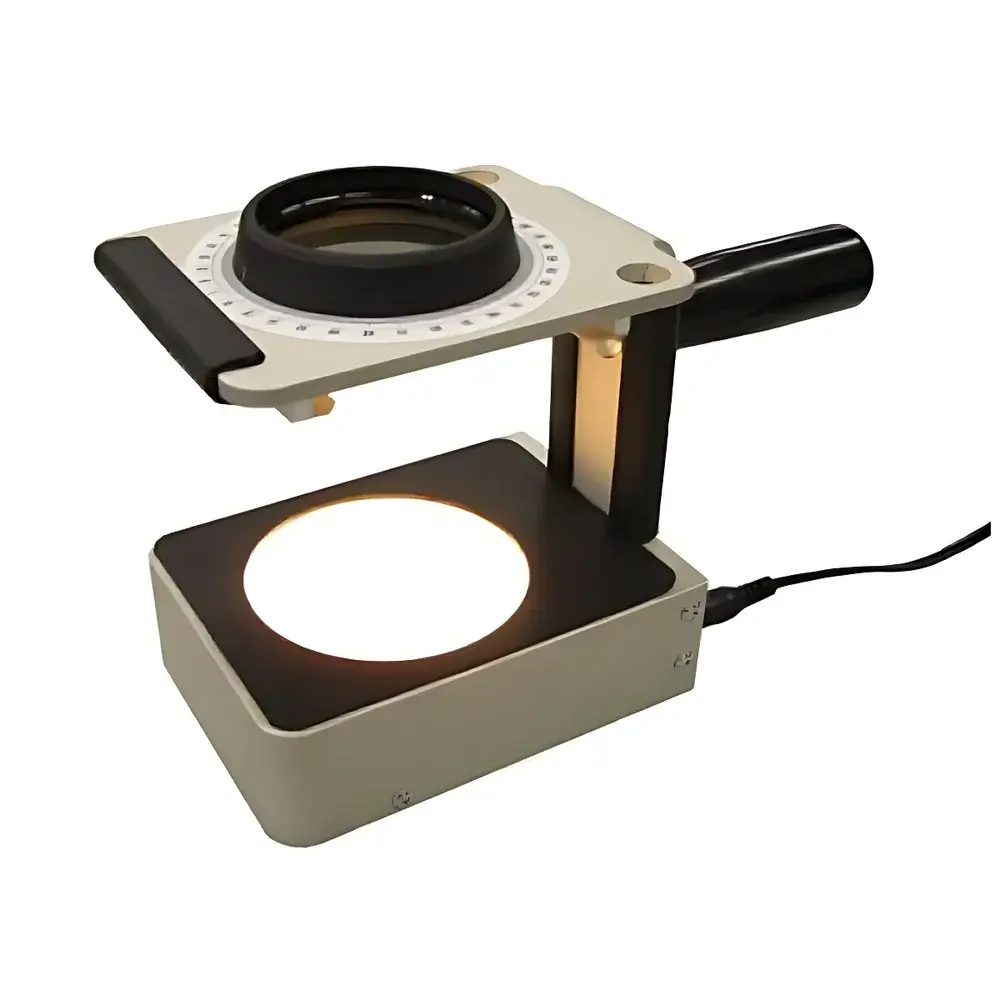
LUCEO LSM Series Stress Analyzer
| Origin | Japan |
|---|---|
| Manufacturer Type | Distributor |
| Origin Category | Imported |
| Model | LSM Series |
| Price | Upon Request |
Overview
The LUCEO LSM Series Stress Analyzer is a precision optical instrument engineered for non-destructive, quantitative evaluation of residual stress in transparent dielectric materials—primarily glass and optically clear polymers. It operates on the fundamental principle of photoelasticity: when stressed, birefringent materials induce phase retardation between orthogonal polarization components of transmitted light, which manifests as interference colors or intensity modulations under controlled polarized illumination. The LSM Series implements multiple complementary optical methodologies—including crossed Nicols, circular polariscope (circular dichroism-assisted), Senarmont, sensitive-tint (tint-of-pass), and RGB linear polarimetry—to accommodate diverse sample geometries, thicknesses, and stress magnitudes. Designed for laboratory, R&D, and quality control environments, it delivers repeatable, traceable measurements aligned with ISO 11477 (optical glass stress birefringence) and ASTM C148 (stress analysis of glass containers), supporting compliance-driven workflows in optics manufacturing, automotive glazing, semiconductor packaging, and medical device production.
Key Features
- Multi-method optical architecture: Simultaneous support for crossed Nicols, circular polariscope, Senarmont, sensitive-tint, and RGB linear polarimetry—enabling optimal method selection per material type and stress regime.
- Calibrated wavelength reference: Senarmont mode utilizes a stabilized 540 nm monochromatic source for high-contrast retardation quantification; all models integrate high-brightness 3000K white LED illumination with uniform intensity distribution.
- Modular mechanical design: Adjustable analyzer height (LSM-4xx1 variants only), interchangeable quarter-wave plates and sensitive-tint filters, and precision-aligned polarizer/analyzer optics ensure long-term calibration stability.
- Scalable form factor: From handheld StrainEye (φ78 mm field, 0.7 kg) to benchtop medium (LSM-2×00 series, 200 × 200 mm FOV) and large-format systems (LSM-4×00 series, up to 290 mm vertical measurement space), accommodating flat panels, curved substrates, and 3D molded parts.
- Robust power architecture: DC input (15–24 V, 0.8 A) for portable operation or universal AC input (100–240 VAC, 50/60 Hz) for permanent installation, with thermal management optimized for continuous-duty use (max. 30 W consumption).
Sample Compatibility & Compliance
The LSM Series accommodates a broad spectrum of transparent substrates: float glass panels, automotive laminated and tempered glass, fused silica and crystalline quartz wafers, optical filter substrates, laser diode protective windows, microlens arrays, V-groove silicon/glass baseplates, pharmaceutical vials, beverage containers, and injection-molded polycarbonate or PMMA optical components. All configurations comply with ISO 11477 Annex B (retardation measurement uncertainty ≤ ±2 nm for <100 nm range) and support GLP/GMP documentation requirements through manual logbook integration. While not inherently 21 CFR Part 11 compliant, the system’s deterministic optical output and stable hardware platform facilitate validation under FDA-regulated environments when paired with validated data recording procedures.
Software & Data Management
The LSM Series operates as a hardware-controlled optical platform requiring external image capture and analysis. Users typically employ calibrated digital cameras (e.g., machine vision sensors with known pixel pitch and gamma correction) coupled with third-party image processing software (e.g., ImageJ with polarimetric plugins, MATLAB-based retardation mapping toolboxes, or custom Python scripts using OpenCV). Quantitative stress mapping is derived from measured retardation (Γ) in nanometers using the standard relation Γ = C·σ·t, where C is the material-specific stress-optic coefficient (e.g., 2.9 × 10⁻⁶ Pa⁻¹ for soda-lime glass), σ is stress (Pa), and t is thickness (m). Documentation workflows align with ISO/IEC 17025 clause 7.7—requiring traceable calibration records for polarizer orientation, waveplate retardance, and illumination spectral output.
Applications
- Optics manufacturing: Verification of annealing efficacy in precision lenses, prisms, and interferometer-grade substrates.
- Automotive glazing: In-line stress profiling of windshields and sunroofs to prevent spontaneous fracture during thermal cycling.
- Semiconductor packaging: Residual stress assessment in glass interposers and MEMS encapsulation wafers prior to dicing.
- Pharmaceutical container qualification: Detection of molding-induced stress in borosilicate vials that may compromise lyophilization cycle integrity.
- R&D labs: Comparative study of polymer annealing kinetics via time-resolved retardation mapping under controlled thermal ramping.
FAQ
What stress measurement range does the LSM Series support?
The core measurement range is 0–270 nm retardation (Re), applicable across all Senarmont and sensitive-tint configurations. This corresponds to ~0–90 MPa in standard float glass (t = 3 mm) and scales inversely with thickness.
Is the system compatible with automated data acquisition?
Yes—via external camera trigger synchronization (TTL-compatible) and standardized USB/RS-232 control interfaces on select models (LSM-4×01 variants), enabling integration into semi-automated QC stations.
Does LUCEO provide NIST-traceable calibration certificates?
Calibration services are offered by authorized distributors; certificates include verification of polarizer extinction ratio (>30 dB), quarter-wave plate retardance accuracy (±1.5 nm at 540 nm), and LED spectral centroid stability (±5 nm over 1000 h).
Can the LSM analyze curved or textured surfaces?
Yes—through adjustable analyzer height (up to 290 mm on LSM-4401B), tilt-compensated mounting fixtures, and high-dynamic-range imaging to resolve localized fringe patterns on non-planar geometries.
What maintenance is required for long-term optical accuracy?
Annual verification of polarizer alignment and waveplate retardance is recommended; cleaning follows ISO 10110-7 protocols using solvent-rinsed optical-grade wipes—no consumables or firmware updates required.



