
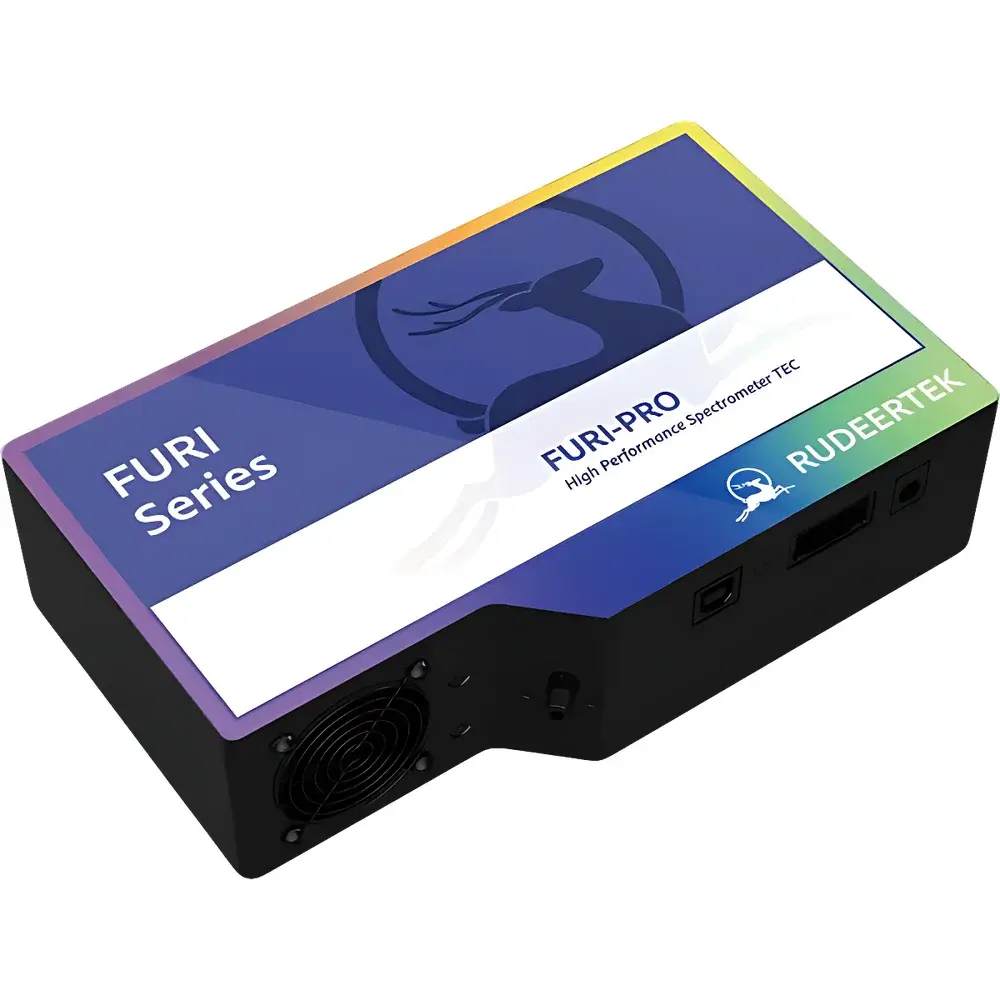
Luchu Tech FURI-PRO Cooled High-Sensitivity Fiber Optic Spectrometer
| Brand | Luchu Tech |
|---|---|
| Origin | Anhui, China |
| Manufacturer Type | Direct Manufacturer |
| Detector Type | CCD |
| Spectral Range | 200–1100 nm |
| Optical Resolution | 0.11–3.42 nm (FWHM) |
| Signal-to-Noise Ratio | 1000:1 (full signal) |
| Dynamic Range | 4400:1 (single acquisition) |
| Stray Light | <1% |
| Detector | 2048 × 64 pixel back-illuminated CCD with single-stage TEC cooling |
| Pixel Size | 14 µm × 14 µm |
| Optical Design | Crossed Czerny-Turner |
| f-number | f/4 |
| Slit Options | 10 / 25 / 50 / 75 / 100 µm |
| Integration Time | 2.4 ms – 10 s |
| Linearity | ≥0.998 |
| A/D Resolution | 16-bit |
| Interface | USB 2.0 Type-B |
| Digital I/O | Yes |
| Fiber Connector | SMA905 |
| Weight | 1.25 kg |
| OS Compatibility | 32/64-bit Windows 7/10/11 |
Overview
The Luchu Tech FURI-PRO is a thermoelectrically cooled, high-sensitivity fiber optic spectrometer engineered for demanding spectroscopic applications requiring low-noise performance and spectral stability. Based on a crossed Czerny-Turner optical architecture (f/4), the instrument delivers broad spectral coverage from 200 nm to 1100 nm—spanning deep UV through visible and into the near-infrared—with configurable resolution down to 0.11 nm (FWHM). Its core innovation lies in the integration of a back-illuminated 2048 × 64 pixel CCD detector actively cooled via single-stage thermoelectric (TEC) control, enabling operation up to 20 °C below ambient temperature. This thermal stabilization significantly suppresses dark current and readout noise, directly enhancing signal fidelity—particularly critical for low-light measurements such as fluorescence decay profiling, weak Raman scattering, or trace-level environmental absorption analysis. Unlike uncooled compact spectrometers, the FURI-PRO maintains consistent quantum efficiency across its full range, including enhanced UV responsivity due to optimized optical coatings and detector passivation.
Key Features
- Thermoelectric cooling system (TEC) stabilizes detector temperature up to 20 °C below ambient, reducing dark current by >90% compared to non-cooled equivalents
- Back-illuminated CCD sensor with 14 µm × 14 µm pixels and high quantum efficiency (>60% at 254 nm, >85% at 600 nm)
- Optically optimized crossed Czerny-Turner design with f/4 throughput and low aberration across 200–1100 nm
- Selectable slit widths (10–100 µm) allow precise trade-off between resolution and light throughput per application requirement
- 16-bit analog-to-digital conversion with ≥0.998 linearity ensures accurate photometric quantification over four decades of intensity
- Rugged aluminum alloy housing (1.25 kg) with integrated thermal management supports stable benchtop or OEM integration use
Sample Compatibility & Compliance
The FURI-PRO is compatible with standard 400 µm or 600 µm core multimode silica fibers (SMA905 interface), supporting both free-space and fiber-coupled excitation configurations. Its spectral response has been validated against NIST-traceable deuterium-halogen reference sources, and calibration data includes wavelength accuracy ±0.2 nm and radiometric stability <0.3% over 8 hours (at constant TEC setpoint). While not certified to ISO/IEC 17025, the instrument meets functional requirements for GLP-compliant laboratories when used with documented calibration protocols and version-controlled firmware. It supports audit-ready metadata logging—including integration time, slit selection, TEC setpoint, and detector temperature—for traceability in regulated environments (e.g., USP , ASTM E275, ISO 17025 Annex A.3).
Software & Data Management
The spectrometer operates via Luchu’s SDK (Windows DLL, C/C++, Python, LabVIEW drivers) and includes SpectraView Pro—a modular acquisition and analysis suite supporting real-time spectral averaging, peak identification (with centroid and Gaussian fitting), baseline correction (asymmetric least squares), and export to CSV, HDF5, or JCAMP-DX formats. All raw spectra include embedded EXIF-style metadata: timestamp, detector temperature, integration time, slit ID, and calibration file hash. For regulated workflows, optional software modules provide 21 CFR Part 11–compliant electronic signatures, user access controls, and immutable audit trails for method changes and calibration events.
Applications
- Fluorescence spectroscopy: Quantitative lifetime-independent analysis of organic dyes, quantum dots, and biological fluorophores under pulsed or CW excitation
- Raman spectroscopy: High-fidelity detection of low-intensity Stokes shifts using notch or edge filters; suitable for 532 nm, 633 nm, and 785 nm laser lines
- Environmental monitoring: Dissolved organic matter (DOM) characterization, nitrate/nitrite UV-Vis quantification, and particulate scattering profiling
- Pharmaceutical QC: Excipient fingerprinting, API concentration assays, and dissolution testing via UV-Vis absorbance kinetics
- Academic research: Time-resolved pump-probe experiments, plasma emission diagnostics, and hyperspectral imaging system cores
FAQ
What cooling performance does the TEC achieve, and how is temperature controlled?
The single-stage TEC maintains detector temperature within ±0.1 °C of the user-defined setpoint (range: −10 °C to +25 °C), with stabilization achieved in <3 minutes. Temperature is monitored via on-sensor diode and reported in real time via SDK.
Is radiometric calibration included, and what standards are used?
Each unit ships with factory wavelength and relative intensity calibration using NIST-traceable deuterium and tungsten-halogen lamps. Absolute irradiance calibration is available as an optional service using calibrated photodiodes.
Can the FURI-PRO be synchronized with external triggers or lasers?
Yes—via TTL-compatible digital I/O (input trigger, exposure gate, strobe output) with sub-microsecond jitter, enabling gated acquisition for time-resolved fluorescence or lock-in Raman.
How is stray light performance verified?
Stray light is measured per ASTM E275 using a 600 nm bandpass filter and 400 nm blocking filter; reported values (<1%) reflect worst-case out-of-band rejection at 400 nm when measuring 600 nm light.
What OEM integration support is provided?
Full mechanical drawings (STEP), electrical schematics (for I/O), thermal dissipation profiles, and RoHS/REACH compliance documentation are supplied under NDA for embedded system integration.




