
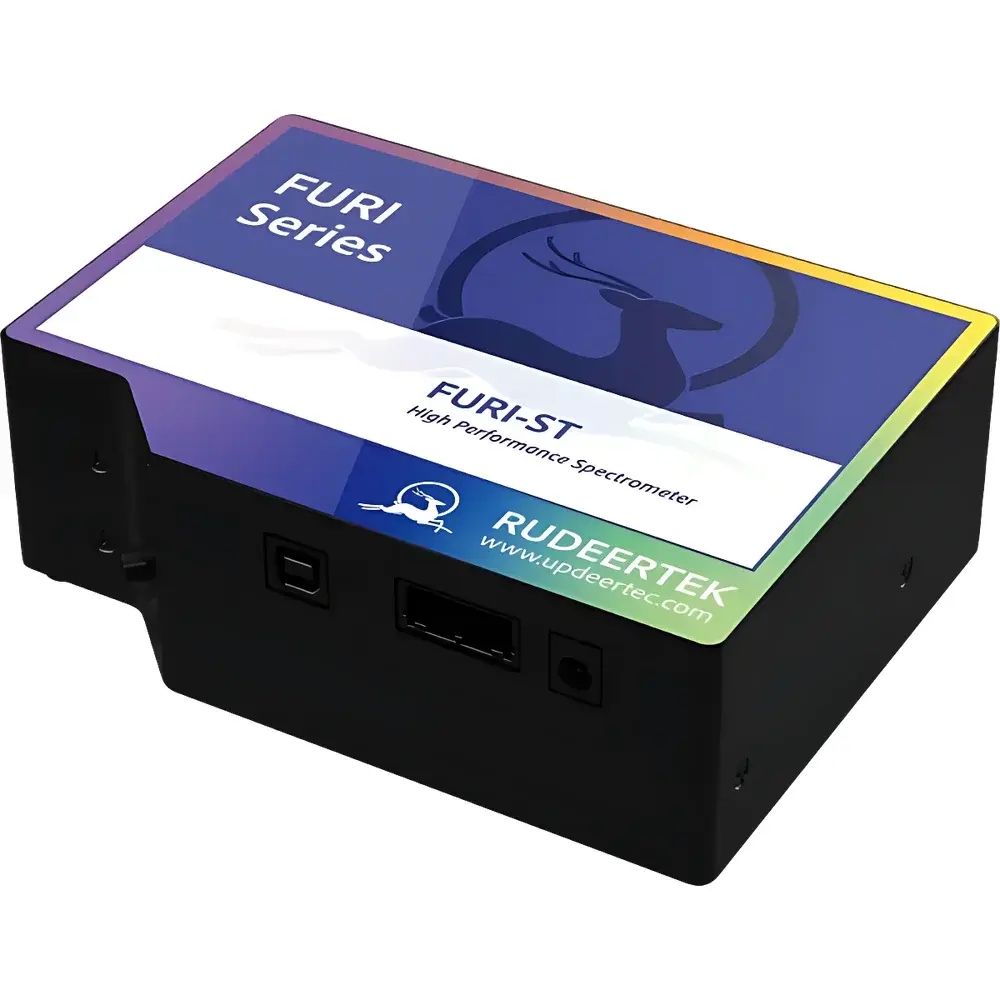
Luchu Technology FURI-ST Long-Focal-Length High-Sensitivity Fiber Optic Spectrometer
| Brand | Luchu Technology |
|---|---|
| Origin | Anhui, China |
| Manufacturer Type | OEM/ODM Manufacturer |
| Detector Type | CCD Array |
| Spectral Range | 200–1100 nm |
| Optical Resolution (FWHM) | 0.11–3.42 nm |
| Signal-to-Noise Ratio | 450:1 (full signal) |
| Dynamic Range | 2100:1 (single acquisition) |
| Stray Light | <1% |
| F-number | f/4 |
| Optical Design | Crossed Czerny-Turner |
| Slit Options | 10/25/50/75/100 µm |
| Pixel Array | 2048 × 64 pixels |
| Pixel Size | 14 µm × 14 µm |
| A/D Resolution | 16-bit |
| Integration Time | 2.4 ms – 10 s |
| Linearity | ≥0.998 |
| Interface | USB 2.0 Type-B, Digital I/O, SMA905 fiber port |
| Weight | 1.07 kg |
| OS Support | 32/64-bit Windows 7/10/11 |
Overview
The Luchu Technology FURI-ST is a high-performance fiber optic spectrometer engineered for demanding spectroscopic applications requiring extended focal length optics, enhanced photon collection efficiency, and fine spectral discrimination. Based on a crossed Czerny-Turner optical architecture with an f/4 aperture, the FURI-ST integrates a large-diameter, long-focal-length collimating and focusing system, high-line-density diffraction grating, and precision-machined slit options (10–100 µm) to achieve optical resolutions ranging from 0.11 nm to 3.42 nm (FWHM), depending on configuration. Its 2048 × 64-pixel back-illuminated CCD array delivers superior quantum efficiency across the full 200–1100 nm range—including strong UV response down to 200 nm—enabling reliable detection of weak emission signals in fluorescence, Raman, and low-light absorption measurements. The instrument’s mechanical and thermal stability supports high reproducibility in laboratory and field-deployable environments, while its modular design allows seamless integration into automated analytical platforms.
Key Features
- Long-focal-length optical path (≥100 mm) optimized for resolution and throughput trade-off control
- High-sensitivity back-thinned CCD detector with 14 µm × 14 µm pixels and >60% peak QE in UV-VIS-NIR
- Configurable slit widths (10/25/50/75/100 µm) enabling user-selectable resolution/sensitivity balance
- Stray light suppression <1% (measured per ASTM E275-21), critical for high-dynamic-range absorbance and fluorescence quantification
- Synchronized multi-unit operation support: hardware-triggered simultaneous acquisition across up to 8 spectrometers via TTL/CMOS digital I/O
- Robust aluminum alloy housing with passive thermal management for stable wavelength calibration over extended integrations
- USB 2.0 interface compliant with USB Device Class Definition for Test & Measurement (USBTMC), ensuring plug-and-play compatibility with LabVIEW, Python (PyVISA), MATLAB, and custom C/C++ applications
Sample Compatibility & Compliance
The FURI-ST accommodates standard 400 µm or 600 µm core multimode silica fibers (SMA905 connector), supporting both free-space and fiber-coupled sample interfaces. It complies with electromagnetic compatibility requirements per CISPR 11 Group 1, Class B and meets RoHS 2011/65/EU directives. While not certified as medical or safety-critical equipment, its performance characteristics align with method validation requirements under ISO/IEC 17025 for routine spectroscopic analysis. Data integrity features—including timestamped metadata embedding, non-volatile calibration storage, and raw frame buffering—support GLP-compliant workflows. Firmware-level integration with NIST-traceable wavelength and intensity calibration standards enables traceable reporting in regulated environments (e.g., environmental monitoring per EPA Method 418.1 or USP for UV-Vis spectrophotometer verification).
Software & Data Management
The FURI-ST ships with Luchu SpectraSuite™ SDK (Windows-based), providing native drivers for 32/64-bit Windows 7/10/11 and comprehensive API support (C++, C#, Python, LabVIEW). All spectral acquisitions include embedded metadata: integration time, temperature sensor reading (on-board thermistor), detector gain setting, slit ID, and grating position. Raw 16-bit spectra are stored in HDF5 format (HDF Group specification v1.12+) with hierarchical attributes for audit-ready traceability. The SDK implements automatic dark current subtraction, pixel non-uniformity correction, and real-time baseline flattening using polynomial fitting. For regulatory compliance, optional firmware upgrade enables 21 CFR Part 11–compliant electronic signatures, audit trail logging, and role-based access control when deployed with validated third-party LIMS or ELN systems.
Applications
- Steady-state and time-resolved fluorescence spectroscopy (e.g., quantum yield determination, FRET assays)
- Low-frequency Raman shift detection (<200 cm⁻¹) using notch-filtered excitation and high-resolution dispersion
- Multi-gas analysis via differential optical absorption spectroscopy (DOAS) in environmental monitoring stations
- In-line process monitoring of pharmaceutical tablet coatings using NIR reflectance (780–1100 nm)
- Plant pigment profiling (chlorophyll a/b, carotenoids) in agricultural phenotyping platforms
- Plasma emission characterization in semiconductor etch chamber diagnostics
- UV curing lamp spectral irradiance mapping per ISO 11664-3 and CIE S 014/E:2006
FAQ
What slit width should I select for optimal resolution in Raman spectroscopy?
For visible-excitation Raman (e.g., 532 nm laser), a 25 µm slit typically balances resolution (~0.25 nm at 532 nm) and signal throughput; narrower slits (10 µm) may be used for high-resolution gas-phase Raman but require longer integration times.
Can the FURI-ST be calibrated against NIST-traceable standards?
Yes—Luchu provides optional factory calibration using NIST SRM 2035 (Holmium Oxide) and SRM 1935 (Deuterium Lamp), with certificate of calibration including uncertainty budgets per GUM (JCGM 100:2008).
Is synchronization supported across spectrometers with different spectral ranges?
Yes—hardware triggering ensures sub-microsecond timing alignment between units, even when configured for non-overlapping ranges (e.g., one unit 200–400 nm, another 700–1100 nm), enabling full-spectrum reconstruction via spectral stitching algorithms.
Does the device support external shutter or light source control?
The digital I/O port provides two programmable TTL outputs (for shutter/laser gating) and two TTL inputs (for external trigger or sync pulse reception), configurable via SDK register-level commands.
How is wavelength calibration stability maintained over temperature fluctuations?
The optical bench uses low-CTE aluminum alloy and incorporates real-time thermal drift compensation using an onboard thermistor and second-order polynomial correction coefficients stored in EEPROM. Typical wavelength drift is <0.015 nm/°C over 15–35 °C ambient range.




