
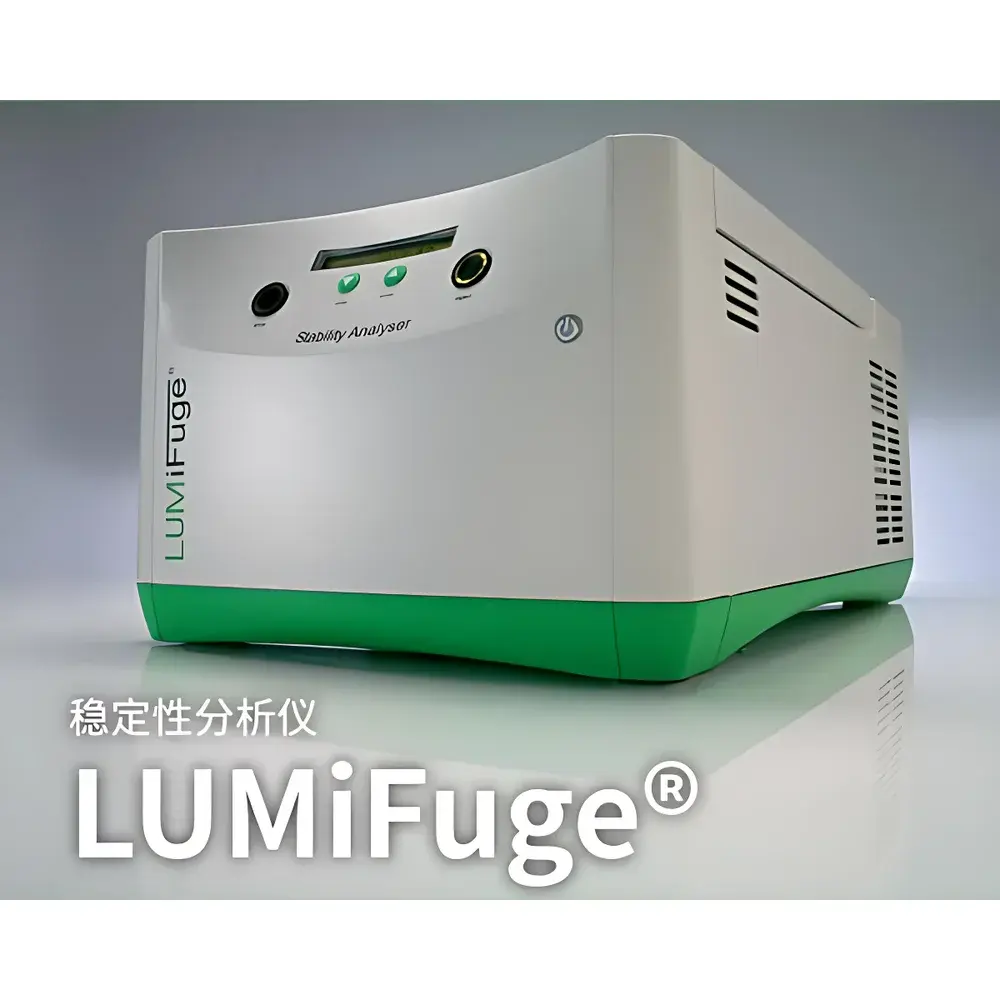
LUM LUMiFuge® Accelerated Stability Analyzer
| Brand | LUM |
|---|---|
| Origin | Germany |
| Model | LUMiFuge® |
| Measurement Principle | Spatially Resolved Extinction Profile Analysis under Controlled Centrifugal Force |
| Sample Throughput | Up to 8 samples per run |
| Rotor Speed Range | 0–4,000 rpm (variable, programmable) |
| Detection Method | Polydisperse near-infrared (NIR) light transmission at 870 nm |
| Spatial Resolution | 10 µm per data point across 5 cm sample path |
| Data Acquisition Frequency | Up to 1 scan/s (adjustable) |
| Temperature Control | 5–40 °C (±0.5 °C) |
| Sample Volume per Cell | 0.1–2.0 mL |
| Compliance | ASTM D7713-19 (Standard Practice for Stability Evaluation of Dispersions by Centrifugation), ISO 13321 (Particle Size Analysis – Photon Correlation Spectroscopy), GLP-ready with audit trail and user access control |
Overview
The LUM LUMiFuge® is a high-performance accelerated stability analyzer engineered for quantitative, time-resolved characterization of colloidal and particulate dispersion stability under controlled centrifugal stress. Unlike conventional sedimentation or visual assessment methods, the LUMiFuge® employs spatially resolved extinction profile analysis (STEP™ Technology): a patented optical method that continuously monitors near-infrared (NIR) light transmission (870 nm) across the full length of a sample cell during centrifugation. This enables real-time, non-invasive tracking of particle migration, phase separation, creaming, sedimentation, coalescence, and consolidation — all without dilution, labeling, or calibration standards. The instrument applies programmable centrifugal forces (0–4,000 × g) to accelerate instability processes that would otherwise require weeks, months, or even years under gravity — achieving up to 2,300× acceleration while preserving hydrodynamic relevance. Its design conforms to fundamental principles of Stokes’ law, hindered settling, and interparticle interaction modeling, making it suitable for both Newtonian and non-Newtonian dispersions.
Key Features
- STEP™ Technology: High-resolution (10 µm) axial scanning of extinction profiles during centrifugation, delivering concentration gradients and velocity distributions as primary output.
- Multi-speed ramping & stepwise protocols: Precise control over acceleration profiles to mimic storage conditions or induce specific instability mechanisms (e.g., flocculation vs. coalescence).
- Integrated Peltier temperature regulation (5–40 °C ±0.5 °C) for thermally sensitive formulations including biologics and thermoresponsive emulsions.
- Low sample consumption: Compatible with 0.1–2.0 mL volumes in standardized quartz or disposable polymer cells — critical for high-value pharmaceutical or R&D samples.
- Modular architecture: Supports optional accessories including automatic sample loader, multi-angle detection modules, and rheo-optical coupling for concurrent viscosity/stability studies.
- GLP-compliant software environment with electronic signatures, role-based access, audit trail logging, and 21 CFR Part 11 readiness for regulated QC environments.
Sample Compatibility & Compliance
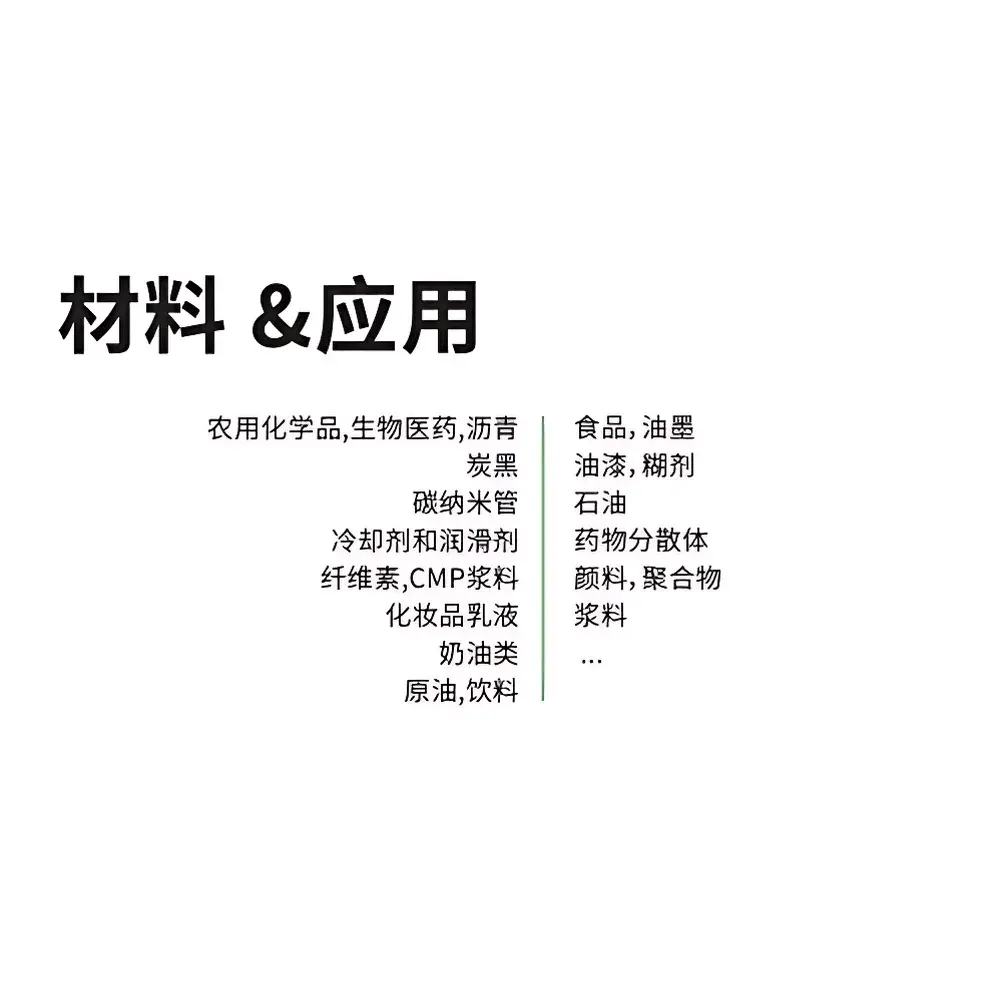
The LUMiFuge® accommodates a broad spectrum of dispersed systems — from low-viscosity aqueous suspensions (<1 mPa·s) to highly concentrated pastes (>10⁶ mPa·s), including opaque, pigmented, and optically heterogeneous media. It has been validated for use with nanoscale dispersions (e.g., carbon nanotubes, silica nanoparticles <10 nm), high-solids slurries (e.g., CMP slurries >50 wt%), and viscoelastic emulsions (e.g., cosmetic creams, drug-loaded lipid nanocapsules). All measurement protocols align with ASTM D7713-19 for accelerated stability evaluation of dispersions and support ISO 13321-compliant particle interaction analysis. Instrument validation documentation, IQ/OQ/PQ templates, and raw data export formats (CSV, HDF5) are provided to facilitate GMP, FDA, and EMA regulatory submissions.
Software & Data Management
The proprietary SEPView® software provides integrated acquisition, visualization, and interpretation tools. Users define custom centrifugation protocols, monitor real-time extinction maps, and extract quantitative parameters including sedimentation coefficient distribution, depletion zone kinetics, interface velocity, and consolidation modulus. Advanced algorithms enable automated classification of instability mechanisms (e.g., sedimentation vs. creaming dominance), prediction of shelf-life endpoints, and comparative ranking of formulation variants. Raw and processed data are stored in a secure, timestamped database with version control; exports comply with FAIR principles (Findable, Accessible, Interoperable, Reusable) and support LIMS integration via RESTful API.
Applications
The LUMiFuge® serves as a core analytical platform across industries requiring robust dispersion stability assessment: formulation development and QC of pharmaceutical nanosuspensions and injectables; optimization of agrochemical suspension concentrates (SC) and emulsifiable concentrates (EC); stability screening of biopolymer-based food emulsions (e.g., dairy analogs, plant-based beverages); performance evaluation of functional coatings, pigment dispersions, and conductive inks; and fundamental research into colloidal interactions, depletion forces, and gelation kinetics in cementitious or ceramic slurries. Its ability to resolve slow dynamics in ultra-stable systems makes it indispensable for long-term storage prediction in battery electrolytes, lubricants, and aerospace thermal fluids.
FAQ
How does the LUMiFuge® differ from traditional centrifuges used for stability testing?
It combines controlled centrifugal stress with high-resolution, real-time optical profiling — enabling quantification of migration kinetics and phase boundaries, not just endpoint separation.
Can the LUMiFuge® analyze highly opaque or colored samples?
Yes — its 870 nm NIR source penetrates turbid, pigmented, and UV-absorbing matrices where visible-light techniques fail.
Is method transfer possible from LUMiFuge® to LUMiSizer®?
Yes — both platforms share identical STEP™ methodology, data structure, and SEPView® software, enabling seamless cross-platform comparison and scalability from R&D to QC.
What regulatory documentation is available for GMP environments?
Full IQ/OQ/PQ protocols, 21 CFR Part 11 configuration reports, and raw data integrity validation packages are supplied standard.
Does the system require routine calibration with reference materials?
No — STEP™ is an absolute measurement technique based on Beer-Lambert law and geometric cell definition; no external standards are needed for concentration profiling.



