
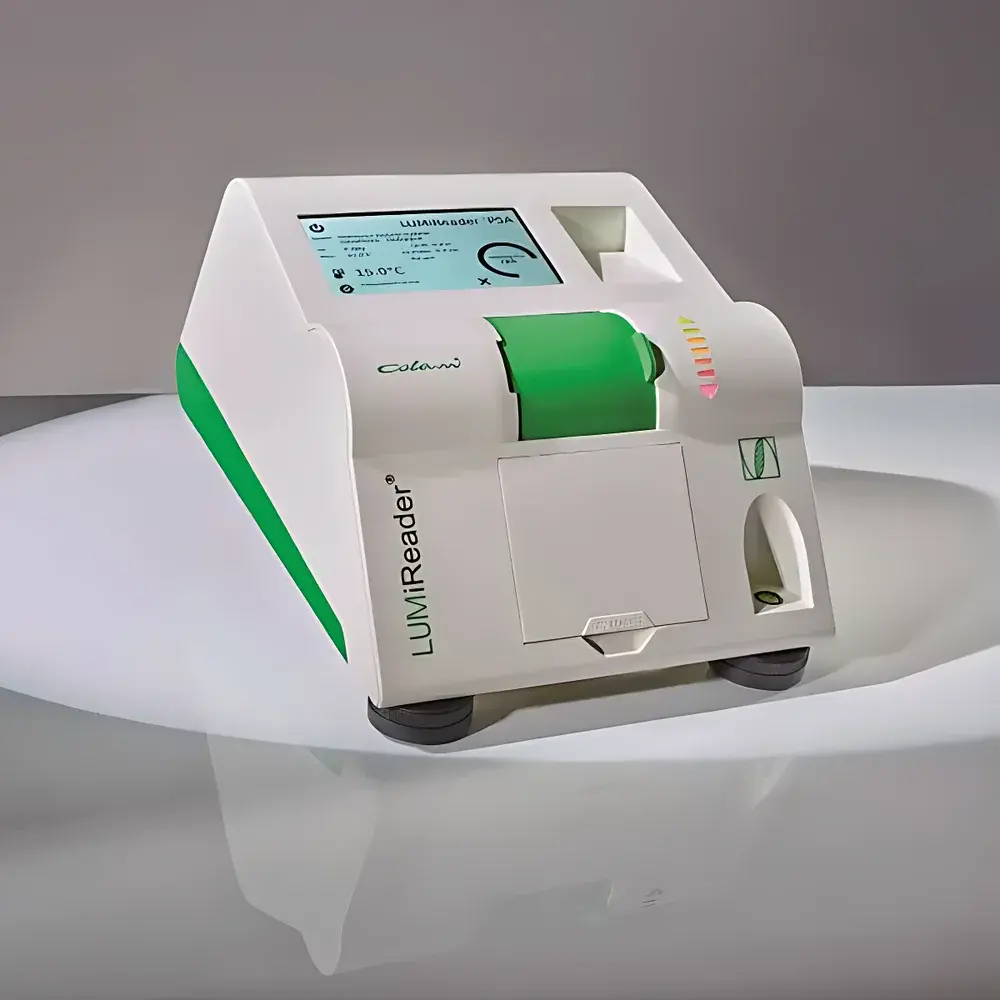
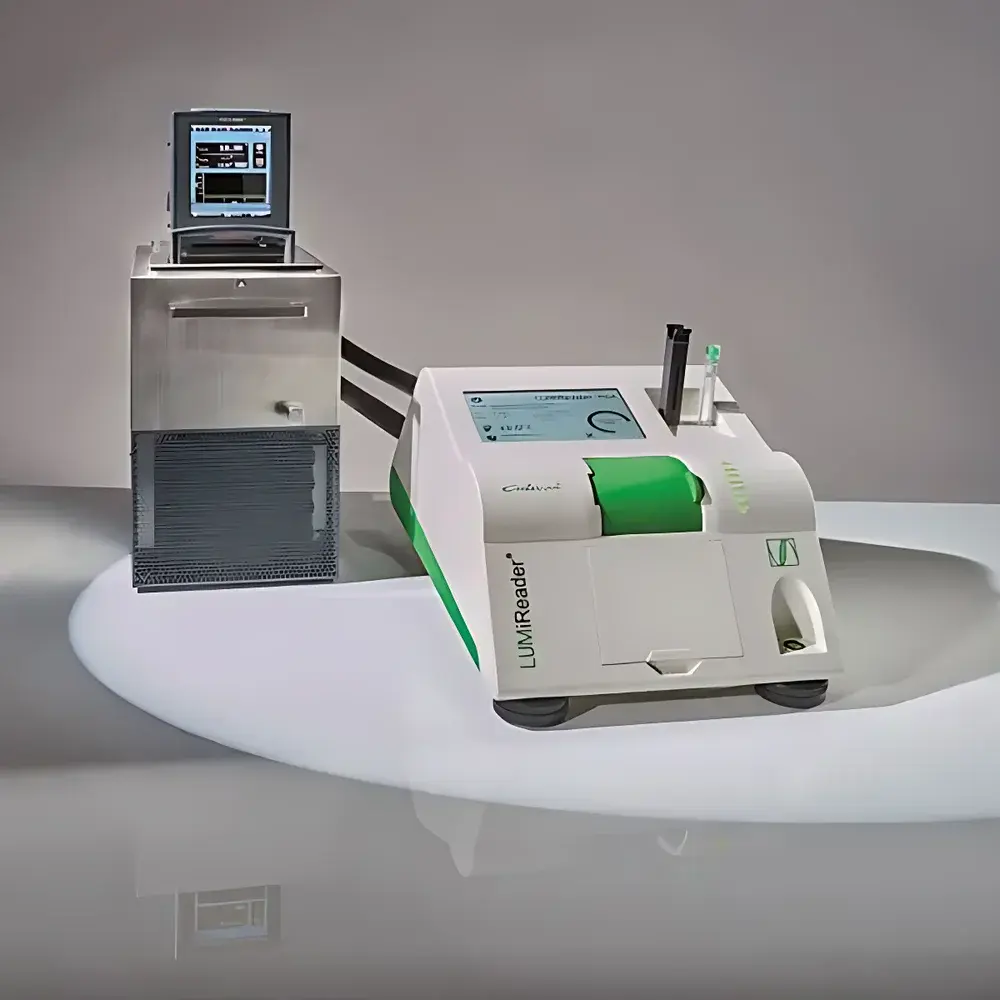
LUM LUMiReader PSA Particle Separation Analyzer
| Brand | LUM |
|---|---|
| Origin | Germany |
| Manufacturer Type | Authorized Distributor |
| Product Category | Imported Instrument |
| Model | LUMiReader PSA |
| Pricing | Upon Request |
Overview
The LUM LUMiReader PSA is a high-precision, non-invasive particle separation analyzer engineered for real-time, spatially resolved characterization of colloidal and heterogeneous dispersions under natural or accelerated gravitational conditions. Based on patented STEP (Spatially Resolved Temporal Evolution of Extinction Profiles) technology, the instrument employs multi-wavelength optical detection to acquire extinction profiles across the entire sample height—simultaneously and without scanning—enabling direct quantification of separation kinetics, particle velocity distributions, and volumetric particle size distributions (PSD). Unlike conventional sedimentation or light-scattering methods, the LUMiReader PSA operates without requiring prior knowledge of particle refractive index, density, shape assumption (e.g., spherical), or medium viscosity. Its measurement principle adheres to the physical fundamentals of sedimentation and creaming under defined g-force conditions, with optional tilt-based acceleration (up to 10× g) governed by geometric and rheological parameters—including vial geometry, sample concentration, temperature, and effective viscosity. This enables robust, first-principles-based stability assessment aligned with ISO/TR 13097 (Colloidal dispersions — Guidelines for the assessment of dispersion stability) and ISO 13317 (Particle size analysis — Sedimentation methods — Determination of particle size distribution by X-ray sedimentation).
Key Features
- Patented multi-wavelength STEP technology for simultaneous acquisition of spatial-temporal extinction profiles across full sample height (0.5 mL to 4.0 mL capacity)
- Integrated precision temperature control (ambient +3 °C to 60 °C, ±1 K accuracy) and independently adjustable illumination optics
- Tilt-based acceleration module enabling controlled gravitational enhancement (0° to 30° inclination in 5° increments), delivering up to 10× nominal g-force without mechanical rotation or centrifugation
- High-resolution optical detection array comprising >9,000 micro-sensors per detector, delivering sub-second temporal resolution (down to 0.5 s per profile) and nanoscale sensitivity to local extinction changes
- PSA (Particle Separation Analysis) module enabling direct derivation of velocity distribution Qv(v), intensity-weighted PSD QInt(x), and volume-weighted PSD Q3(x)—all without calibration or material property inputs
- No moving parts in optical path or sample handling; designed for unattended long-term monitoring (hours to weeks) under GLP-compliant conditions
- Compliance-ready architecture supporting 21 CFR Part 11 audit trails, electronic signatures, and secure data integrity protocols
Sample Compatibility & Compliance
The LUMiReader PSA accommodates a broad operational range: particle sizes from 200 nm to 2000 µm; sample densities up to 22 g/cm³; concentrations spanning 0.00015% to 75% w/w; and viscosities compatible with gravitational separation kinetics. It supports standard cylindrical sample tubes fabricated from quartz, glass, or polymer materials with customizable optical path lengths. The system meets international regulatory and standards frameworks including ISO/TR 13097 (stability classification), ISO 13317 (sedimentation-based PSD), ASTM D7827 (emulsion stability testing), and FDA 21 CFR Part 11 for electronic records and signatures. All measurement data are timestamped, version-controlled, and stored with immutable metadata—including temperature history, tilt angle, illumination wavelength, and detector gain settings—to ensure full traceability for GMP, GLP, and quality assurance audits.
Software & Data Management
The proprietary SEPView software provides a unified platform for instrument control, real-time visualization, quantitative modeling, and report generation. It supports automated batch processing of multiple stability indices—including sedimentation rate, clarification front velocity, interface thickness, and phase separation onset time. Advanced algorithms convert raw extinction profiles into physically meaningful outputs: Qv(v) velocity histograms, Q3(x) volume-based particle size distributions, and stability ranking matrices compliant with ISO/TR 13097 classification tiers (e.g., “stable”, “slowly separating”, “unstable”). Data export options include CSV, HDF5, and PDF reports with embedded metadata. Role-based user access, encrypted database storage, and configurable electronic signature workflows ensure alignment with regulated laboratory environments.
Applications
The LUMiReader PSA delivers actionable insights across R&D, quality control, and process development for complex dispersions. Key application domains include: formulation optimization of pharmaceutical suspensions and emulsions; stability benchmarking of industrial coatings, inks, and pigments; rheological fingerprinting of drilling muds, sludges, and oilfield fluids; performance evaluation of food emulsions (e.g., dairy, dressings, plant-based alternatives); particle engineering of ceramics, catalysts, and battery slurries; and accelerated shelf-life prediction for agrochemicals and personal care products. Its ability to quantify both macroscopic phase behavior (e.g., creaming, sedimentation, flocculation) and microscopic particle dynamics (e.g., aggregation kinetics, density-driven stratification) makes it indispensable for root-cause analysis of instability mechanisms.
FAQ
Does the LUMiReader PSA require calibration with reference standards?
No. The STEP methodology is absolute and self-referencing—quantitative results are derived directly from physical models of sedimentation/creaming, eliminating dependence on calibration particles or empirical correlations.
Can it measure samples with high optical opacity or strong absorption?
Yes. Multi-wavelength illumination (typically 470–940 nm) allows selection of optimal wavelengths to maximize signal-to-noise ratio for turbid, colored, or absorbing systems.
Is tilt-based acceleration equivalent to centrifugation?
No. Tilt acceleration preserves laminar flow and avoids shear-induced artifacts, enabling true gravitational separation kinetics—unlike centrifugal methods that introduce non-physiological forces and particle reorientation.
What sample tube types are supported?
Standard 2 mm, 4 mm, and 10 mm diameter cylindrical cells made from fused silica, borosilicate glass, or UV-transparent polymers—with custom geometries available upon request.
How does the system handle temperature-sensitive formulations?
The integrated Peltier-based thermal module maintains setpoint stability within ±1 K over extended runs, with real-time logging of temperature gradients across the sample height.



