
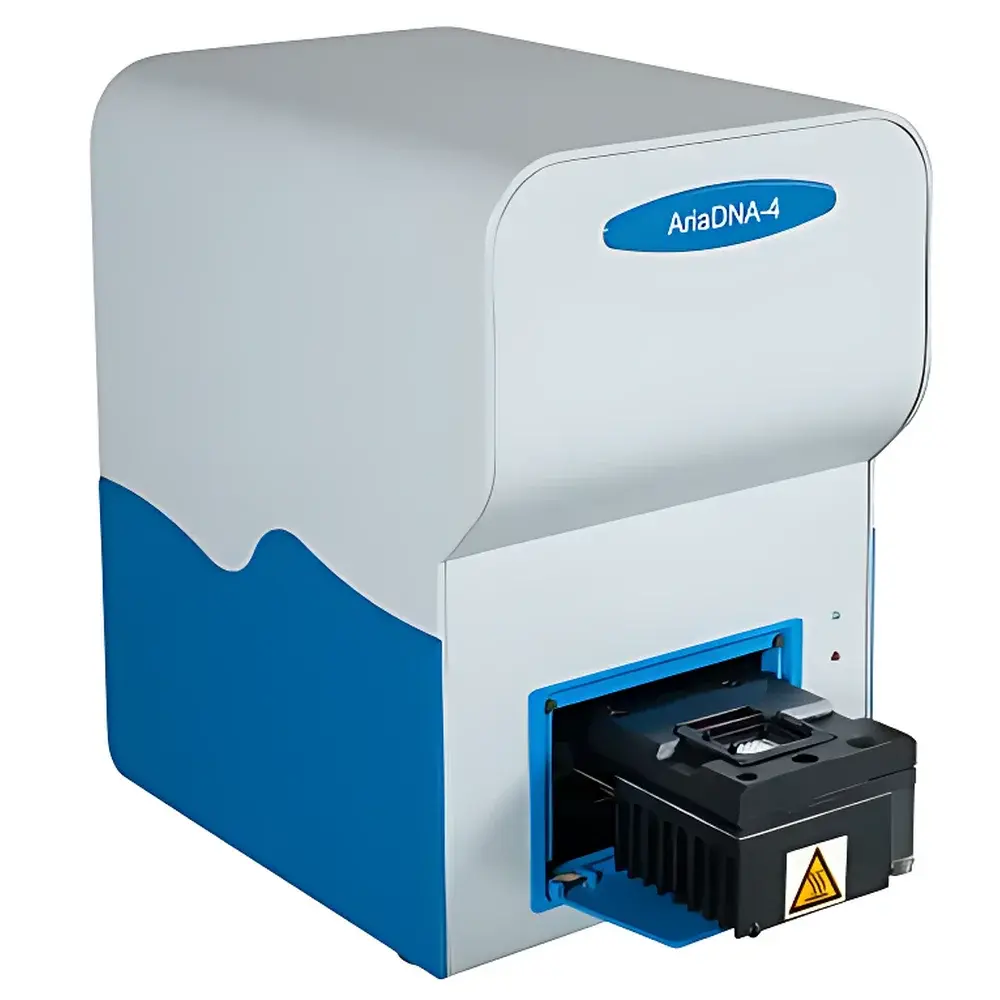
LUMEX AriaDNA-4 Real-Time Fluorescent Quantitative PCR System
| Brand | LUMEX |
|---|---|
| Origin | Canada |
| Model | AriaDNA-4 |
| Instrument Type | Real-Time Fluorescent Quantitative PCR System |
| Sample Throughput | 48-well microchip format |
| Heating Rate | 7 °C/s |
| Cooling Rate | 7 °C/s |
| Temperature Accuracy | ±0.1 °C |
| Inter-well Temperature Uniformity | <0.3 °C |
| Sample Volume per Reaction | 1–2 µL |
| Minimum Detectable Target | 1–5 DNA/RNA copies per microreactor |
| Thermal Range | 0–99 °C |
| Detection Channels | 4 (FAM/SYBR Green, HEX/VIC, ROX, Cy5) |
| Power Consumption | 100 W |
| Dimensions | 185 × 260 × 285 mm |
Overview
The LUMEX AriaDNA-4 Real-Time Fluorescent Quantitative PCR System is an integrated, chip-based thermal cycler engineered for high-precision nucleic acid quantification using real-time fluorescence detection. Unlike conventional block-based PCR instruments, the AriaDNA-4 employs a monolithic silicon microchip platform that integrates thermal control, optical excitation, and emission detection in a single disposable cartridge. This architecture enables rapid thermal cycling—achieving heating and cooling rates of 7 °C/s—while maintaining exceptional temperature uniformity (<0.3 °C across 48 microreactors) and accuracy (±0.1 °C). The system operates on the principle of sequence-specific fluorescent probe hybridization (e.g., hydrolysis probes) or intercalating dye binding (e.g., SYBR Green), with real-time signal acquisition synchronized to each amplification cycle. By continuously monitoring fluorescence intensity during extension phases, the AriaDNA-4 generates quantitative amplification curves, enabling accurate determination of the threshold cycle (Ct)—a rigorously defined, instrument-independent parameter directly proportional to the logarithm of initial target copy number. Its design supports both absolute and relative quantification workflows compliant with MIQE (Minimum Information for Publication of Quantitative Real-Time PCR Experiments) guidelines.
Key Features
- Monolithic 48-well microfluidic chip with pre-applied, lyophilized PCR reagents—eliminates pipetting errors and cross-contamination risks
- Ultra-low sample consumption: 1–2 µL per reaction, paired with only 0.5–1 µL of master mix
- Four independent optical channels supporting multiplex detection with FAM/SYBR Green, HEX/VIC, ROX, and Cy5 dyes
- Integrated thermal control with bidirectional 7 °C/s ramping and precise dwell stabilization at all setpoints (0–99 °C)
- On-board real-time data acquisition with cycle-by-cycle fluorescence logging, Ct calculation, and amplification efficiency estimation
- Compact benchtop footprint (185 × 260 × 285 mm) and low power draw (≤100 W) suitable for shared labs and field-deployable molecular diagnostics units
Sample Compatibility & Compliance
The AriaDNA-4 accommodates standard nucleic acid templates—including genomic DNA, cDNA, synthetic oligonucleotides, and RNA (with prior reverse transcription)—across diverse biological matrices: clinical swabs, serum, tissue homogenates, food extracts, environmental water filtrates, and agricultural samples. Its sealed microchip architecture ensures complete physical isolation between reaction chambers and ambient environment, satisfying biosafety Level 2 (BSL-2) containment requirements for pathogen detection. The system supports assay development and validation under ISO/IEC 17025:2017 and CLIA-compliant laboratory frameworks. When operated with validated assays, it meets analytical performance criteria outlined in FDA Guidance for Industry: Molecular Diagnostic Devices for Infectious Diseases (2022) and EU IVDR Annex I general safety and performance requirements. Data integrity is preserved via audit-trail-enabled software adhering to ALCOA+ principles (Attributable, Legible, Contemporaneous, Original, Accurate, Complete, Consistent, Enduring, Available).
Software & Data Management
Controlled exclusively via external Windows-based PC, the AriaDNA-4 runs proprietary LUMEX PCR Analysis Suite v4.x—a GxP-ready application featuring role-based user access, electronic signatures, and full 21 CFR Part 11 compliance (including audit trail, electronic records retention, and change control). The software provides real-time visualization of amplification curves, melting curve analysis, multi-channel overlay, baseline correction algorithms, and automatic Ct calling with user-adjustable thresholds. All raw fluorescence values, thermal profiles, and metadata are stored in encrypted SQLite databases with configurable backup policies. Export options include CSV, PDF reports (with customizable templates), and XML-compatible results files compatible with LIMS integration. Batch processing, plate layout mapping, and QC flagging (e.g., no-template control deviation, inhibition index) are supported for high-throughput diagnostic laboratories.
Applications
The AriaDNA-4 delivers validated performance in regulated and research settings requiring rapid, reproducible nucleic acid quantification. Key use cases include: clinical virology (HBV, HCV, HIV-1, SARS-CoV-2, avian influenza subtypes); veterinary diagnostics (NDV, FMDV, CSFV, Brucella spp., IBDV, VHSV); food safety testing (Salmonella enterica, Shigella spp., Listeria monocytogenes, GMO screening and copy-number quantification); environmental microbiology (Cryptosporidium parvum, Giardia lamblia); and agricultural pathology (Phytophthora infestans, Clavibacter michiganensis, Potato leafroll virus, Globodera pallida). Its sensitivity (1–5 copies/reaction) and speed (20–30 min for 45 cycles) make it particularly suited for point-of-need molecular surveillance in resource-limited settings where cold-chain stability and operator training constraints exist.
FAQ
Is the AriaDNA-4 compatible with third-party qPCR master mixes?
Yes—though optimal performance and contamination control are achieved using LUMEX’s pre-formulated, lyophilized chips; open-tube protocols are supported via custom chip loading.
Does the system support melt curve analysis?
Yes—post-amplification high-resolution melting (HRM) is enabled across all four detection channels with programmable ramp rates from 0.01 to 0.5 °C/s.
What regulatory documentation is provided for clinical deployment?
LUMEX supplies a comprehensive Technical File aligned with IVDR Class D requirements, including risk management report (ISO 14971), verification/validation protocols, and IFU translations in EN, FR, DE, and ES.
Can the instrument be integrated into automated laboratory workflows?
The AriaDNA-4 supports RS-232 and Ethernet communication protocols, enabling bidirectional command exchange with robotic liquid handlers and LIS systems via HL7 or ASTM E1384 interfaces.
How is calibration verified and maintained?
Each instrument ships with NIST-traceable thermal and optical calibration certificates; annual recalibration services include thermocouple mapping, LED intensity profiling, and spectral filter verification per ISO/IEC 17025.



