
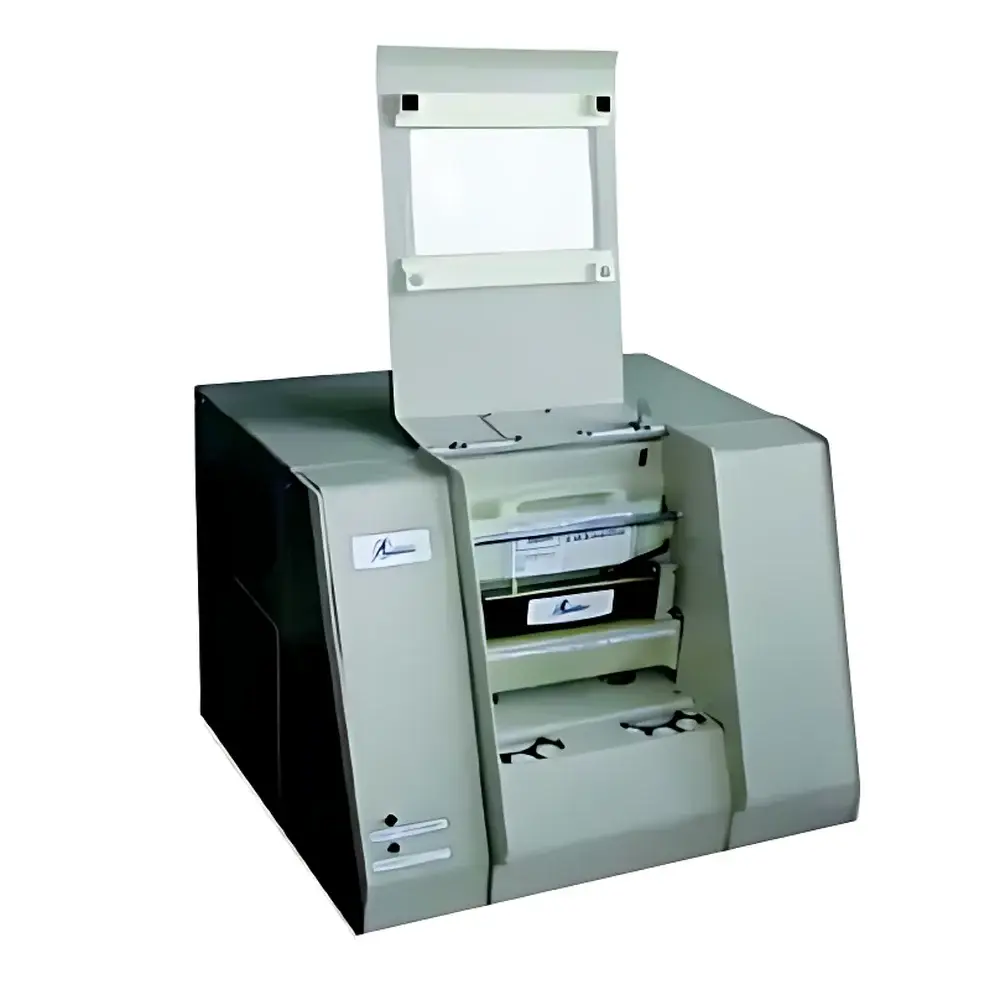
LUMEX Capel-105 Capillary Electrophoresis System
| Brand | LUMEX |
|---|---|
| Origin | Tianjin, China |
| Manufacturer Type | Authorized Distributor |
| Country of Assembly | China |
| Model | Capel-105 |
| Instrument Type | Capillary Electrophoresis (CE) System |
| Sample Analysis | Inorganic Ions, Small Molecules, Biomolecules |
| Operating Voltage | 1–25 kV (1 kV step increment, polarity auto-switching) |
| Detection | UV Absorbance (190–380 nm) |
| Light Source | High-Intensity Deuterium Lamp |
| Injection Mode | Pressure or Electrokinetic |
| Pressure Range | 0–99 mbar (step resolution: 1 mbar) |
| Electrokinetic Injection Voltage | 1–25 kV (1 kV step) |
| Capillary Cooling | Liquid-Cooled Thermostatic System |
| Temperature Control Range | –10 °C to +30 °C (±0.1 °C stability) |
| Capillary Dimensions | 30–100 cm length × 50/75/100 µm ID |
| Current Range | 0–200 µA |
| Flushing Pressure | 0–1000 / 2000 mbar |
| Power Consumption | 200 W |
| Dimensions | 500 × 500 × 500 mm |
| Weight | 25 kg |
| Compliance | Designed for GLP-compliant laboratories |
Overview
The LUMEX Capel-105 Capillary Electrophoresis System is a high-performance, modular CE platform engineered for precision separation of inorganic ions, organic acids, amino acids, pharmaceuticals, and small biomolecules. It operates on the fundamental principle of capillary electrophoresis—where analytes migrate under a high-voltage electric field (1–25 kV) through a fused-silica capillary filled with electrolyte buffer. Separation resolution is governed by differences in electrophoretic mobility (charge-to-size ratio) and electroosmotic flow (EOF), enabling baseline resolution of structurally similar species in sub-minute run times. The system integrates a thermally stabilized liquid-cooling module, ensuring capillary temperature uniformity within ±0.1 °C across the full operational range (–10 °C to +30 °C), which directly enhances migration time reproducibility and peak shape fidelity—critical for quantitative regulatory applications.
Key Features
- High-stability liquid-cooled thermostatic system eliminates thermal gradients along the capillary, minimizing band broadening and improving inter-run precision (RSD < 1.5% for migration time, typical)
- Dual-mode injection capability: pressure-driven (0–99 mbar, 1 mbar resolution) and electrokinetic (1–25 kV, 1 kV step), supporting method flexibility for diverse sample matrices
- UV-Vis detection with deuterium lamp source (190–380 nm), optimized optical path design for low detection limits (typical LOD: 0.1–1.0 µM for common inorganic cations/anions)
- Automated capillary conditioning and rinsing via programmable pressure flushing (0–2000 mbar), reducing carryover and extending capillary lifetime
- Fully computer-controlled operation via Elforun software—supporting method development, sequence execution, real-time monitoring, and compliance-ready data handling
- Modular architecture with interchangeable capillaries (30–100 cm × 50/75/100 µm ID), compatible with multiple CE modes: CZE, MEKC, CIEF, CGE, and CITP
Sample Compatibility & Compliance
The Capel-105 accommodates aqueous samples with minimal pretreatment—ideal for environmental water extracts, food digestates, pharmaceutical formulations, and biological fluids (e.g., serum, urine). It supports direct analysis of cations (Na⁺, K⁺, Ca²⁺, Mg²⁺, NH₄⁺), anions (Cl⁻, NO₃⁻, SO₄²⁻, PO₄³⁻), organic acids (citrate, malate, lactate), amino acids, preservatives (benzoate, sorbate), and antioxidants (ascorbic acid, tocopherols). All hardware and software components are designed to meet essential requirements for regulated environments: temperature and voltage parameters are logged with timestamps; Elforun enforces role-based user authentication, electronic signatures, and immutable audit trails aligned with FDA 21 CFR Part 11 and ISO/IEC 17025 documentation standards. The system is routinely validated for use in laboratories adhering to ASTM D6919 (anion analysis in water), USP <1058>, and EU Pharmacopoeia 2.2.47 methods.
Software & Data Management
Elforun is a dedicated, Windows-based CE control and analysis suite offering intuitive workflow management without requiring scripting expertise. It includes preconfigured methods for common applications (e.g., “Drinking Water Anions”, “Wine Organic Acids”, “Pharmaceutical Counterions”) and allows full parameter customization—including voltage ramping, dynamic temperature profiling, multi-wavelength detection, and sequential injection protocols. Chromatograms and electropherograms are processed using baseline correction, peak integration (tangent skim, valley-to-valley), and calibration curve generation (linear, quadratic, or weighted). Raw data (.cef format) and reports are exportable to CSV, PDF, Excel, and XML—ensuring compatibility with LIMS and enterprise QA/QC systems. All user actions, method changes, and instrument events are recorded in a tamper-evident audit log, supporting GLP/GMP traceability and internal audit readiness.
Applications
The Capel-105 delivers robust performance across regulated and research-intensive domains. In environmental labs, it quantifies inorganic ions and pesticides in surface water, wastewater, and soil leachates per EPA Method 300.0 and ISO 10304-1. Food and beverage testing includes simultaneous determination of cations/anions in mineral water, organic acids and sulfites in wine and beer, caffeine and catechins in tea/coffee, and melamine in dairy products. In pharmaceutical QC, it resolves chiral impurities, counterions in APIs, and degradation products in stability studies. Biomedical applications include hemoglobin variant profiling (CZE mode), amino acid analysis in clinical nutrition panels, and protein charge heterogeneity assessment. Industrial process monitoring—such as catalyst ion leaching in chemical synthesis or electrolyte composition in battery R&D—is enabled by rapid (<3 min), repeatable separations with minimal solvent consumption (<1 mL/run).
FAQ
What CE separation modes does the Capel-105 support?
It natively supports capillary zone electrophoresis (CZE), micellar electrokinetic chromatography (MEKC), capillary isoelectric focusing (CIEF), capillary gel electrophoresis (CGE), and capillary isotachophoresis (CITP) through configurable voltage profiles, buffer selection, and detection settings.
Is the system compliant with FDA 21 CFR Part 11?
Yes—Elforun software provides electronic signatures, audit trail logging, user access levels, and data integrity controls required for Part 11 compliance in regulated pharmaceutical and clinical laboratories.
What is the minimum detectable concentration for common inorganic ions?
Under optimized conditions (254 nm, 50 µm ID capillary, 50 cm effective length), typical LODs range from 0.1 µM (Na⁺, Cl⁻) to 0.5 µM (Ca²⁺, SO₄²⁻), depending on matrix complexity and injection volume.
Can the Capel-105 be integrated into a laboratory automation workflow?
Yes—it features RS-232 and USB interfaces for remote command execution and status polling, enabling integration with robotic sample handlers and centralized LIMS platforms via standard ASCII protocol commands.
What maintenance is required for long-term reliability?
Routine maintenance includes daily capillary rinsing with NaOH and water, quarterly optical window cleaning, annual deuterium lamp replacement, and biannual calibration of pressure and voltage sensors using NIST-traceable reference standards.





