
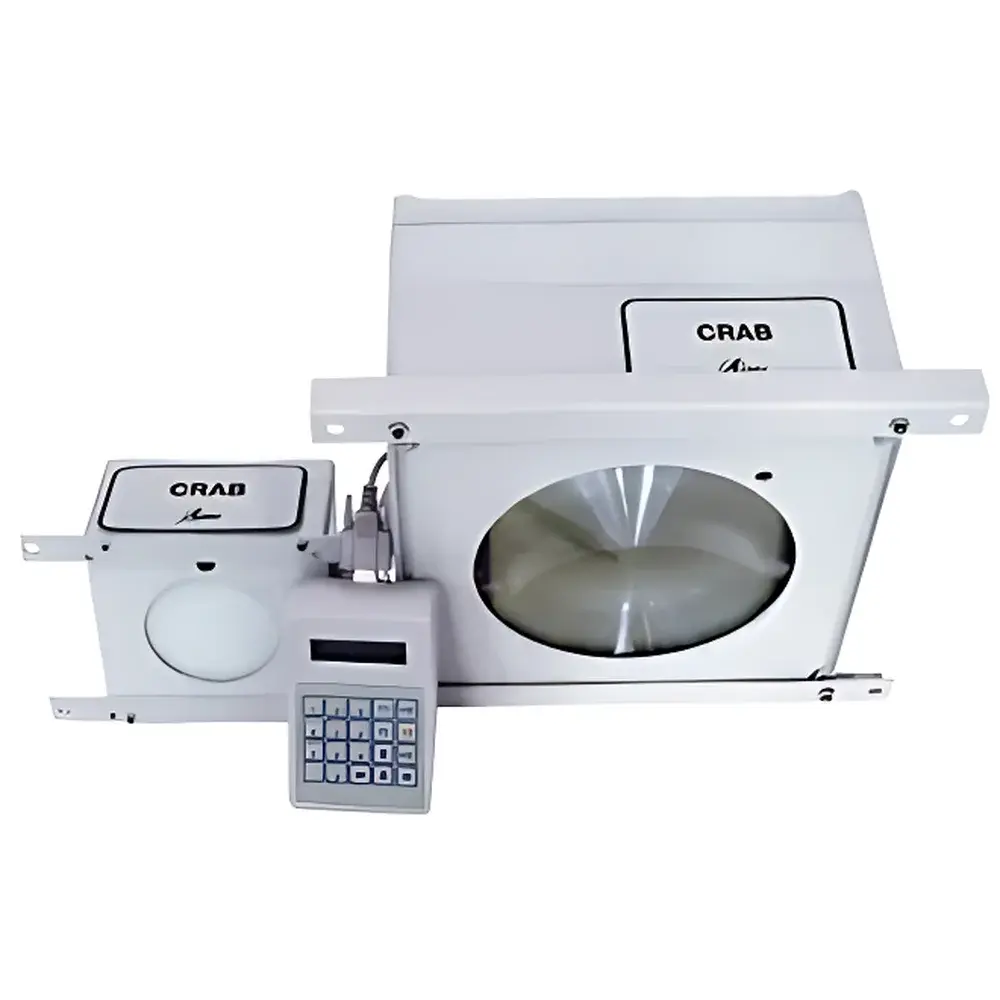
LUMEX CRAB Online Oil Film Monitor
| Brand | LUMEX |
|---|---|
| Origin | Russia |
| Model | CRAB |
| Type | Online Oil Film Monitoring System |
| Measurement Range | 0–111 mg/L (as mineral oil, typical calibration) |
| Detection Limit | 0.2 mg/L |
| Accuracy | ±1 mg/L |
| Resolution | 0.1 mg/L |
| Measurement Frequency | 1 Hz |
| Minimum Detectable Oil Film Thickness | ≥0.5 µm |
| Maximum Sensor-to-Water Distance | 25 m |
| Maximum Communication Distance (RS485) | 300 m |
| Operating Temperature | −10 to +50 °C |
| Relative Humidity | Up to 100% |
| Power Supply | 187–242 VAC, 50 Hz |
| Power Consumption | 20 W |
| Dimensions | 160 × 160 × 110 mm |
| Weight | 2 kg |
| Optical Field Tilt Tolerance | ±20° |
| Communication Interfaces | RS232, RS485 |
| Alarm Output | Relay + Visual/Audible Alert |
| Mounting Options | Fixed, pendant, angled, or UAV-integrated |
Overview
The LUMEX CRAB Online Oil Film Monitor is an industrial-grade, non-contact optical remote sensing instrument engineered for continuous, real-time detection and monitoring of surface oil films on open water bodies. It operates on the physical principle of differential infrared reflectance: hydrocarbon-based oil films alter the specular reflection characteristics of water surfaces in the near-infrared (NIR) spectrum (typically 1.2–1.7 µm), enabling reliable discrimination between clean water and even sub-micron-thick oil layers. Unlike extractive or laboratory-based methods (e.g., gravimetric or fluorescence analysis), the CRAB system performs direct, in-situ measurement without sample collection, reagent use, or physical contact—eliminating cross-contamination risk, maintenance downtime, and analytical delay. Designed for permanent outdoor deployment in wastewater outfalls, industrial cooling water intakes, port zones, riverine transit corridors, and offshore platforms, it meets the operational rigor required under ISO 17025-aligned environmental monitoring programs and supports compliance with national regulatory frameworks mandating petroleum hydrocarbon surveillance—including China’s HJ 970-2018 (determination of petroleum in water by infrared spectrophotometry) and EU Water Framework Directive Annex V monitoring protocols.
Key Features
- Non-invasive NIR remote sensing with no consumables, zero sampling, and no chemical reagents
- High-sensitivity detection of floating oil films down to ≥0.5 µm thickness—equivalent to ~0.2 mg/L aqueous-phase equivalent concentration for light mineral oils
- Optimized optical path design with intensity modulation to suppress interference from wind-induced surface roughness, solar glint, and ambient lighting variations
- Robust mechanical housing rated IP67, enabling operation across full humidity (0–100% RH) and temperature ranges (−10 to +50 °C)
- Modular architecture supporting daisy-chained multi-sensor networks via RS485 (up to 300 m cable length), enabling spatially resolved oil spill mapping and dynamic plume tracking
- Integrated dual-stage alarm: programmable threshold-triggered relay output plus local audible/visual alert with “YES”/“NO” status indication
- Sub-100 ms response time (<0.1 s), ensuring rapid incident recognition during transient leakage events
- Flexible mounting options—including fixed bracket, suspended mast, downward-tilt configuration, and integration onto autonomous surface vehicles (ASVs) or drones
Sample Compatibility & Compliance
The CRAB monitor detects free-phase hydrocarbon films—including diesel, gasoline, lubricating oils, crude oil, and refined mineral oils—on freshwater, brackish, and seawater surfaces. It does not quantify dissolved or emulsified hydrocarbons; its domain is strictly surface-confined, optically reflective oil layers. The system complies with electromagnetic compatibility standards (IEC 61326-1), safety requirements (IEC 61010-1), and environmental operating specifications per IEC 60721-3-3 (Class 3K5). While not certified to US EPA Method 1664 or ASTM D3921, its performance envelope aligns with field validation benchmarks used in ISO/IEC 17025-accredited laboratories for screening-level oil-in-water surveillance. Data logging and alarm records support audit-ready documentation for GLP-compliant environmental reporting and internal EHS management systems.
Software & Data Management
The CRAB operates autonomously via embedded ARM-based processor with onboard data acquisition, real-time signal processing, and configurable threshold logic. Communication occurs over standard serial interfaces (RS232/RS485), enabling seamless integration into SCADA, DCS, or custom IoT telemetry platforms. Optional Bluetooth module allows local commissioning and diagnostic access without physical cabling. Firmware supports user-defined averaging windows, alarm hysteresis, and event-triggered snapshot storage. All raw reflectance values, processed oil presence flags, timestamps, and system health metrics are timestamped and exportable in CSV or Modbus TCP format. Audit trail functionality—including operator login, parameter changes, and alarm acknowledgments—is available when deployed with compatible supervisory software compliant with FDA 21 CFR Part 11 requirements (electronic signatures, data integrity controls).
Applications
- Continuous monitoring of effluent discharge points at petrochemical plants, refineries, and metalworking facilities
- Early warning surveillance at municipal wastewater treatment plant outfalls and combined sewer overflows (CSOs)
- Port authority oil spill contingency planning and harbor entrance monitoring
- Environmental impact assessment (EIA) baseline studies and post-incident plume delineation
- Integration into automated leak detection systems for above-ground storage tank (AST) bunds and pipeline right-of-ways
- Research-grade field validation of oil dispersion models and bioremediation kinetics
FAQ
Does the CRAB require calibration with reference oil standards?
No—factory calibration is performed using traceable mineral oil reference films; field recalibration is not required under normal operating conditions. Drift verification can be conducted annually using built-in self-test routines.
Can the CRAB distinguish between oil types (e.g., diesel vs. crude)?
No—it detects hydrocarbon film presence and relative thickness but does not perform spectral identification or compositional classification.
What is the maximum allowable wave height for reliable detection?
The system maintains functional accuracy up to significant wave height (SWH) of 0.3 m, supported by tilt compensation within ±20° and adaptive signal filtering.
Is explosion-proof certification available?
Standard units carry CE and RoHS markings; ATEX or IECEx variants are available upon request for Zone 1/2 hazardous area deployment.
How is data security ensured during remote transmission?
Raw serial communication is unencrypted; secure data transport requires integration with external TLS-enabled gateways or industrial firewalls—consistent with ISA/IEC 62443 Level 1 guidelines.







