
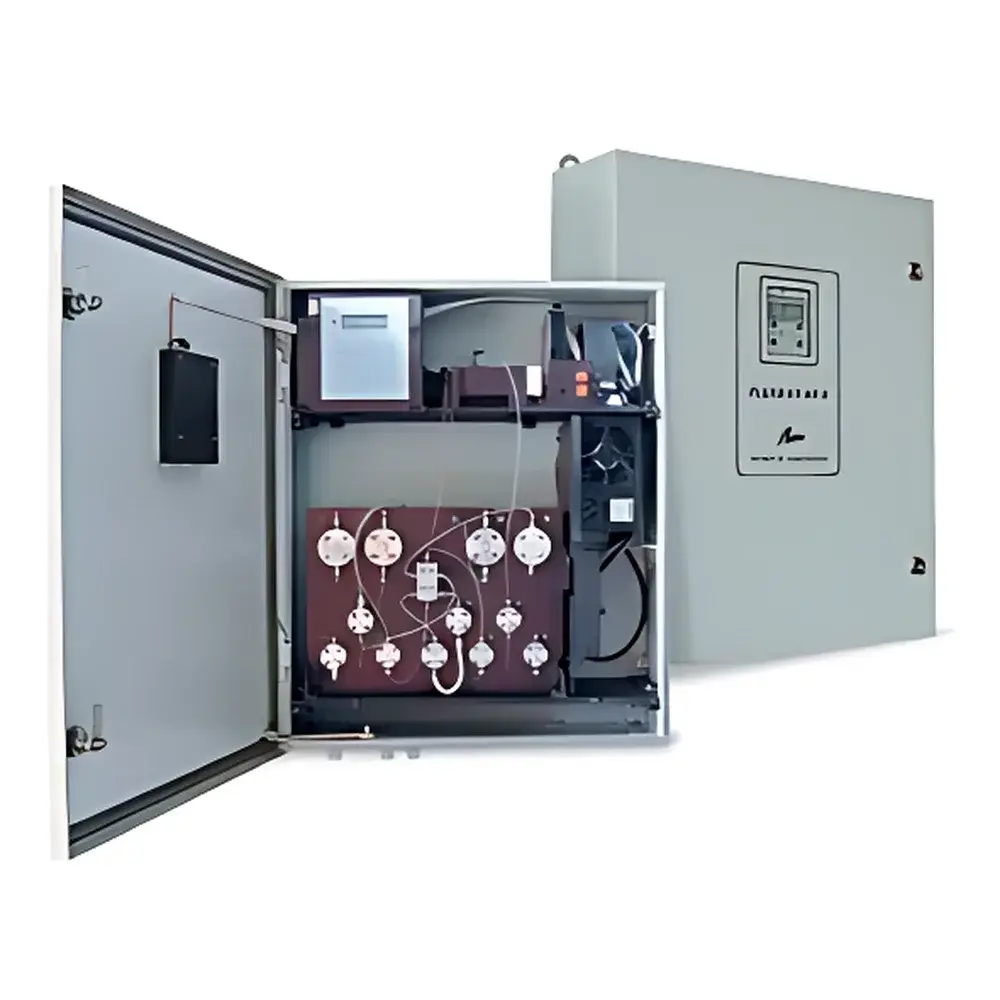
LUMEX Fluorat-AE-2 Online Oil-in-Water Analyzer
| Brand | LUMEX |
|---|---|
| Origin | Russia |
| Model | Fluorat-AE-2 |
| Instrument Type | Online |
| Measurement Principle | UV Fluorescence with Patented Signal Separation Technology |
| Measurement Range | 0.001–500 mg/L |
| Detection Limit | 0.01 mg/L |
| Accuracy | <2% |
| Resolution | 0.1 mg/L |
| Measurement Frequency | 8 samples/hour |
| Sample Input | Up to 10 parallel aqueous streams |
| Power Supply | 187–242 VAC, 50 ±1 Hz / 12 VDC |
| Power Consumption | 100 W |
| Dimensions | 500 × 660 × 200 mm |
| Weight | 50 kg |
Overview
The LUMEX Fluorat-AE-2 Online Oil-in-Water Analyzer is an industrial-grade, continuous-monitoring instrument engineered for precise quantification of petroleum hydrocarbons—including crude oil, refined fuels (gasoline, diesel), lubricants, hydraulic oils, and aromatic compounds (e.g., benzene, toluene, phenol, styrene)—in aqueous matrices. It operates on the principle of ultraviolet-induced fluorescence (UVF), enhanced by LUMEX’s proprietary optical signal separation technology. Unlike conventional online fluorometers that report total fluorescence—confounded by natural organic matter (NOM), humic substances, or particulate autofluorescence—the Fluorat-AE-2 selectively isolates the characteristic fluorescence signature of petroleum-derived aromatics via spectral and kinetic discrimination. This enables true petroleum hydrocarbon measurement in complex environmental and industrial waters without chemical extraction or solvent-intensive pre-treatment. The system integrates fully automated sample handling, on-line oil–water phase separation, real-time signal processing, and self-cleaning cycles—making it suitable for unattended, long-term deployment in regulatory compliance, process control, and early-warning monitoring applications.
Key Features
- Patented UV fluorescence signal separation technology: Discriminates petroleum hydrocarbon fluorescence from background NOM and turbidity-related interference, ensuring measurement specificity.
- Sub-ppb detection capability: Achieves a practical limit of detection of 0.01 mg/L (10 µg/L) for aromatic hydrocarbons in clean and moderately turbid waters.
- Continuous multi-stream monitoring: Supports up to 10 independent water intake lines with programmable sampling sequence and individual calibration tracking.
- Fully automated operation: Includes integrated peristaltic sampling, membrane-based oil–water separation, solvent (n-hexane) regeneration and recirculation, and automatic system flush cycles.
- Robust industrial design: IP65-rated enclosure, corrosion-resistant wetted materials (e.g., PTFE, quartz, stainless steel 316), and thermal stabilization for stable performance across ambient temperatures from 5°C to 40°C.
- Low operational cost: Eliminates need for consumable reagents beyond initial solvent fill; n-hexane recovery efficiency exceeds 92%, reducing annual solvent consumption by >80% versus batch-extraction methods.
Sample Compatibility & Compliance
The Fluorat-AE-2 is validated for use with surface water, groundwater, drinking water sources, cooling water (including nuclear plant secondary loops), boiler feedwater, condensate, produced water, refinery effluents, and stormwater runoff. It complies with methodological principles aligned with ASTM D7678 (Standard Test Method for Determination of Aromatic Hydrocarbons in Water by Fluorescence), ISO 9562 (Petroleum products — Determination of aromatic hydrocarbons), and supports data integrity requirements under EPA Method 1664B (when used as a screening tool prior to gravimetric confirmation). Its audit-ready data logging meets GLP and GMP documentation expectations, including time-stamped events, calibration history, fault diagnostics, and user-access logs—facilitating readiness for regulatory inspections under EU Water Framework Directive (WFD) reporting or US EPA NPDES permit monitoring.
Software & Data Management
The analyzer runs embedded Linux-based firmware with a web-accessible interface (HTTPS-enabled) and local 7-inch TFT touchscreen. Data acquisition occurs at 1 Hz resolution, with configurable averaging intervals (1–60 min) and auto-scaling dynamic range. All measurements are timestamped, tagged with sample ID and stream source, and stored internally (8 GB flash memory, ≥18 months of 5-min data). Export formats include CSV, XML, and MODBUS TCP. Communication protocols supported: RS-232, RS-485 (Modbus RTU), isolated 4–20 mA analog output (user-configurable range), and optional Ethernet/IP integration. Software features include remote firmware updates, scheduled self-diagnostics, drift compensation algorithms, and alarm thresholds with email/SMS notification via external gateway. Audit trails comply with FDA 21 CFR Part 11 requirements when deployed with validated third-party SCADA or LIMS interfaces.
Applications
- Regulatory discharge monitoring: Real-time compliance tracking at national key pollution sources, wastewater treatment plant outfalls, and offshore oil platform discharge points (IMO MEPC.107(49)-compliant).
- Cooling and steam cycle integrity: Early leak detection in heat exchangers, condensers, and turbine lube oil systems in thermal and nuclear power plants.
- Source water protection: Continuous surveillance of rivers, reservoirs, and aquifer recharge zones near petrochemical facilities or transport corridors.
- Industrial process control: Monitoring metalworking fluid concentration, desalination pretreatment efficacy, and bilge water cleanliness aboard vessels (MEPC.251(66)-certified configurations available).
- Emergency response: Rapid deployment for spill impact assessment in coastal zones, harbors, and flood-prone urban watersheds.
FAQ
Does the Fluorat-AE-2 require daily manual calibration?
No. The system performs automatic zero and span verification using internal reference standards every 24 hours; field calibration is recommended only quarterly or after maintenance.
Can it distinguish between diesel and gasoline in mixed contamination scenarios?
It reports total extractable petroleum hydrocarbons (EPH) in the aromatic fraction; compound-specific identification requires GC-MS. However, its excitation–emission matrix (EEM) profiling supports semi-quantitative fingerprinting when coupled with multivariate calibration models.
Is the instrument compatible with hazardous area classifications (e.g., ATEX Zone 2)?
The standard unit is rated for non-hazardous environments; explosion-proof variants (ATEX II 2G Ex db IIB T4 Gb) are available upon request with customized housing and purge systems.
What maintenance is required beyond solvent replenishment?
Annual replacement of the UV lamp (254 nm, low-pressure Hg), quartz flow cell cleaning, and verification of membrane separation efficiency—typically requiring <2 person-hours per year.
How does it handle high-suspended-solids or emulsified oil samples?
Integrated inline filtration (50 µm) and coalescing membrane separation ensure consistent phase isolation; for highly emulsified streams, optional ultrasonic pre-treatment modules can be added to improve recovery accuracy.
Related Products







