
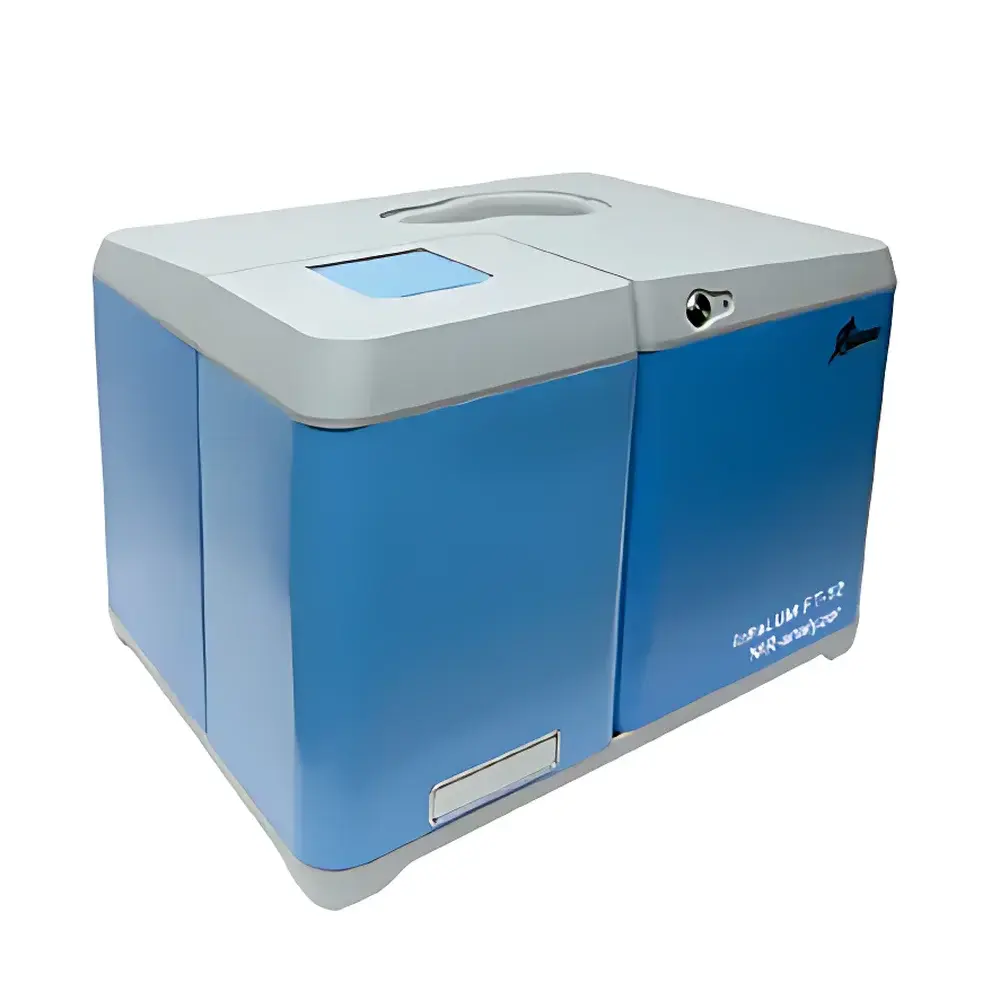
LUMEX InfraLUM FT-12 Fourier Transform Near-Infrared Spectrometer
| Brand | LUMEX |
|---|---|
| Origin | Russia |
| Manufacturer Type | Authorized Distributor |
| Instrument Type | Laboratory |
| Model | InfraLUM FT-12 |
| Wavelength Range | 760–1150 nm |
| Spectral Resolution | 8 / 16 / 32 / 64 cm⁻¹ |
| Sampling Mode | Diffuse Reflectance / Transmission |
| Data Acquisition Interval | 1 cm⁻¹ |
| Scan Speed | 1 spectrum per second |
| Sample Volume | 50 mL |
| Analysis Time | ≤90 s |
| Dimensions | 530 × 450 × 380 mm |
| Weight | 32 kg |
| Power Supply | 220 V AC, 50 Hz |
| Power Consumption | 110 W |
| Chemometrics Software | RIM (with PARCLE integration) |
Overview
The LUMEX InfraLUM FT-12 is a laboratory-grade Fourier Transform Near-Infrared (FT-NIR) spectrometer engineered for high-reproducibility quantitative and qualitative analysis across agri-food, feed, oilseed, dairy, and petrochemical industries. It operates on the principle of interferometric spectral acquisition—using a Michelson-type interferometer to generate high-fidelity interferograms, which are Fourier-transformed into absorbance spectra in the 760–1150 nm range (8700–13200 cm⁻¹). This spectral window targets overtones and combination bands of C–H, N–H, and O–H bonds, enabling robust prediction of moisture, protein, fat, fiber, starch, ash, and metabolizable energy without chemical reagents or sample digestion. Unlike dispersive NIR systems, the FT architecture delivers inherent wavelength accuracy, superior signal-to-noise ratio (SNR), and long-term photometric stability—critical for method transfer and regulatory compliance in GLP/GMP environments.
Key Features
- Modular optical design with thermally stabilized interferometer and InGaAs detector for consistent performance across ambient temperature fluctuations (15–30 °C).
- Selectable spectral resolution (8, 16, 32, or 64 cm⁻¹) optimized for trade-offs between spectral detail and acquisition speed—enabling rapid screening (<90 s per sample) without compromising model validity.
- Integrated dual-path sampling interface supporting both transmission (for liquids, oils, slurries) and diffuse reflectance (for grains, pellets, powders, whole kernels) with standardized cuvette and cup holders.
- No sample preparation required for intact grain analysis—enabling non-destructive, whole-kernel measurement of wheat, corn, soybean, rapeseed, sunflower, oats, and rye.
- Pre-loaded, application-specific calibration models—including universal feed, cereal, oilseed, and dairy modules—validated against reference ASTM D6342 (moisture), AOAC 984.13 (crude protein), and ISO 15104 (oil content) methods.
- Fully open chemometrics architecture: native compatibility with PARCLE software for custom model development, validation (via SEP, RMSEP, R²), and cross-instrument transfer using standard .spc and .csv formats.
Sample Compatibility & Compliance
The InfraLUM FT-12 accommodates heterogeneous solid, semi-solid, and liquid matrices—including whole grains (wheat, barley, corn), ground meals, DDGS, fishmeal, soybean meal, rapeseed cake, milk powder, cheese, meat emulsions, biodiesel, and refined petroleum fractions. Its optical path geometry and automated background correction ensure minimal interference from particle size variation or surface heterogeneity. The system complies with ISO/IEC 17025 requirements for analytical instrument qualification and supports full audit trails per FDA 21 CFR Part 11 when deployed with RIM’s secure user-role management. All factory calibrations are traceable to NIST SRM 1920a (polystyrene film) and certified via internal wavelength and photometric validation routines prior to shipment.
Software & Data Management
RIM (Robust Instrument Manager) is the embedded Windows-based control and chemometrics platform, featuring intuitive workflow-driven operation, real-time spectral visualization, outlier detection (Mahalanobis distance), and automated result reporting in PDF/Excel. It natively imports and exports PLS, PCR, and SVM regression models developed in PARCLE, Unscrambler, or MATLAB. Multi-instrument network deployment enables centralized calibration library management, version-controlled model distribution, and synchronized firmware updates across distributed QA labs. Data integrity safeguards include electronic signatures, session logging, and immutable raw-data archiving compliant with ALCOA+ principles (Attributable, Legible, Contemporaneous, Original, Accurate, Complete, Consistent, Enduring, Available).
Applications
- Feed & Grain Industry: Real-time verification of raw material specifications (e.g., corn moisture <14.5%, soy protein ≥38%), in-line blend uniformity checks, and finished feed compliance with AAFCO nutrient profiles.
- Oilseed Processing: Batch-wise quantification of oil content in sunflower, rapeseed, and soybeans; simultaneous monitoring of phospholipid levels in crude vegetable oils; and residual solvent detection in de-oiled meals.
- Dairy & Meat QA: Rapid assessment of dry matter, casein-to-whey ratio, and adulteration screening in milk powder; fat/protein profiling in minced meat and sausage formulations.
- Petrochemical QC: Prediction of cetane number, aromatic content, and oxidation stability in diesel fuel; ethanol blending verification in gasoline (E5–E15).
- Research & Method Development: Support for collaborative NIR method transfer studies under ICH Q5E guidelines; generation of primary reference datasets for multivariate statistical modeling.
FAQ
Is the InfraLUM FT-12 suitable for regulatory submissions?
Yes—when operated under validated SOPs with documented calibration, performance qualification (PQ), and data governance protocols aligned with ISO 17025 and FDA 21 CFR Part 11, its results support GLP/GMP documentation packages.
Can calibration models be transferred between different FT-12 units?
Yes—standardized optical alignment, interferometer phase correction, and RIM’s built-in instrument normalization algorithms enable direct model portability across instruments within the same LUMEX FT-NIR product family.
What maintenance is required beyond routine cleaning?
Annual interferometer alignment verification and detector dark-current characterization are recommended; no lamp replacement or grating recalibration is necessary due to solid-state laser reference and fixed-optic design.
Does the system support external automation interfaces?
Yes—it provides TCP/IP and RS-232 communication protocols for integration with LIMS, PLC-controlled sample handlers, and robotic autosamplers via Modbus or custom API scripting.
How is spectral drift compensated during extended operation?
The system performs automatic background acquisition every 30 minutes (configurable) and applies real-time offset correction using the internal reference beam path—ensuring baseline stability over 8+ hour continuous runs.





