
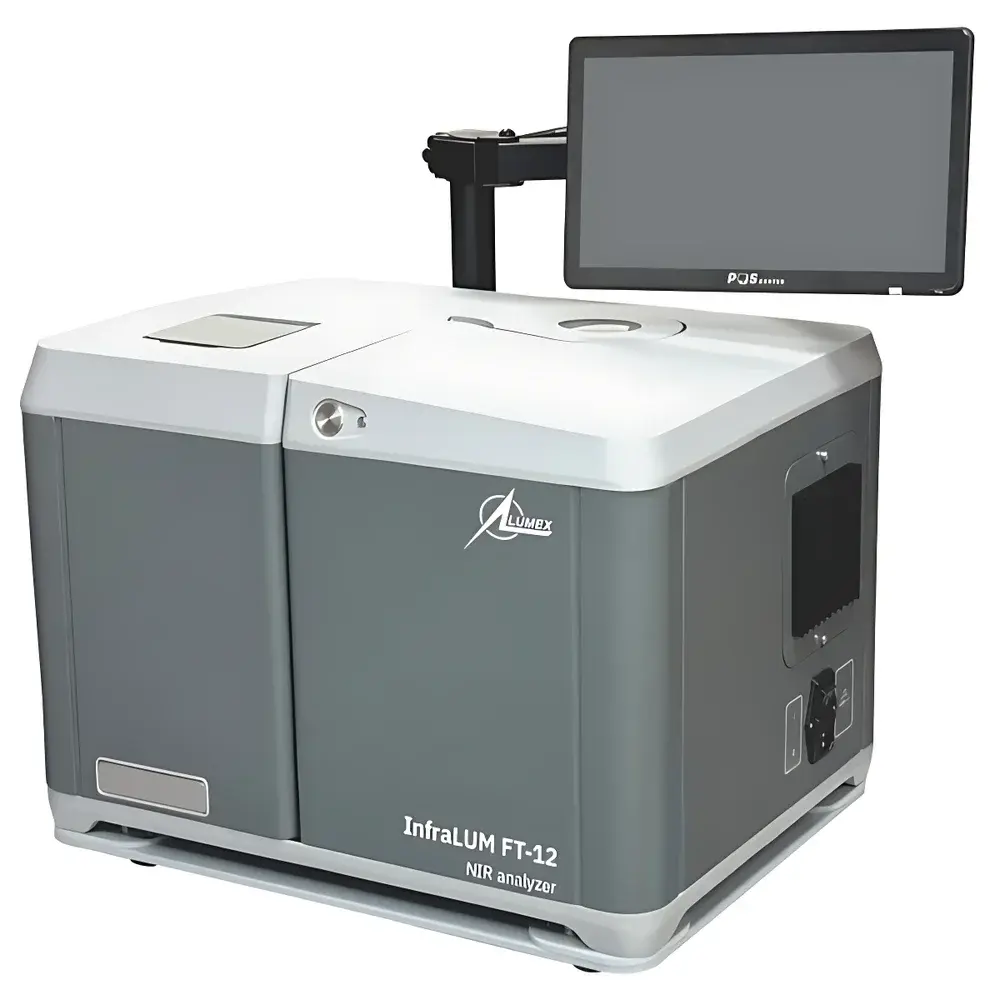
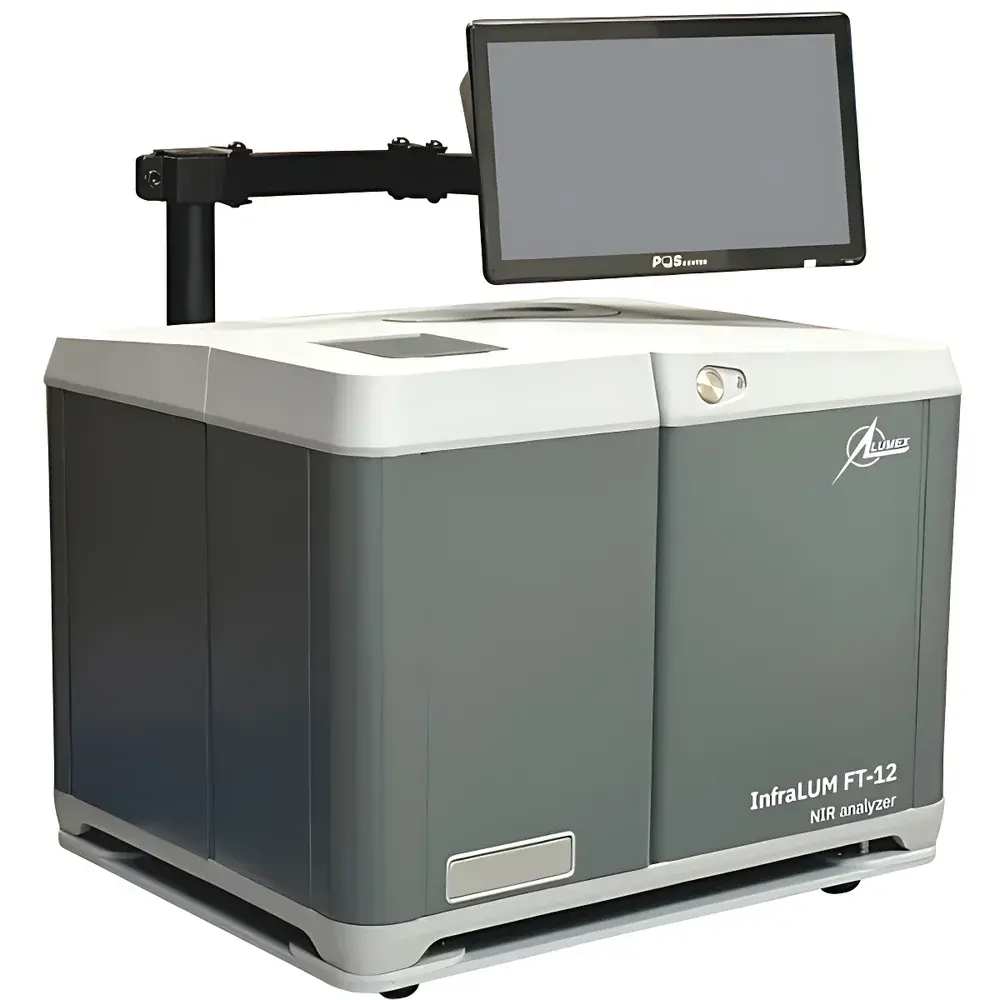
LUMEX InfraLUM FT-12 Industrial Fourier Transform Near-Infrared Spectrometer
| Brand | LUMEX |
|---|---|
| Origin | Canada |
| Model | InfraLUM FT-12 Industrial |
| Instrument Type | Laboratory |
| Principle | Fourier Transform (FT) NIR |
| Wavelength Range | 760–1150 nm |
| Measurement Mode | Transmission |
| Chemometrics Software | Parcel |
| Sample Compatibility | Liquid, semi-solid, and homogeneous solid samples in transmission cells |
| Compliance | Designed for GLP/GMP-aligned workflows |
Overview
The LUMEX InfraLUM FT-12 Industrial is a laboratory-grade Fourier Transform Near-Infrared (FT-NIR) spectrometer engineered for high-precision, routine quantitative analysis in industrial quality control environments. Based on Michelson interferometry with a permanently aligned optical path, the instrument delivers exceptional wavelength accuracy (< 0.05 nm), photometric stability (< 0.0005 AU/h), and long-term signal reproducibility—critical for calibration transfer across instruments and sites. Operating in the 760–1150 nm spectral window, it targets first-overtone C–H, O–H, and N–H vibrational absorptions, enabling rapid, non-destructive quantification of key compositional parameters without reagents or sample preparation. Its robust mechanical architecture—including vibration-damped optics, sealed interferometer housing with IP54-rated dust and moisture resistance, and thermally stabilized beam splitter—ensures operational reliability in demanding production laboratories, mobile QC units, or field-deployed settings where ambient temperature fluctuations or mechanical disturbances are common.
Key Features
- High-stability FT-NIR optical design with permanent alignment and no moving mirrors—eliminates periodic recalibration and maintains spectral fidelity over extended operation cycles.
- Transmission-based measurement geometry optimized for liquid and semi-liquid samples; compatible with standardized quartz or sapphire flow cells (1–50 mm pathlengths) to maximize signal-to-noise ratio and spectral information depth.
- Magnetic coupling and disposable cell interface options reduce cross-contamination risk and simplify cleaning protocols—essential for high-throughput screening of viscous or particulate-laden samples (e.g., crude oil fractions, dairy emulsions, soybean meal slurries).
- Integrated industrial-grade touch-panel PC (optional) with pre-installed Parcel chemometrics software enables standalone operation, real-time model inference, and local result export without external computing infrastructure.
- Modular mounting system supports benchtop, wall-mounted, or shock-isolated platform configurations—including optional active/passive anti-vibration bases compliant with ISO 20483 for mobile lab deployment.
- Instrument-to-instrument model transfer capability validated per ASTM E2862, ensuring consistent prediction performance across multi-site manufacturing networks.
Sample Compatibility & Compliance
The InfraLUM FT-12 Industrial accommodates a broad range of process-relevant matrices: transparent to semi-opaque liquids (gasoline, diesel, ethanol blends, milk, vegetable oils), suspensions (feed mash, protein concentrates), and compressed pellets (grain flour, polymer granules). All transmission measurements adhere to ISO 12099:2017 guidelines for NIR spectroscopic analysis in agriculture and food, while spectral acquisition parameters align with ASTM E1655-22 for multivariate calibration development. The system supports audit-ready data integrity through time-stamped spectral logging, user-access controls, and electronic signature-capable workflow modules—facilitating compliance with FDA 21 CFR Part 11 requirements when deployed in regulated pharmaceutical or nutraceutical QC labs.
Software & Data Management
Parcel chemometrics software provides a validated, intuitive environment for PLS (Partial Least Squares) regression modeling, outlier detection, spectral preprocessing (Savitzky-Golay smoothing, multiplicative scatter correction, derivative transformation), and validation against reference methods (e.g., GC, titration, HPLC). Calibration models are stored with full metadata—including instrument ID, operator, date, reference method traceability, and uncertainty estimates—enabling automated version control and GMP-compliant model lifecycle management. Raw spectra and prediction reports export in ASTM E1309-compliant .jdx format; integration with LIMS via OPC UA or CSV API is supported for enterprise-level data synchronization.
Applications
- Petroleum refining: Simultaneous prediction of octane number, benzene, olefins, aromatics, oxygenates, density, and cetane index in gasoline, diesel, and ethanol-blended fuels—replacing >90% of wet chemistry assays per ASTM D7793 and D7804.
- Grain & oilseed processing: Rapid determination of moisture, protein, oil, starch, and fiber in wheat, corn, soybean, and rapeseed at intake, storage, and milling stages—aligned with ISO 21508 and AACCI 46-15.
- Dairy & food manufacturing: Quantitative analysis of fat, protein, lactose, and solids-not-fat in raw milk, UHT milk, whey powder, and cheese curd—validated per IDF 141:2021 and AOAC 2016.01.
- Feed & biofuel production: Monitoring of residual solvent, glycerol, and FAME content in biodiesel; crude protein and amino acid profiles in soybean meal and distillers’ dried grains.
FAQ
What reference methods are required to develop a valid calibration model?
Calibration requires representative samples analyzed using definitive reference methods (e.g., ASTM D2699 for research octane number, ISO 1442 for meat protein) under GLP conditions. Minimum sample size depends on matrix heterogeneity but typically ranges from 80–200 specimens.
Can models built on one InfraLUM FT-12 be deployed directly on another unit?
Yes—inter-instrument transfer is enabled by built-in standardization algorithms and verified using ASTM E2862 transfer standards. Full model portability requires identical optical configuration and cell pathlength.
Is the system compatible with existing LIMS or ERP platforms?
Yes—via configurable CSV export, OPC UA server interface, or RESTful API for bidirectional data exchange with LabVantage, Thermo Fisher SampleManager, or SAP QM modules.
What maintenance is required beyond routine cleaning?
No optical alignment or lamp replacement is needed. Annual verification of wavelength accuracy and photometric linearity using NIST-traceable standards is recommended for ISO/IEC 17025 accreditation.
Does Parcel support collaborative model development across multiple sites?
Yes—Parcel’s centralized model repository allows secure cloud-based sharing, version comparison, and federated calibration updates with role-based access control.
Related Products




