
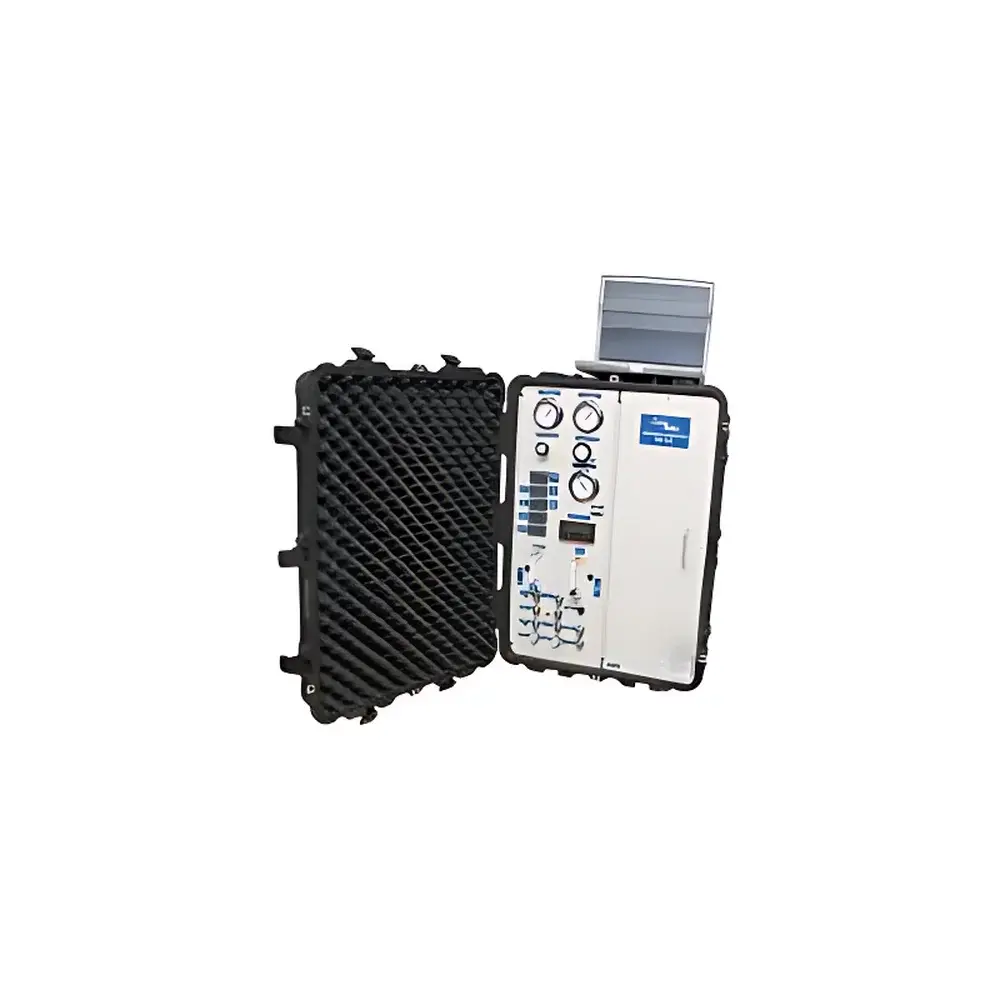
LUMEX IRM-915 Continuous Online Mercury Emission Monitoring System for Flue Gas
| Brand | LUMEX |
|---|---|
| Origin | USA |
| Model | IRM-915 |
| Detection Principle | Zeeman-effect Background-Corrected Cold Vapor Atomic Absorption Spectrometry (CVAAS) with High-Temperature Dry Catalytic Conversion |
| Measurement Range | 0.05–1000 µg/m³ (wet basis, HgT and Hg⁰) |
| Zero Drift | ±2.5% |
| Precision | ±2.5% |
| Accuracy | ±5% |
| Conversion Temperature | 700–750 °C |
| Dilution Ratio | Up to 1:100 |
| Sample Flow | Heated probe + heated filter + dilution/conversion module |
| Power Requirement | 220 V, 1000 W |
| Compressed Air | 15–20 L/min at 80 psig |
| Data Output | Real-time acquisition |
| System Weight | 67 kg |
Overview
The LUMEX IRM-915 is a fully automated, continuous emission monitoring system (CEMS) engineered for regulatory-grade measurement of total mercury (HgT) and elemental mercury (Hg⁰) in industrial flue gas streams. It operates on the principle of cold vapor atomic absorption spectrometry (CVAAS) enhanced by longitudinal Zeeman background correction—a technique that eliminates spectral interferences from complex combustion matrices without chemical reagents or optical filters. Unlike conventional gold-amalgam preconcentration systems, the IRM-915 employs dry catalytic conversion at 700–750 °C, enabling direct, real-time quantification of mercury species without sample enrichment or cryogenic trapping. Its multi-pass absorption cell increases optical path length while maintaining compact footprint, delivering sub-part-per-trillion (pg/m³) detection capability on a wet-basis measurement protocol—eliminating need for moisture correction and associated uncertainty propagation.
Key Features
- Zeeman-effect background-corrected CVAAS: Provides inherent compensation for broadband and structured molecular absorption, critical for high-ash, high-NOx, or high-Cl flue gases typical of coal-fired boilers and waste incinerators.
- Dry catalytic conversion at 700–750 °C: Achieves >99.5% oxidation efficiency for divalent mercury (Hg²⁺) to elemental form within <1 second residence time, minimizing recombination artifacts with reactive flue gas constituents.
- Heated sampling train: Includes temperature-controlled probe (≥180 °C), ceramic-filtered particulate removal, and integrated dilution-conversion unit—ensuring representative sampling across wide dynamic ranges (0.05–1000 µg/m³).
- Wet-basis reporting: Delivers directly traceable, audit-ready concentration values referenced to actual flue gas moisture content—fully compliant with EPA Method 29, ASTM D6784-22, and EN 14883:2015 requirements.
- Modular architecture: Designed for rapid field deployment; all subsystems—including analyzer cabinet, sampling interface, and calibration manifold—are mechanically and pneumatically decoupled for transport and reassembly with metrological integrity preserved.
Sample Compatibility & Compliance
The IRM-915 is validated for use in heterogeneous flue gas environments characterized by variable temperature (80–200 °C), high particulate loading (<50 g/Nm³), and acidic components (SO₂, HCl, HF). It meets performance criteria specified in U.S. EPA Performance Specification 12A (PS-12A) and has successfully passed Relative Accuracy Test Audit (RATA) under field conditions per 40 CFR Part 60 Appendix B. The system supports compliance with EU IED (2010/75/EU) mercury monitoring mandates and aligns with ISO 17025-accredited laboratory practices when operated under documented QA/QC protocols. All firmware and data handling routines conform to FDA 21 CFR Part 11 requirements for electronic records and signatures, including full audit trail, user access control, and immutable raw data archiving.
Software & Data Management
The embedded control software provides real-time visualization of Hg⁰ and HgT concentrations, conversion efficiency diagnostics, system health status, and automatic zero/span validation logs. Data are timestamped, stored locally in non-volatile memory (≥30 days at 1-min resolution), and exported in native .csv or Excel-compatible formats with metadata headers (e.g., moisture content, temperature, pressure, dilution factor). Remote access via secure HTTPS enables centralized fleet monitoring, while optional OPC UA integration supports interoperability with DCS/SCADA platforms. All calibration events, maintenance alerts, and fault codes are recorded with ISO/IEC 17025-compliant traceability.
Applications
- Continuous compliance monitoring at coal- and biomass-fired power plants subject to MATS (Mercury and Air Toxics Standards) and EU LCP BREF guidelines.
- Mercury speciation support for sorbent injection optimization studies—enabling correlation between Hg⁰/Hg²⁺ ratios and activated carbon dosage.
- Performance verification of flue gas desulfurization (FGD) and selective catalytic reduction (SCR) systems on mercury redox behavior.
- Stack testing and reference method validation per ASTM D6784-22 (Ontario Hydro Method alternative).
- Long-term trend analysis for environmental reporting under GHG and air toxics inventories (e.g., TRI, E-PRTR).
FAQ
Does the IRM-915 require gold-coated traps or chemical reagents for mercury preconcentration?
No. It utilizes dry thermal catalysis followed by direct Zeeman-CVAAS detection—eliminating consumables, reducing maintenance intervals, and avoiding memory effects associated with amalgamation surfaces.
Can the system differentiate between elemental and oxidized mercury species?
Yes. By operating in dual-mode configuration—direct measurement for Hg⁰ and post-conversion measurement for HgT—the IRM-915 calculates Hg²⁺ concentration by difference, supporting redox speciation without chromatographic separation.
Is wet-basis reporting configurable to dry-basis output?
The system reports natively on wet basis as required by most regulatory frameworks. Dry-basis conversion is available as a post-processing option using user-supplied moisture data, but is not applied automatically to preserve regulatory audit integrity.
What maintenance schedule is recommended for unattended operation?
Routine tasks include quarterly optical alignment verification, biannual catalyst bed inspection, and annual lamp replacement. Full preventive maintenance is recommended every 12 months or after 8,000 operational hours—whichever occurs first.
How is system accuracy verified during operation?
Automated daily zero/span checks using certified NIST-traceable mercury permeation sources are performed. Optional RATA-ready mode allows simultaneous parallel sampling with reference methods for third-party validation per PS-12A protocols.
Related Products







