
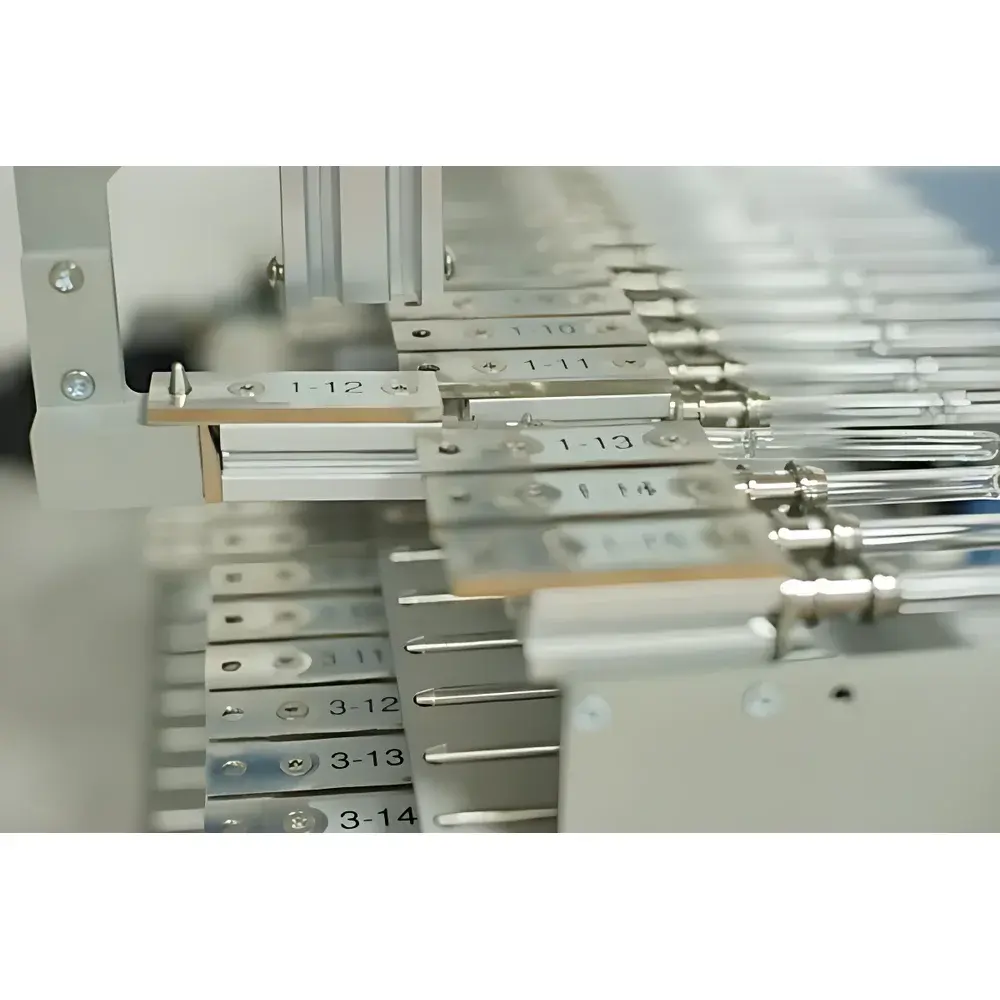
LUMEX LS-915 Automated Mercury Sampler
| Brand | LUMEX |
|---|---|
| Origin | Canada |
| Model | LS-915 |
| Instrument Type | Benchtop Laboratory System |
| Measurement Principle | Cold Vapor Atomic Absorption Spectrometry (CVAAS) |
| Detection Limit | 1 pg Hg |
| Repeatability | ≤1% RSD |
| Linearity Error | ≤2% |
| Sample Capacity | 75 positions |
| Solid Sample Mass | ≥1000 mg |
| Liquid Sample Volume | ≥500 µL |
| Robotic Architecture | Cartesian XYZ Coordinate System |
| Crucible Material | High-Purity Quartz (operable up to >1000 °C) |
Overview
The LUMEX LS-915 Automated Mercury Sampler is a benchtop, fully integrated sample introduction module engineered for high-throughput, trace-level mercury quantification in solid and liquid matrices using Cold Vapor Atomic Absorption Spectrometry (CVAAS). Designed as a dedicated front-end automation solution for LUMEX mercury analyzers—particularly those employing thermal decomposition–atomic absorption detection—the LS-915 eliminates manual handling and pre-digestion steps by enabling direct, unassisted analysis of complex samples including foodstuffs, biological tissues, coal, sediments, and industrial catalysts. Its core architecture relies on a precision Cartesian XYZ robotic positioning system, ensuring micron-level repeatability in crucible placement and thermal alignment with the decomposition furnace. This mechanical fidelity underpins analytical robustness, especially critical when measuring sub-picogram mercury concentrations where positional drift or inconsistent thermal coupling can introduce systematic bias.
Key Features
- Precision Cartesian XYZ robotic arm with closed-loop feedback control, delivering positional accuracy < ±25 µm across all three axes for consistent thermal transfer and furnace interface alignment.
- 75-position programmable sample carousel accommodating standardized quartz boats; supports sequential, randomized, or priority-based run sequences via method-defined scheduling.
- High-temperature quartz sample boats rated for continuous operation at ≥1000 °C, chemically inert toward halogens, sulfur, and chloride-rich matrices encountered in coal and seafood analysis.
- Integrated auto-return functionality: after thermal decomposition and vapor transport, the robotic arm retracts the used boat to its designated parking slot and advances the next sample—enabling uninterrupted overnight runs without operator intervention.
- Dual-mode sampling capability: optimized for both solid samples (≥1000 mg mass tolerance, with optional auto-compensation for density variation) and liquid samples (≥500 µL volume range, with gravimetric calibration support).
- Modular thermal interface design ensures compatibility with LUMEX’s standard pyrolysis units (e.g., RP-915+), maintaining uniform heating profiles and minimizing memory effects through active purge cycles between injections.
Sample Compatibility & Compliance
The LS-915 is validated for use with heterogeneous, high-matrix samples requiring minimal preparation—fully aligned with EPA Method 7473, ASTM D6722-22, and ISO 16595:2016 for mercury determination in solids and liquids. Its quartz boat geometry and thermal ramping profile have been verified to prevent mercury volatilization loss during loading and ensure quantitative release during controlled pyrolysis (typically 600–850 °C). The system supports GLP-compliant workflows: all sample IDs, timestamps, position indices, and thermal event logs are timestamped and stored with cryptographic integrity. Audit trails meet FDA 21 CFR Part 11 requirements when paired with LUMEX’s certified Mercury Analysis Software Suite v4.x or later.
Software & Data Management
Control and monitoring are executed via LUMEX Mercury Control Center (MCC) software—a Windows-based platform supporting method creation, real-time robotic status visualization, thermal profile logging, and automatic QC flagging (e.g., carryover detection, peak asymmetry alerts). Raw absorbance data, integration parameters, and furnace temperature curves are exported in ASTM E1382-compliant .csv and .xml formats. Batch reporting includes ICH M7-aligned uncertainty propagation calculations based on measured repeatability (≤1% RSD) and linearity error (≤2%). Remote diagnostics and firmware updates are supported over secure TLS 1.2 connections, with role-based access control (administrator, analyst, reviewer) enforced at the OS level.
Applications
- Regulatory testing of fish tissue and infant formula per FDA Action Level (1 ppm Hg) and EU Commission Regulation (EU) No 1881/2006.
- Coal and petroleum coke certification for ASTM D6722 compliance in power generation and metallurgical feedstock qualification.
- Environmental monitoring of sediment cores and sludge digestates under EPA Region 10 protocols for Superfund site characterization.
- Pharmaceutical excipient screening per USP elemental impurities guidelines, particularly for mercury in polysorbates and lactose carriers.
- Research-scale mercury speciation support when coupled with LUMEX’s hyphenated systems (e.g., LC-CVAAS interfaces for methylmercury separation).
FAQ
Does the LS-915 require acid digestion prior to analysis?
No—thermal decomposition replaces wet chemistry digestion. Samples are introduced directly into quartz boats and pyrolyzed under controlled oxygen flow, releasing elemental mercury vapor quantitatively.
Can the LS-915 be retrofitted to non-LUMEX mercury analyzers?
It is mechanically and electronically optimized for LUMEX platforms (e.g., RA-915M, RA-915+, RP-915+). Interfacing with third-party CVAAS systems requires custom engineering and is not supported under warranty.
How is carryover mitigated between high-mercury and low-mercury samples?
The system executes a 90-second high-purity argon purge cycle post-analysis, combined with real-time absorbance baseline verification; software flags deviations exceeding 0.5% of full-scale signal.
Is method validation documentation provided?
Yes—each unit ships with a Factory Acceptance Test (FAT) report, IQ/OQ protocol templates, and application notes aligned with ISO/IEC 17025 method validation requirements.
What maintenance intervals are recommended for the robotic mechanism?
Linear guides and stepper motors require lubrication every 12 months or 5,000 cycles; quartz boat inspection is advised before each batch containing sulfidic or halogenated matrices.




