
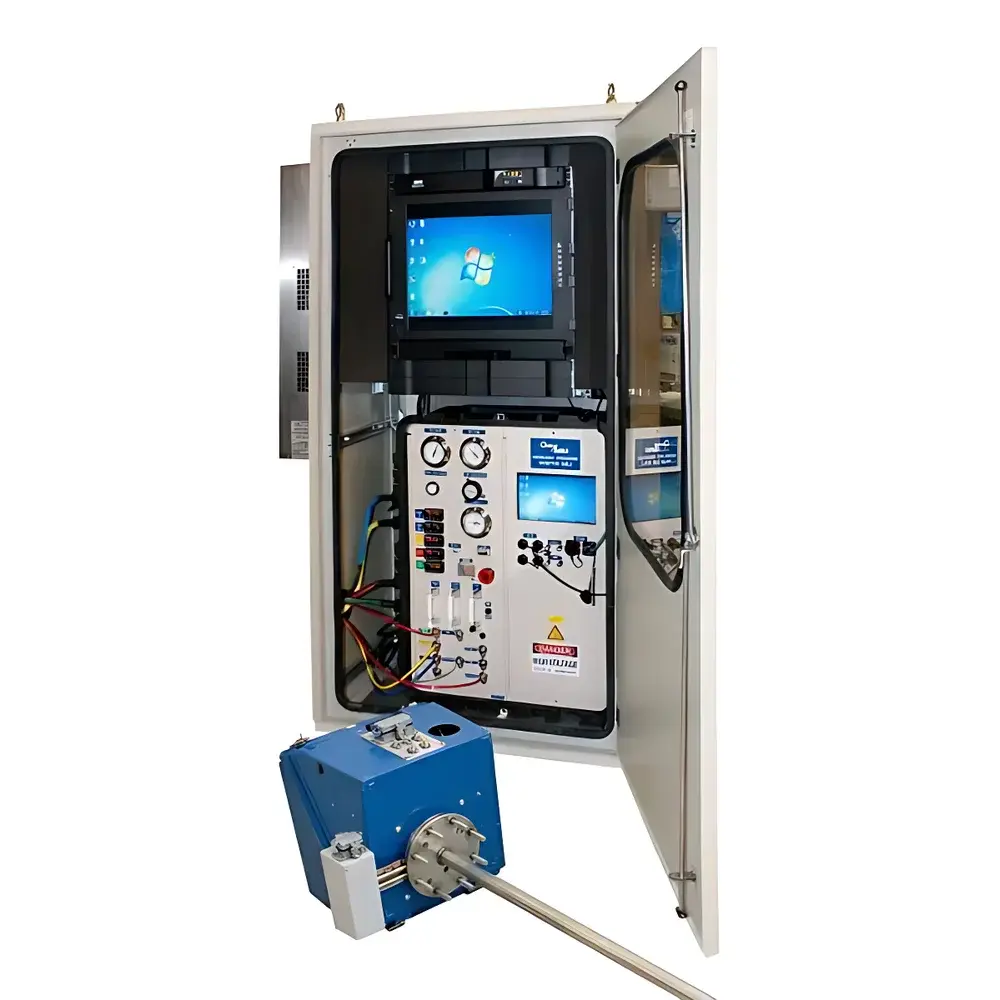
LUMEX OLM915J Continuous Online Flue Gas Mercury Monitoring System
| Brand | LUMEX |
|---|---|
| Origin | USA |
| Model | OLM915J |
| Detection Principle | High-Temperature Catalytic Conversion + Zeeman-Background-Corrected Atomic Absorption Spectrometry (AAS) |
| Measurement Range | 0.1–100 µg/m³ |
| Response Time | ≤30 seconds per reading |
| Compliance | EPA Method PS 12A (Level 3 Certified) |
| Sample Handling | Hot-wet extraction with heated sampling probe (10–50 ft customizable), Ni-based alloy filter/dilution module, dry catalytic conversion at 750 °C |
| Enclosure Rating | NEMA 4X |
| Operating Ambient Temperature | –10 to 50 °C |
| Power Requirement | 110/220 VAC, 2000 W |
| Compressed Air Supply | Dry, dew point ≤ –40 °C |
| Calibration | Integrated elemental Hg vapor generator, fully automated, no external standards required |
| Data Output | Real-time Ethernet (Modbus TCP/IP, OPC UA), Excel export via embedded industrial PC, ESC8832-compatible |
Overview
The LUMEX OLM915J Continuous Online Flue Gas Mercury Monitoring System is an EPA PS 12A Level 3 certified instrument engineered for regulatory-grade, real-time quantification of elemental and total gaseous mercury (Hg⁰ and Hgtot) in undiluted, high-temperature flue gas streams. It employs a dual-path, high-temperature catalytic conversion architecture coupled with Zeeman-effect background-corrected atomic absorption spectrometry — eliminating the need for gold amalgamation preconcentration or cryogenic trapping. This direct optical detection method ensures trace-level sensitivity (detection limit <0.1 µg/m³) while maintaining immunity to spectral interferences from SO₂, NOₓ, HCl, water vapor, and particulate-laden matrices commonly encountered downstream of ESPs, SCR/NSCR units, and FGD scrubbers. The system operates continuously under ISO 17025-aligned measurement conditions and delivers compliant data for CEMM (Continuous Emission Monitoring and Measurement) reporting under 40 CFR Part 60, Appendix A–8 and EU IED Directive 2010/75/EU.
Key Features
- Zeeman-background-corrected AAS with high-frequency modulated polarized light source — delivers exceptional selectivity and baseline stability without mechanical choppers or dual-beam referencing
- Dual-stream sample conditioning: one path bypasses the 750 °C catalytic converter for elemental Hg⁰; the other passes through for total mercury (Hgtot) analysis — enabling real-time speciation ratio calculation
- Fully heated, corrosion-resistant sampling train: 10–50 ft customizable stainless-steel伴热 (heat-traced) probe with Inconel 625 filtration and precision orifice-based dilution (±1% flow control)
- Integrated Hg⁰ calibration source: thermally generated mercury vapor at trace concentrations (2–5 µg/m³ steps), eliminating reliance on external permeation tubes or standard gas cylinders
- NEMA 4X-rated, climate-controlled analyzer enclosure with automatic thermal management (–10 to 50 °C operational range) and IP66 ingress protection
- Modular Pelikan transport case housing all electronics, data acquisition, and control logic — supports hot-swap replacement and field serviceability without system shutdown
- Automated probe back-pulse cleaning cycle with programmable frequency — maintains consistent sampling efficiency in high-dust environments (e.g., coal-fired boiler ducts, cement kiln exhaust)
Sample Compatibility & Compliance
The OLM915J is validated for direct measurement in raw, unconditioned flue gas from coal combustion, municipal solid waste incineration, non-ferrous metal smelting, cement clinker production, and biomass co-firing facilities. Its dry-conversion methodology avoids condensation-related losses and eliminates dependence on chilled mirror dew point control or chemical drying agents. The system meets full technical requirements of U.S. EPA Performance Specification 12A (PS 12A) at Level 3 certification — including dynamic spiking accuracy (±10%), 7-day stability (±5% drift), and interference testing against 100 ppm SO₂, 200 ppm NO, and 50 ppm HCl. It supports GLP-compliant audit trails, 21 CFR Part 11–enabled electronic signatures (via optional software license), and generates timestamped, checksum-verified data packets suitable for regulatory submission to state EPAs or the U.S. EPA’s CDX portal.
Software & Data Management
Embedded industrial PC runs LUMEX MercuryView™ v4.x firmware — a deterministic real-time OS with dual redundant storage (SSD + SD card). All measurements are timestamped with GPS-synchronized UTC and logged at user-defined intervals (default: 30 s). Data export formats include native CSV/Excel, Modbus TCP/IP registers (for DCS integration), and OPC UA server endpoints. Remote diagnostics, parameter reconfiguration, and zero/span validation can be executed via secure TLS 1.2–encrypted web interface or SSH terminal. Optional ESC8832 data acquisition compatibility enables centralized fleet monitoring across multi-stack installations. Audit logs record every calibration event, maintenance action, and configuration change with operator ID and digital signature — satisfying ISO/IEC 17025 Clause 7.7 and EU Annex 11 ALCOA+ data integrity requirements.
Applications
- Regulatory compliance monitoring at coal-, oil-, and biomass-fired power plants subject to MATS (Mercury and Air Toxics Standards) and cross-state air pollution rule (CSAPR) reporting
- Process optimization and sorbent injection control in activated carbon injection (ACI) systems for mercury capture efficiency assessment
- Stack testing support and QA/QC verification for reference method ASTM D6784–22 (Ontario Hydro Method)
- Long-term trend analysis in waste-to-energy facilities operating under EU Industrial Emissions Directive (IED) permit conditions
- Commissioning and performance validation of flue gas desulfurization (FGD) and selective catalytic reduction (SCR) retrofits where mercury redox behavior impacts removal efficiency
FAQ
Does the OLM915J require gold-coated traps or cryogenic preconcentration?
No. It uses direct Zeeman-AAS detection following high-temperature catalytic oxidation, eliminating consumable traps and associated maintenance downtime.
Can it distinguish between elemental and oxidized mercury species?
Yes — via parallel sample paths: one measures native Hg⁰; the other measures total Hg after catalytic conversion at 750 °C. Speciation ratio (Hg⁰/Hgtot) is calculated in real time.
Is the system compatible with existing plant DCS/SCADA networks?
Yes — native Modbus TCP/IP and OPC UA support enable seamless integration without protocol gateways or third-party middleware.
What is the recommended maintenance interval under continuous operation?
Filter replacement every 3–6 months depending on dust loading; annual verification of catalytic converter activity and Zeeman lamp output stability — documented in ISO 17025–traceable service reports.
Does it meet European MCERTS or TÜV certification requirements?
While not MCERTS-certified as a standalone unit, its PS 12A Level 3 validation, NEMA 4X enclosure, and adherence to EN 14181 QAL1/QAL2 protocols make it suitable for MCERTS-compliant installations when deployed with approved QA procedures.







