
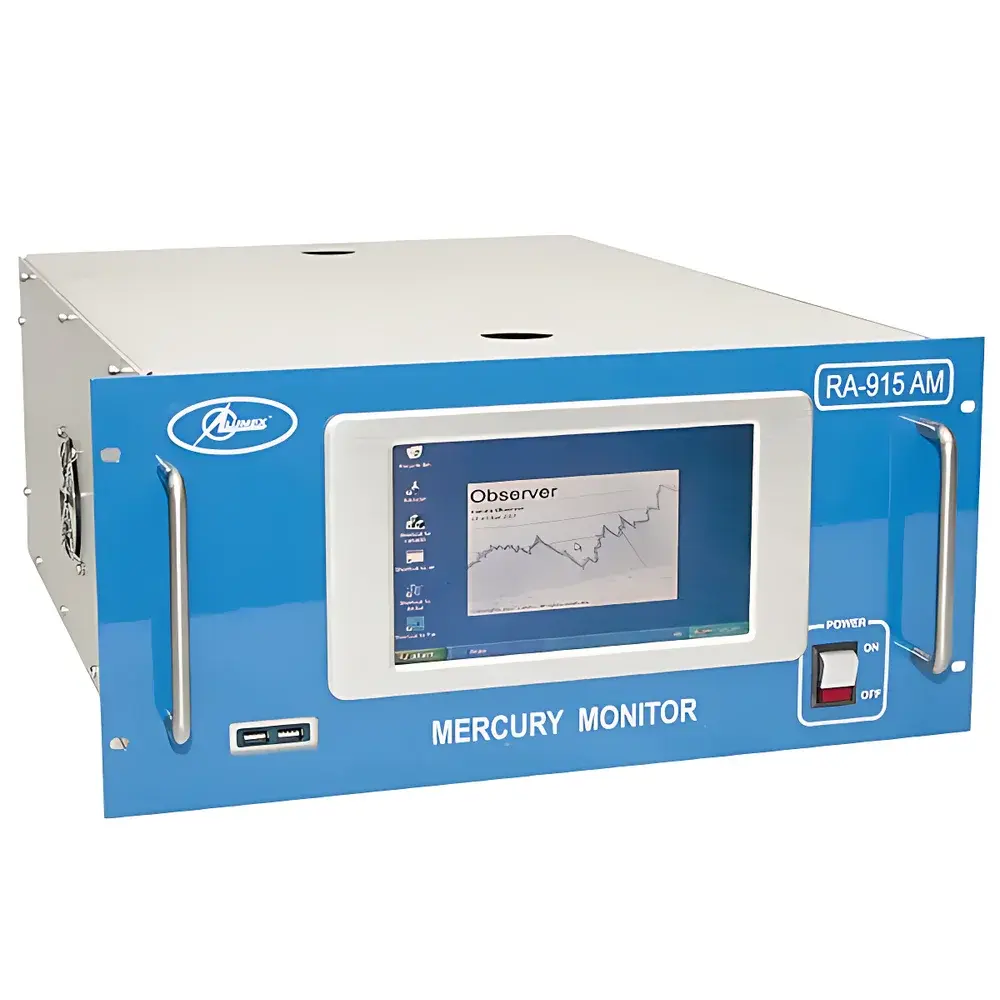
LUMEX RA-915AM Online Mercury Analyzer
| Brand | LUMEX |
|---|---|
| Origin | Canada |
| Model | RA-915AM |
| Instrument Type | Online Analyzer |
| Measurement Principle | Zeeman Atomic Absorption Spectrometry with High-Frequency Modulation (ZAAS-HFM) |
| Detection Limit | 0.5 ng/m³ |
| Repeatability | ±1% |
| Linearity Error | ±2% |
| Gas Flow Rate | 3–10 L/min |
| Response Time | 10–300 s |
| Range I | 0.5–2000 ng/m³ |
| Range II | 100–400,000 ng/m³ |
| Operating Temperature | −20 to +50 °C |
| Pressure Range | 84–106.7 kPa |
| Relative Humidity | <99% at 35 °C |
| Power Supply | 240 VAC, 50/60 Hz |
| Power Consumption | 120 W |
| Dimensions | 600 × 480 × 220 mm |
| Weight | 19 kg |
| Communication Interfaces | RS-232, Dual USB, LAN, Isolated 4–20 mA Output |
Overview
The LUMEX RA-915AM Online Mercury Analyzer is a high-performance, fully automated continuous emission monitoring system engineered for real-time quantification of elemental mercury (Hg⁰) in ambient air, indoor environments, and industrial stack emissions. It operates on the principle of Zeeman Atomic Absorption Spectrometry with High-Frequency Modulation (ZAAS-HFM), a physically robust and interference-resistant variant of cold vapor atomic absorption spectroscopy (CVAAS). Unlike conventional gold-amalgam preconcentration systems, the RA-915AM performs direct, in-situ measurement of gaseous mercury without sample digestion, chemical reduction, or trapping—enabling true real-time response with a typical air response time of ≤10 seconds. Its optical design employs polarization-modulated 254 nm resonance radiation, combined with longitudinal Zeeman background correction, to eliminate spectral interferences from water vapor, particulate matter, ozone, hydrocarbons, and other common atmospheric constituents. The instrument meets EN 15852:2010 for ambient air mercury monitoring and has been deployed globally within the GMOS (Global Mercury Observation System) network across terrestrial, marine, and aerial platforms for long-term background monitoring in remote and polar regions.
Key Features
- Direct, reagent-free, and calibration-free continuous measurement—no gold trap, no chemical vapor generation, no sample pretreatment required
- High-frequency Zeeman background correction ensures exceptional selectivity and stability under variable humidity and particulate load conditions
- Integrated automatic zero and span calibration system with traceable Hg⁰ permeation source; supports unattended operation for ≥30 days between maintenance cycles
- Onboard embedded PC with 6.4-inch capacitive touchscreen interface; local data visualization, configuration, and diagnostics without external hardware
- Configurable reporting intervals down to 2 seconds; full-cycle analysis time <4 minutes, adjustable per regulatory or operational requirements
- Robust environmental tolerance: operational at −20 to +50 °C and 84–106.7 kPa, with humidity resistance up to 99% RH at 35 °C
- Comprehensive status signaling via discrete outputs (MEASURING, ZERO CONTROL, CALIBRATION, SERVICE, FAILURE) compliant with SCADA integration protocols
Sample Compatibility & Compliance
The RA-915AM is validated for direct analysis of undiluted ambient air, indoor air, flue gas (with optional heated sampling line), and clean-room atmospheres. It complies with EN 15852:2010 for ambient air mercury monitoring and aligns with the technical specifications adopted by the UNEP Global Mercury Partnership and the EU Monitoring and Assessment Programme (MAP). Its measurement uncertainty profile satisfies QA/QC requirements for Level 2 monitoring stations under the European Environment Agency (EEA) framework. While not intrinsically certified for hazardous area installation, it may be deployed in Zone 2/Class I, Division 2 environments when housed in an appropriately rated monitoring shelter. Data integrity adheres to GLP principles, with audit-trail-capable internal logging supporting ISO/IEC 17025 laboratory accreditation workflows.
Software & Data Management
The analyzer runs LUMEX’s proprietary MercuryControl™ firmware, featuring embedded database storage capable of retaining >1000 days of second-level resolution data (timestamped Hg concentration, flow rate, temperature, pressure, diagnostic flags). Data export is supported via CSV over USB, FTP over LAN, or real-time streaming via TCP/IP socket. The system provides native Modbus TCP and OPC UA compatibility for seamless integration into central EMS/DCS platforms. All calibration events, zero checks, and error logs are time-stamped and cryptographically signed to ensure traceability. Remote firmware updates and parameter configuration are supported via secure HTTPS interface. No third-party software licenses or annual subscriptions are required for core functionality.
Applications
- Long-term background monitoring in remote, Arctic, and alpine sites as part of GMOS and EMEP networks
- Urban and suburban ambient air quality networks tracking Hg⁰ diurnal patterns and transboundary transport
- Indoor air quality assessment in dental clinics, chlor-alkali plants, and coal-fired power station control rooms
- Continuous compliance monitoring of mercury emissions from waste incinerators, cement kilns, and non-ferrous smelters
- Research-grade validation of mercury speciation instruments (e.g., Tekran 2537/1030 series) through parallel Hg⁰ reference measurement
- Mobile monitoring on research vessels and aircraft using customized vibration-dampened mounting kits
FAQ
Does the RA-915AM measure oxidized or particulate-bound mercury species?
No—it is specifically designed for elemental mercury (Hg⁰) vapor detection. For total gaseous mercury (TGM) or speciated measurements, coupling with a thermal converter or Tekran-style speciation module is required.
Can the instrument operate continuously without manual intervention?
Yes—its integrated auto-zero and auto-calibration routines, coupled with stable ZAAS-HFM optics, enable unattended operation for up to 30 days under standard ambient conditions.
Is the RA-915AM compatible with EPA Method 1631 or ISO 6978-2?
It is not a wet-chemistry method-compliant instrument; however, its performance characteristics (detection limit, repeatability, linearity) meet or exceed the metrological requirements specified in those standards for reference-grade continuous monitoring.
What maintenance is required beyond routine calibration?
Annual optical alignment verification and quarterly replacement of the quartz absorption cell seal kit are recommended. No consumables such as reagents, traps, or lamps are used.
How is data security and integrity ensured during transmission?
All internal logs include SHA-256 hash signatures; network communications support TLS 1.2 encryption; audit trails record user actions, timestamps, and configuration changes per ISO/IEC 17025 Annex A.2.14 requirements.





