
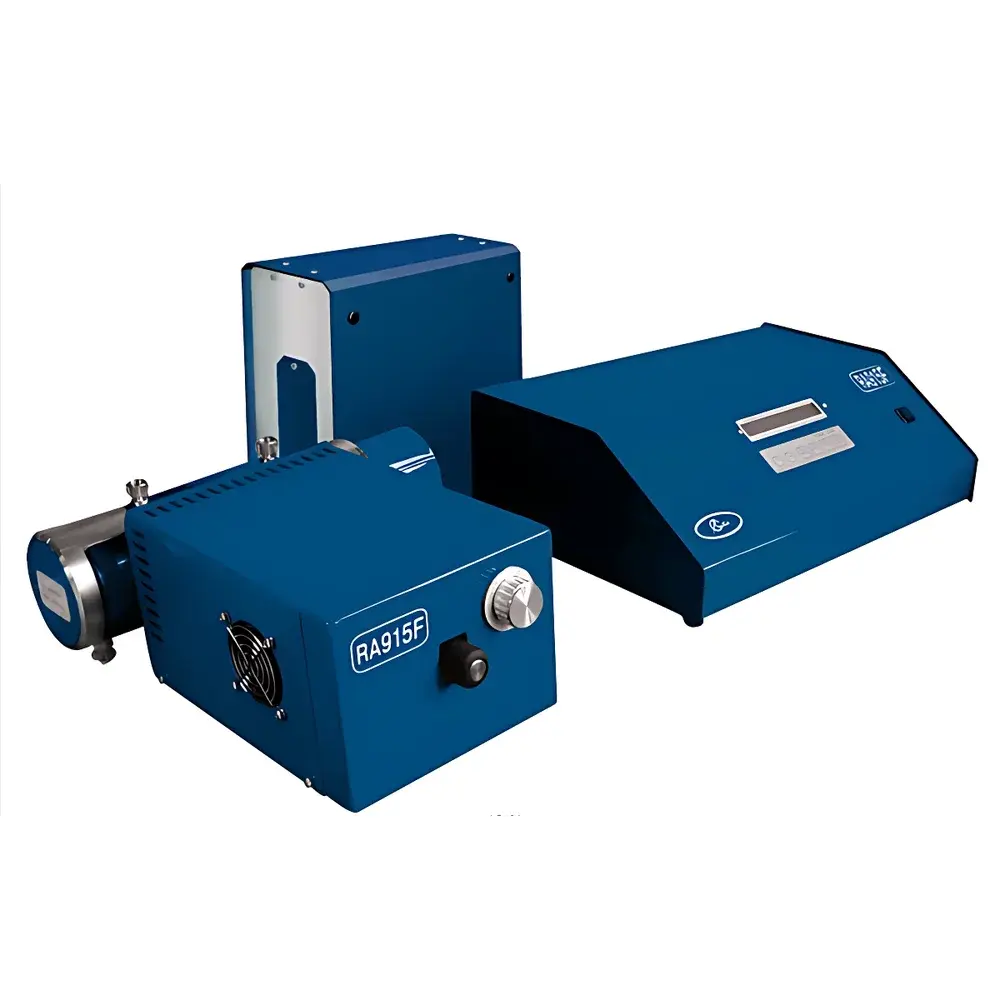
LUMEX RA-915F Portable Mercury Analyzer with Zeeman-Effect Background Correction
| Brand | LUMEX |
|---|---|
| Origin | Canada |
| Model | RA-915F |
| Instrument Type | Portable |
| Measurement Principle | Cold Vapor Atomic Absorption Spectrometry (CVAAS) with Thermal Decomposition |
| Detection Limit | 0.005 ng Hg |
| Repeatability | ±1% RSD |
| Linearity Error | ±1% |
| Detection Range | 5 orders of magnitude |
| Sample Throughput | 1–5 min per analysis |
| Power Supply | 220 VAC, 50 Hz (with optional DC/vehicle power adapter) |
| Dimensions (Analyzer Unit) | 300 × 260 × 130 mm |
| Weight (Analyzer Unit) | 4.0 kg |
| Dimensions (Thermal Decomposer Module) | 350 × 260 × 120 mm |
| Weight (Thermal Decomposer Module) | 7.5 kg |
| Dimensions (Power Supply Unit) | 380 × 260 × 130 mm |
| Weight (Power Supply Unit) | 10.0 kg |
| Sample Mass Range | 10–500 mg |
| Liquid Detection Limit | 0.5 µg/L |
| Solid Upper Quantitation Limit | 200 mg/kg |
Overview
The LUMEX RA-915F Portable Mercury Analyzer is a field-deployable, direct-reading instrument engineered for quantitative mercury determination in solid, liquid, and semi-solid matrices using thermal decomposition coupled with Zeeman-effect background-corrected cold vapor atomic absorption spectrometry (CVAAS). Unlike conventional gold amalgamation-based systems, the RA-915F employs high-frequency Zeeman background correction at the 254 nm mercury resonance line to eliminate spectral interferences from molecular absorption, chloride vapors, and organic pyrolysis byproducts—enabling accurate, interference-free quantification without pre-concentration or carrier gas dependency. The integrated thermal decomposer module enables rapid, controlled pyrolysis (programmable multi-step temperature ramping) to volatilize mercury from complex matrices—including soils, sediments, biological tissues, foodstuffs, and industrial catalysts—while suppressing memory effects and halogen-induced signal suppression. Its modular architecture supports rapid reconfiguration for lab, mobile lab, or on-site deployment, including vehicle-integrated operation via DC power input.
Key Features
- Zeeman-effect background correction operating at 254 nm for real-time spectral interference compensation, eliminating false positives from chloride, sulfur, and organic matrix emissions
- Integrated thermal decomposition unit with programmable gradient heating profiles (up to 3 temperature zones), optimized to release mercury quantitatively while minimizing co-volatilization of interfering species
- No gold trap, no catalyst tube, no external carrier gas required—reducing consumables, maintenance intervals, and operational cost-of-ownership
- Five-decade linear dynamic range (sub-pg to mg-level Hg), enabling direct analysis of environmental, clinical, and industrial samples without dilution or pre-concentration
- Self-contained air pump with closed-loop flow regulation; automatic flow stabilization ensures consistent atomization and transport efficiency
- Modular hardware design: analyzer core (4.0 kg), thermal decomposer (7.5 kg), and dedicated power supply (10.0 kg) are mechanically and electrically decoupled for transport, service, and field replacement
- Onboard calibration verification using certified Hg standard solutions; traceable calibration stability maintained over extended operational cycles
Sample Compatibility & Compliance
The RA-915F is validated for direct analysis of heterogeneous, high-matrix samples including soil, sediment, sludge, plant tissue, animal feed, fish muscle, dairy products, wine, crude oil, coal, catalyst residues, and human biofluids (urine, blood lysates, hair digests). It complies with method principles aligned with ASTM D6722-22 (Standard Test Method for Total Mercury in Coal and Coal Combustion Residues), EPA Method 7473 (Mercury in Solids and Solutions by Thermal Decomposition, Amalgamation, and Atomic Absorption Spectrophotometry), and ISO 16595:2016 (Water quality — Determination of mercury — Method using thermal decomposition and atomic absorption spectrometry). Its background-correction architecture satisfies analytical specificity requirements under GLP and ISO/IEC 17025 accreditation frameworks. No sample digestion, derivatization, or chemical reduction is required—minimizing contamination risk and analyst exposure.
Software & Data Management
The RA-915F operates via an embedded Linux-based control interface with touchscreen navigation and context-sensitive workflow guidance. All measurement parameters—including temperature ramp profiles, dwell times, lamp current, and background correction settings—are stored in audit-trail-enabled configuration files. Raw absorbance spectra, time-resolved mercury release curves, and calibration history are timestamped and exportable in CSV and XML formats. The system supports 21 CFR Part 11-compliant user access control (role-based login), electronic signatures, and immutable data logging when connected to a networked laboratory information management system (LIMS). Firmware updates are delivered via secure HTTPS and verified with SHA-256 checksums.
Applications
- Environmental monitoring: Field screening of contaminated soils, river sediments, landfill leachates, and atmospheric particulate filters
- Food safety laboratories: Rapid verification of Hg in seafood, rice, infant formula, and alcoholic beverages per EU Commission Regulation (EC) No 1881/2006 limits
- Industrial process control: Catalyst integrity assessment in chlor-alkali plants, mercury recovery optimization in recycling facilities
- Occupational health: Urinary mercury quantification for OSHA PEL and ACGIH TLV compliance verification
- Research applications: Speciation-supportive total Hg screening prior to HPLC-ICP-MS or GC-AFS workflows
FAQ
Does the RA-915F require external carrier gas or compressed air?
No. It incorporates a built-in diaphragm air pump with PID-controlled flow regulation (±2% stability), eliminating dependency on external gas sources.
Can it analyze samples containing high chloride or sulfur content?
Yes. The Zeeman background correction continuously monitors and subtracts non-atomic absorption signals arising from HCl, SO₂, and other combustion byproducts during thermal decomposition.
Is method validation documentation available for regulatory submissions?
Yes. LUMEX provides ICH Q2(R2)-aligned validation reports covering specificity, linearity, LOD/LOQ, precision, and robustness—applicable to EPA, ISO, and pharmacopoeial submissions.
What maintenance is required between analyses?
No routine cleaning or component replacement is needed. The quartz cell and optical path are self-cleaning via thermal purging; only periodic lamp intensity verification and calibration standard checks are recommended.
How is traceability ensured for field measurements?
Each unit ships with NIST-traceable Hg calibration standards and a factory-issued calibration certificate; onboard calibration verification routines generate documented pass/fail logs for every analytical session.
Related Products





