
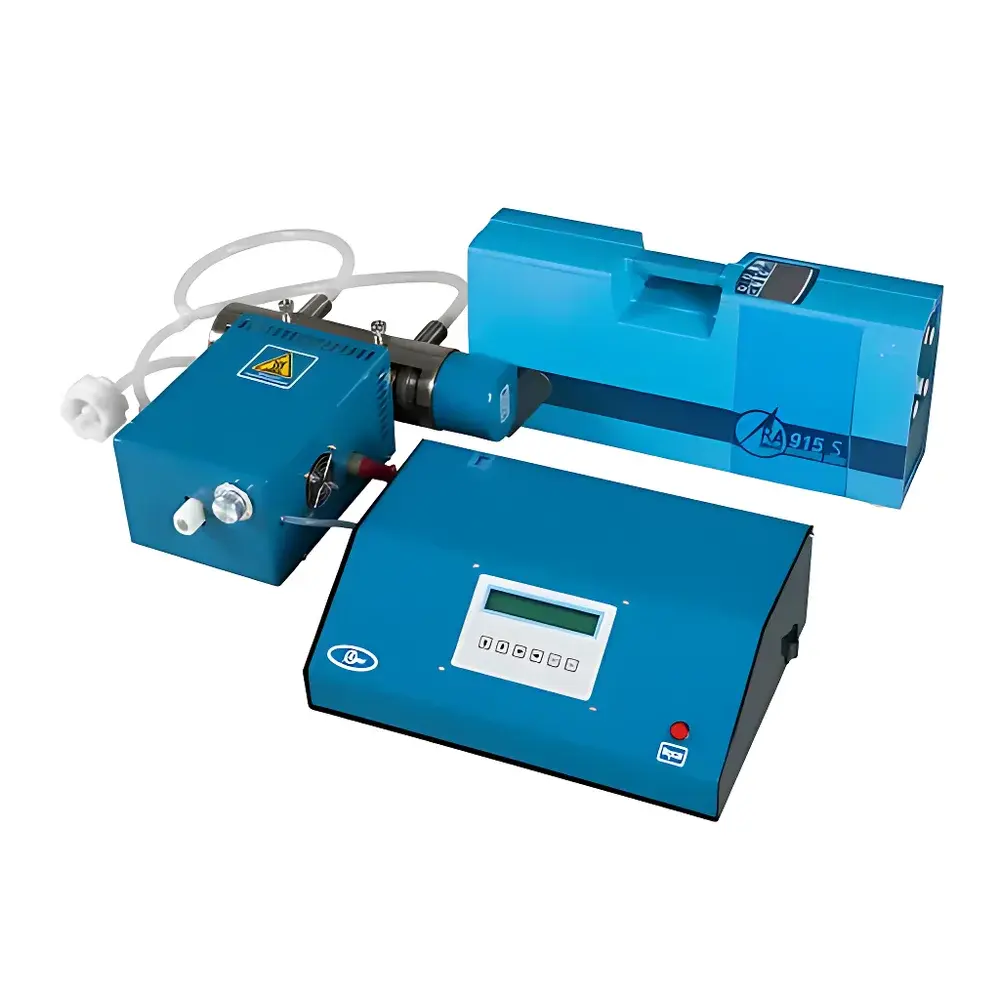
LUMEX RA-915S Portable Mercury Analyzer (Cold Vapor Atomic Absorption with Zeeman Background Correction)
| Brand | LUMEX |
|---|---|
| Origin | Canada |
| Model | RA-915S |
| Instrument Type | Portable |
| Principle | Cold Vapor Atomic Absorption Spectrometry (CVAAS) with Zeeman-effect background correction |
| Detection Limit | 0.01 µg/kg |
| Repeatability | ≤1% RSD |
| Linearity Error | ≤1% |
| Sample Introduction | Direct thermal decomposition (10–1500 mg solid/liquid) |
| Analysis Time | 1–2 min per sample |
| Dynamic Range | 5 orders of magnitude |
| Wavelength | 254 nm (Hg resonance line) |
| Power Supply | 198–242 VAC, 50 ± 1 Hz |
| Dimensions (Detector Unit) | 470 × 210 × 110 mm |
| Integrated Air Pump | Yes |
| Onboard Calibration | Certified Hg standard traceable to NIST |
Overview
The LUMEX RA-915S Portable Mercury Analyzer is a field-deployable, direct-reading instrument engineered for quantitative determination of total mercury (Hg0 + Hg2+) in solid, liquid, and gas-phase matrices using Cold Vapor Atomic Absorption Spectrometry (CVAAS) coupled with high-frequency Zeeman-effect background correction. Unlike conventional gold-amalgamation systems requiring carrier gas, catalysts, or pre-concentration steps, the RA-915S employs rapid, controlled thermal decomposition (up to 900 °C) to quantitatively release mercury from complex matrices—including activated carbon traps, coal fly ash, soil, sediment, biological tissue, and wastewater solids—into elemental vapor form. The liberated Hg atoms are then measured via absorption of 254 nm UV light emitted by a low-pressure mercury lamp. The integrated Zeeman modulator enables real-time correction of non-specific absorption (e.g., from halogens, SO2, or particulate scattering), ensuring robust performance in high-interference industrial environments such as coal-fired power plants and waste incineration facilities. Designed to meet U.S. EPA Method 30B (for sorbent trap-based flue gas Hg speciation) and EPA Method 7473 (for solids and liquids), the RA-915S serves as both a reference-grade validation tool for Continuous Emission Monitoring Systems (CEMS) and a primary analyzer for regulatory compliance sampling under national and international mercury control frameworks, including UNEP’s Global Mercury Assessment initiatives.
Key Features
- Direct thermal decomposition without gold traps, catalysts, or external carrier gas—eliminates consumables and reduces operational cost
- Zeeman-effect background correction at 254 nm ensures high selectivity and immunity to spectral interferences from Cl, Br, S, and matrix-derived aerosols
- Five-decade linear dynamic range (0.01 µg/kg to 200 mg/kg) accommodates trace-level environmental samples and concentrated industrial residues without dilution or detector saturation
- Programmable gradient heating profiles suppress organic volatiles and chloride interference, preventing memory effects and enabling accurate analysis of high-salt or high-carbon samples
- Integrated air pump with closed-loop flow control maintains stable carrier flow (no external gas cylinder required); compatible with 12 V DC vehicle power for true field deployment
- Modular architecture supports rapid reconfiguration for solid, liquid, or sorbent-trap applications; optional accessories extend capability to EPA-compliant air and wastewater analysis per ASTM D6784 and ISO 17852
- Real-time mercury release kinetics visualization and intuitive touchscreen interface simplify method development and operator training
Sample Compatibility & Compliance
The RA-915S accepts untreated, homogenized solid samples (10–1500 mg), slurries, digested liquids, and thermally desorbed sorbent tubes (e.g., KCl- or sulfur-impregnated activated carbon). It is validated for use with EPA Method 30B sorbent trap sampling trains and fully compliant with EPA Method 7473 for total mercury in solids and liquids. Its measurement uncertainty and detection capability align with ISO/IEC 17025 requirements for accredited testing laboratories. Data integrity meets FDA 21 CFR Part 11 expectations when used with LUMEX’s optional audit-trail-enabled software package, supporting GLP/GMP-aligned reporting for environmental monitoring programs governed by national emission standards (e.g., MATS in the U.S., EU IED Annex VIII).
Software & Data Management
The instrument operates via embedded firmware with USB and RS-232 connectivity. Optional LUMEX Mercury Control Software provides full method storage, calibration curve management (multi-point with certified NIST-traceable standards), automatic QC flagging (spike recovery, blank drift), and export-ready reports in CSV/PDF formats. All analytical events—including temperature ramp logs, absorbance spectra, and background subtraction traces—are time-stamped and stored locally. When deployed in networked lab environments, data can be synchronized with LIMS platforms via ODBC-compatible drivers. Audit trails record user login, parameter changes, and calibration history—enabling full traceability for regulatory submissions.
Applications
- Flue gas mercury speciation validation: Quantitative analysis of HgT from EPA 30B sorbent tubes across coal, biomass, and waste-to-energy combustion sources
- Fuel and ash characterization: Rapid screening of coal, fly ash, bottom ash, and activated carbon injection (ACI) sorbents for Hg content and retention efficiency
- Environmental monitoring: Total Hg in soils, sediments, biota, and landfill leachates per EPA 7473 and ISO 16772
- Industrial hygiene: Workplace air filter analysis and occupational exposure assessment
- Research & development: Kinetic studies of Hg release during thermal treatment, catalytic conversion, or stabilization processes
FAQ
Does the RA-915S require carrier gas or gold-coated traps for operation?
No. It uses ambient air as the carrier medium via its built-in pump and requires no consumable traps, catalysts, or external gas cylinders.
Can it quantify Hg0 and Hg2+ separately?
No—it measures total mercury (HgT). Speciation requires coupling with upstream sorbent trap methods (e.g., EPA 30B) followed by individual trap analysis.
Is calibration traceable to international standards?
Yes. Calibration is performed using NIST-traceable mercury standards; certificate of analysis is provided with each batch.
What maintenance is required for long-term field operation?
Routine cleaning of the quartz decomposition tube and optical window every 50–100 analyses; no alignment or lamp replacement needed within 2 years of typical use.
How is data integrity ensured during unattended operation?
All measurements include timestamped raw absorbance, background-corrected signal, and thermal profile metadata; optional software adds electronic signatures and change-controlled audit logs.
Related Products




