
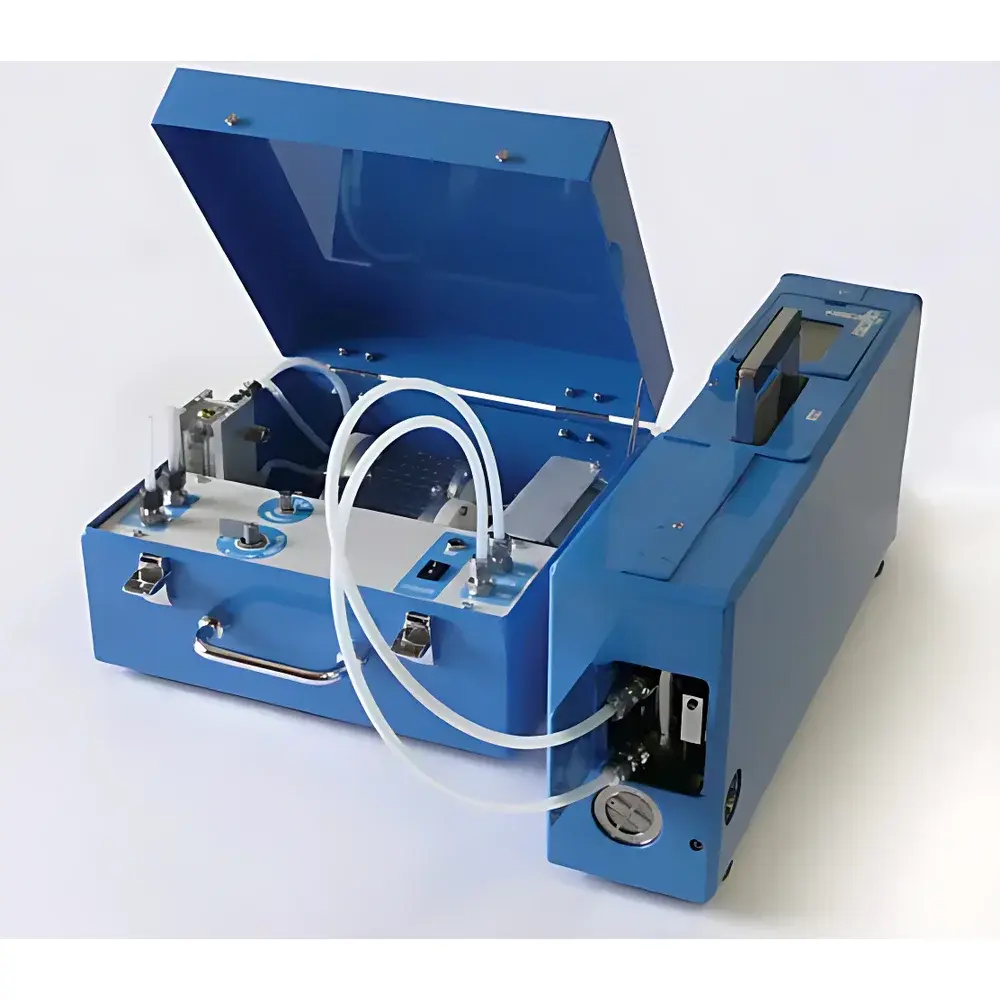
LUMEX RP-91NG Natural Gas Mercury Analysis Unit
| Brand | LUMEX |
|---|---|
| Origin | Canada |
| Manufacturer Type | Authorized Distributor |
| Origin Category | Imported |
| Model | RP-91NG |
| Instrument Type | Portable |
| Measurement Principle | Cold Vapor Atomic Absorption Spectrometry (CVAAS) with High-Frequency Zeeman Modulation (ZAAS-HFM) |
| Detection Limit | 1 ng/m³ |
| Repeatability | ±1% RSD |
| Linearity Error | ±1% |
| Concentration Range | 0.5–20,000 ng/m³ (optional high- and ultra-high-concentration modes available) |
| Air Pump Flow Rate | 2–5 L/min |
| Operating Ambient Temperature | 1–40 °C |
| Atmospheric Pressure Range | 84.0–106.7 kPa |
| Relative Humidity | >95% at 35 °C |
| Power Supply | 100–240 VAC, 50/60 Hz |
| Power Consumption | 35 W |
| Internal Battery Runtime | 8 h |
| Dimensions | 320 × 290 × 160 mm |
| Weight | 6.5 kg |
Overview
The LUMEX RP-91NG Natural Gas Mercury Analysis Unit is a field-deployable, portable mercury monitoring system engineered for direct, real-time quantification of elemental mercury (Hg⁰) in natural gas streams—including pipeline-grade dry gas, wet gas, sour gas, and condensate-rich natural gas—as well as LNG, LPG, and coalbed methane. It operates on the principle of Cold Vapor Atomic Absorption Spectrometry (CVAAS) enhanced by High-Frequency Zeeman Modulation (ZAAS-HFM), a physics-based background correction technique that eliminates spectral interference from hydrocarbon matrices without chemical derivatization or pre-concentration steps. Unlike conventional gold-amalgam trap-based analyzers, the RP-91NG introduces sample gas directly into the optical cell, where Hg⁰ atoms absorb 254 nm UV radiation emitted by a low-pressure mercury lamp. The Zeeman effect—induced by a high-frequency magnetic field—splits the absorption line, enabling precise discrimination between atomic mercury signals and broadband absorption from aromatic compounds, alkenes, and other organic interferents common in raw gas. This results in robust, interference-free measurements with sub-second response time and full data output within 2 seconds per analysis cycle.
Key Features
- Direct gas-phase analysis: No sample conditioning, no gold-coated traps, no thermal desorption or regeneration cycles—enabling true continuous monitoring.
- High-frequency Zeeman background correction (ZAAS-HFM): Eliminates false positives caused by aromatic hydrocarbons and unsaturated compounds, ensuring measurement integrity in complex gas matrices.
- Real-time operation: Full quantitative result generation in ≤2 seconds; supports automated sequential sampling across multiple gas sources via optional multiplexer.
- Portable architecture: Integrated battery (8 h runtime), compact footprint (320 × 290 × 160 mm), and ruggedized enclosure rated for field deployment in upstream, midstream, and LNG terminal environments.
- Wide dynamic range: Standard mode covers 0.5–20,000 ng/m³; optional high-range and ultra-high-range configurations extend coverage to 200 µg/m³ for amine unit inlet or mercury removal bed breakthrough detection.
- Regulatory-compliant design: Meets requirements for trace-level mercury monitoring under ISO 6978-2, ASTM D6350, and EN 15267-3; supports audit-ready data logging aligned with GLP and GMP principles.
Sample Compatibility & Compliance
The RP-91NG is validated for use with untreated natural gas containing up to 30% C₂₊ hydrocarbons, water vapor saturation (>95% RH at 35 °C), and total sulfur content ≤500 ppmv. It tolerates transient particulate loading (<1 mg/m³) and operates reliably under variable pressure (84–106.7 kPa) and ambient temperature (1–40 °C). Sample introduction is compatible with direct pipeline tap connections, Tedlar® gas bags, stainless steel canisters, and online process ports using standard 1/8" Swagelok® fittings. All internal wetted materials (quartz optical cell, PTFE-lined flow path, sapphire windows) are inert to Hg⁰ and resistant to H₂S and mercaptans. The system complies with IEC 61000-6-2 (EMC immunity) and IEC 61000-6-3 (EMC emission) standards and carries CE marking for industrial instrumentation. Data integrity features—including time-stamped raw absorbance records, operator ID tagging, and immutable audit logs—support compliance with FDA 21 CFR Part 11 when integrated with validated LUMEX Mercury Control Software (MCS v4.2+).
Software & Data Management
The RP-91NG interfaces exclusively with LUMEX Mercury Control Software (MCS), a Windows-based application providing full instrument control, calibration management, and traceable data handling. MCS implements role-based access control, electronic signature workflows, and automatic generation of PDF reports compliant with ISO/IEC 17025 documentation requirements. All spectral scans, peak integration parameters, and background subtraction coefficients are stored with metadata (date/time, operator, gas source ID, pressure/temperature compensation values). Raw data files (.mcsd) are encrypted and structured for third-party import into LIMS or SCADA platforms via OPC UA or Modbus TCP protocols. Calibration verification routines include multi-point linearity checks, drift monitoring over 24 h, and zero-gas stability validation—all logged with timestamps and pass/fail flags.
Applications
- Pre- and post-mercury removal unit (MRU) monitoring in natural gas processing plants.
- Real-time surveillance of mercury breakthrough in activated carbon or sulfur-impregnated adsorbent beds.
- Field verification of mercury speciation prior to cryogenic separation (e.g., LNG liquefaction feed assurance).
- Environmental compliance testing at flare stacks, vent headers, and compressor station emissions points.
- Research-grade mercury partitioning studies across gas–liquid–solid phases in reservoir simulation experiments.
- Mobile lab deployments for pipeline integrity assessment and sour gas field development support.
FAQ
Does the RP-91NG require gold amalgamation or chemical oxidation prior to analysis?
No. The instrument performs direct cold vapor AAS on unmodified gas samples, eliminating consumables, regeneration downtime, and memory effects associated with trap-based systems.
Can it operate unattended for extended periods in remote locations?
Yes. With its internal Li-ion battery (8 h runtime), wide operating temperature range, and optional solar-charging kit, the RP-91NG supports autonomous 72-hr monitoring campaigns when paired with external data loggers.
How is calibration traceability maintained?
Calibration is performed using NIST-traceable mercury permeation tubes (e.g., Apollo Scientific or VICI Metronics) with certified emission rates; all calibrations are documented in MCS with digital signatures and version-controlled method files.
Is the system compatible with hazardous area classifications?
The base RP-91NG is rated for non-hazardous locations (Zone 2/Class I Div 2); explosion-proof variants (ATEX II 2G Ex db IIB T4 Gb / UL Class I Div 1) are available upon request with factory-certified modifications.
What maintenance intervals are recommended?
Optical window cleaning every 30 days in high-particulate environments; annual lamp replacement and Zeeman magnet recalibration; biannual verification of pump flow accuracy and pressure sensor drift per ISO/IEC 17025 procedures.





