
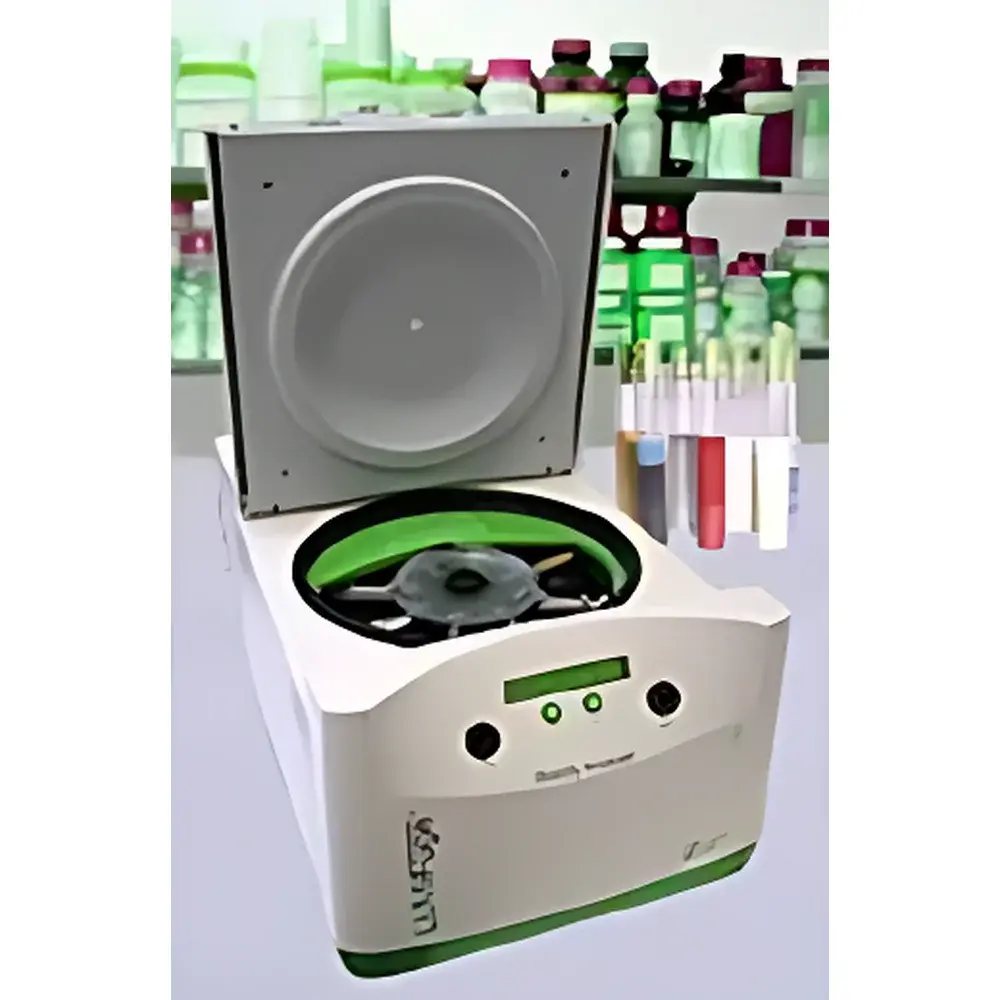
LUMiFuge Stability Analyzer by LUM GmbH
| Brand | LUM |
|---|---|
| Origin | Germany |
| Model | LUMiFuge |
| Centrifugal Acceleration | up to 1200 × g |
| Sample Capacity | 8 positions |
| Temperature Control Range | 4–60 °C (in three programmable zones) |
| Sample Volume | 0.1–2 mL |
| Particle Size Range | 0.05–1000 µm |
| Concentration Range | 1–90 vol% |
| Viscosity Range | 0.8–10⁸ mPa·s |
| Density Range | 0.01–10 g/cm³ |
| Separation Velocity Resolution | 0.01–1000 µm/s |
| Compliance | ISO 13318-2 |
Overview
The LUMiFuge Stability Analyzer is a high-precision, analytical ultracentrifuge engineered for rapid, quantitative assessment of colloidal and particulate system stability under accelerated gravitational stress. Unlike conventional visual sedimentation tests or static light scattering methods, the LUMiFuge employs patented STEP (Spatially Resolved Temporal Evolution of Transmission) technology — a dynamic, full-length optical scanning principle compliant with ISO 13318-2 for particle characterization in dispersed systems. By applying controlled centrifugal fields (300–3000 rpm, equivalent to 100–1200 × g), it induces and monitors real-time phase separation processes — including sedimentation, creaming, flocculation, coalescence, aggregation, and crystallization — across the entire sample height (1–2 mm path length). This enables predictive shelf-life modeling, formulation optimization, and root-cause analysis of instability mechanisms without requiring prior knowledge of particle size distribution or interfacial chemistry.
Key Features
- STEP Technology: Full-sample-height, high-resolution transmission profiling at up to 1200 data points per scan, capturing transient structural evolution with µm-level spatial resolution and sub-second temporal sampling.
- Multi-Zone Temperature Control: Independent thermal regulation across three distinct zones (4–60 °C), enabling precise simulation of storage conditions and temperature-dependent destabilization kinetics.
- 8-Position Parallel Analysis: Simultaneous monitoring of eight samples under identical acceleration and thermal profiles — essential for comparative formulation screening and DOE-based development.
- Quantitative Separation Kinetics: Direct calculation of migration velocity (0.01–1000 µm/s), layer thickness, interface sharpness, and phase boundary dynamics — all traceable to SI units and ISO-defined parameters.
- Robust Optical Architecture: Dual-wavelength (870 nm & 650 nm) LED-based transmission detection with auto-calibrated baseline correction, minimizing interference from absorption, fluorescence, or multiple scattering artifacts.
- Modular Rotor Design: Interchangeable sample carriers accommodating standard 2 mm path-length quartz cuvettes (0.1–2 mL volume), compatible with opaque, turbid, and highly concentrated dispersions (up to 90 vol%).
Sample Compatibility & Compliance
The LUMiFuge accommodates a broad spectrum of industrial and research-grade dispersions: aqueous and non-aqueous suspensions, oil-in-water and water-in-oil emulsions, polymeric colloids, nanostructured gels, CMP slurries, pharmaceutical nanosuspensions, agrochemical concentrates, food model systems (e.g., dairy emulsions, beer colloids), and wastewater flocs. It operates within defined physical boundaries — particle diameters from 50 nm to 1 mm, densities between 0.01 and 10 g/cm³, and viscosities spanning three orders of magnitude (0.8–10⁸ mPa·s). All measurement protocols and data outputs conform to ISO 13318-2 for centrifugal particle characterization. The system supports audit-ready documentation required for GLP and GMP environments, including electronic signatures, user access control, and full metadata logging per ICH and FDA 21 CFR Part 11 guidelines.
Software & Data Management
SEPView software provides an integrated platform for instrument control, real-time visualization, and advanced post-processing. It delivers time-resolved transmission profiles, derivative velocity maps, phase boundary tracking, and automated classification of destabilization modes (e.g., sediment compaction vs. network collapse). Raw data are stored in vendor-neutral HDF5 format, supporting third-party integration with MATLAB, Python (via h5py), or LIMS systems. Built-in statistical tools enable batch comparison, ANOVA-based significance testing, and Arrhenius modeling for temperature-accelerated stability prediction. All processing steps are fully traceable, with version-controlled algorithms and timestamped audit trails meeting regulatory requirements for data integrity.
Applications
- Pharmaceutical Development: Quantifying physical stability of injectable nanosuspensions, topical emulsions, and oral solid dispersion slurries under accelerated stress.
- Food Science: Predicting creaming kinetics in plant-based beverages, sedimentation behavior in fruit pulps, and haze formation in filtered beers.
- Coatings & Inks: Optimizing pigment dispersion stability, evaluating rheological modifiers, and benchmarking anti-settling additives.
- Agrochemical Formulations: Assessing suspension concentrate (SC) robustness, droplet coalescence in EC formulations, and clay-based carrier compatibility.
- Materials Science: Characterizing nanoparticle dispersion homogeneity in battery slurries, catalyst suspensions, and additive manufacturing feedstocks.
- Academic Research: Mechanistic studies of depletion flocculation, DLVO/non-DLVO interactions, and gel-sol transitions under controlled shear-free acceleration.
FAQ
How does the LUMiFuge differ from conventional centrifuges used for stability testing?
It replaces endpoint-only “yes/no” sedimentation checks with continuous, spatially resolved optical monitoring — delivering kinetic parameters, not just pass/fail outcomes.
Can the LUMiFuge measure zeta potential or particle size distribution directly?
No — it quantifies macroscopic separation behavior; complementary techniques like DLS or electrophoresis are recommended for microstructural characterization.
Is calibration required before each measurement?
The system performs automatic optical zeroing and reference normalization prior to every run; no user-performed calibration is needed.
Does SEPView support automated report generation for regulatory submissions?
Yes — customizable PDF/Excel templates include raw data plots, summary statistics, method parameters, and electronic signature fields compliant with 21 CFR Part 11.
What sample preparation steps are necessary?
Minimal: Samples are loaded into standardized cuvettes without dilution or filtration — preserving native dispersion state and avoiding artefactual destabilization.



