
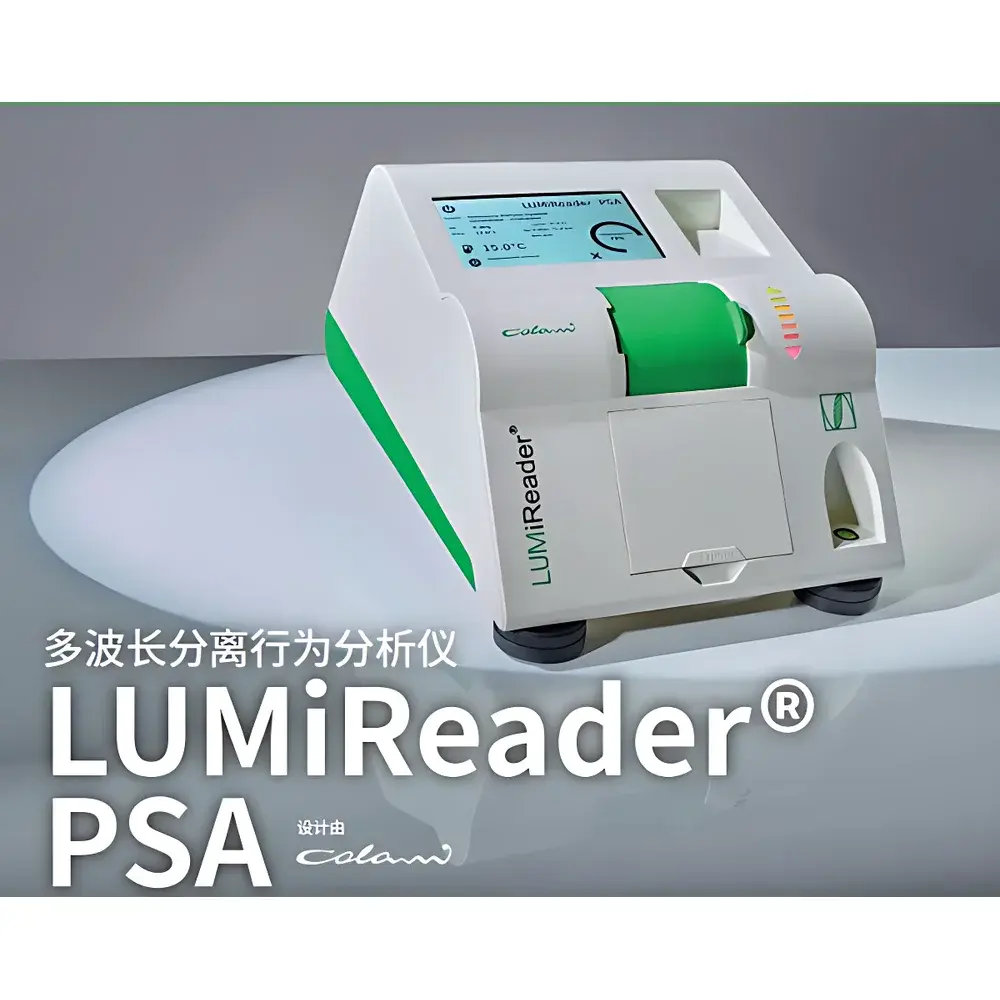
LUMiReader® PSA – Multi-Wavelength Dispersion Analyzer for Particle Separation Behavior
| Brand | LUM |
|---|---|
| Origin | Germany |
| Model | LUMiReader® PSA |
| Measurement Principle | Spatially Resolved Transmission Analysis (SRTA) with Multi-Wavelength Optical Detection |
| Compliance | Designed for GLP/GMP environments |
Overview
The LUMiReader® PSA is a high-precision, multi-wavelength dispersion analyzer engineered by LUM GmbH (Germany) for the quantitative assessment of particle separation behavior in colloidal and suspension systems. Unlike conventional sedimentation analyzers relying on single-wavelength light transmission, the LUMiReader® PSA employs spatially resolved transmission analysis (SRTA) across multiple discrete wavelengths (typically 470 nm, 525 nm, 625 nm, and 850 nm), enabling simultaneous monitoring of optical density gradients throughout the entire sample height (up to 60 mm) at sub-millimeter resolution. This capability allows differentiation between phenomena driven by particle size, density, refractive index contrast, and surface chemistry—critical for interpreting complex destabilization mechanisms such as creaming, sedimentation, flocculation, coalescence, and phase inversion. The instrument operates under controlled temperature (±0.1 °C) and centrifugal acceleration (up to 2,300 × g), accelerating separation kinetics while preserving thermodynamic relevance through defined stress profiles. Its core output—the Relative Sedimentation Time (RST)—is derived from time-resolved transmission profiles and serves as a robust, comparative metric for solvent quality ranking in Hansen Solubility Parameter (HSP) space.
Key Features
- Multi-wavelength optical detection (470 / 525 / 625 / 850 nm) for wavelength-dependent dispersion fingerprinting
- High-resolution spatial scanning (25 µm step size) across full 60 mm sample path length
- Programmable centrifugal field (100–2,300 × g) with real-time acceleration control
- Integrated Peltier temperature regulation (10–40 °C, ±0.1 °C stability)
- Automated RST calculation per wavelength channel, supporting HSP mapping workflows
- Non-invasive, label-free operation requiring no dilution or pre-treatment
- Compliant architecture for IQ/OQ/PQ validation protocols in regulated labs
Sample Compatibility & Compliance
The LUMiReader® PSA accommodates standard 2 mm × 40 mm glass capillaries (volume: ~120 µL), compatible with opaque, colored, and highly concentrated suspensions (up to 60 vol% solids). It has been validated for use with nanoscale systems (e.g., TiO₂/SiO₂ composites, ITO nanoparticles), biologics (adenoviral vectors, chitosan oligomers), pharmaceutical suspensions (paracetamol, ampicillin trihydrate), food-grade emulsions (beverage clouds, spirulina-based emulsions), and functional nanocomposites (PCL/HAp, boehmite-dental adhesives). All hardware and firmware conform to IEC 61000-6-3 (EMC) and IEC 61010-1 (safety). When operated with LUM Software Suite v5.4+, the system supports electronic signatures, user role management, and immutable audit trails aligned with FDA 21 CFR Part 11 and EU Annex 11 requirements for data integrity in GxP environments.
Software & Data Management
LUM Software Suite provides a dedicated module for Hansen Parameter analysis, enabling direct import of experimental RST datasets into 3D HSP space visualization tools. Users can generate “good solvent”/“bad solvent” clusters, compute interaction radius (R₀), and quantify dispersion stability via normalized sedimentation rate (NSR) and instability index (II). Raw transmission vs. time/position matrices are stored in HDF5 format, ensuring long-term readability and interoperability with MATLAB, Python (h5py), and JMP. Batch processing, report templating (PDF/CSV), and metadata tagging (ISO/IEC 17025-compliant) are fully supported. Audit logs record operator ID, parameter changes, calibration events, and export actions with timestamps—essential for GLP audits and regulatory submissions.
Applications
The LUMiReader® PSA is routinely deployed in formulation development and quality control across industries where colloidal stability dictates product performance: pharmaceutical suspension shelf-life prediction; optimization of Pickering emulsions in catalysis and food science; characterization of clay–polymer nanocomposites for barrier coatings; evaluation of surface-modified sepiolite/montmorillonite for rheology control; assessment of magnetic nanoparticle suspensions for hyperthermia agents; and screening of solvents for carbon nanotube dispersion in conductive inks. It further supports academic research in sol-gel synthesis (e.g., chitosan oligomer nanoparticles), interfacial engineering of cellulose nanocrystals, and immunoadjuvant formulation (TLR4 agonist delivery systems), providing quantitative, reproducible metrics beyond visual inspection or offline centrifugation tests.
FAQ
What physical principle does the LUMiReader® PSA use to assess dispersion stability?
It applies spatially resolved transmission analysis (SRTA) under controlled centrifugal stress to quantify time- and position-dependent optical density changes—directly correlating to particle migration, aggregation, and phase separation kinetics.
Can the instrument determine Hansen Solubility Parameters without external modeling software?
No. While it generates the essential RST input data, HSP mapping requires post-processing using LUM’s dedicated Hansen module or third-party HSPiP-compatible tools.
Is sample preparation standardized across different material classes?
Yes—capillary loading follows ISO 13321:2022 guidelines for sedimentation analysis; no filtration, dilution, or labeling is required for most opaque or high-viscosity samples.
Does the system support automated calibration verification?
Yes—built-in reference standards (e.g., certified polystyrene latex dispersions) enable daily optical and acceleration calibration checks traceable to NIST SRMs.
How is data integrity ensured during long-term stability studies spanning weeks?
Through continuous timestamped acquisition, cyclic redundancy checksums on HDF5 files, and write-once-read-many (WORM) archive options compliant with ALCOA+ principles.
Related Products



