
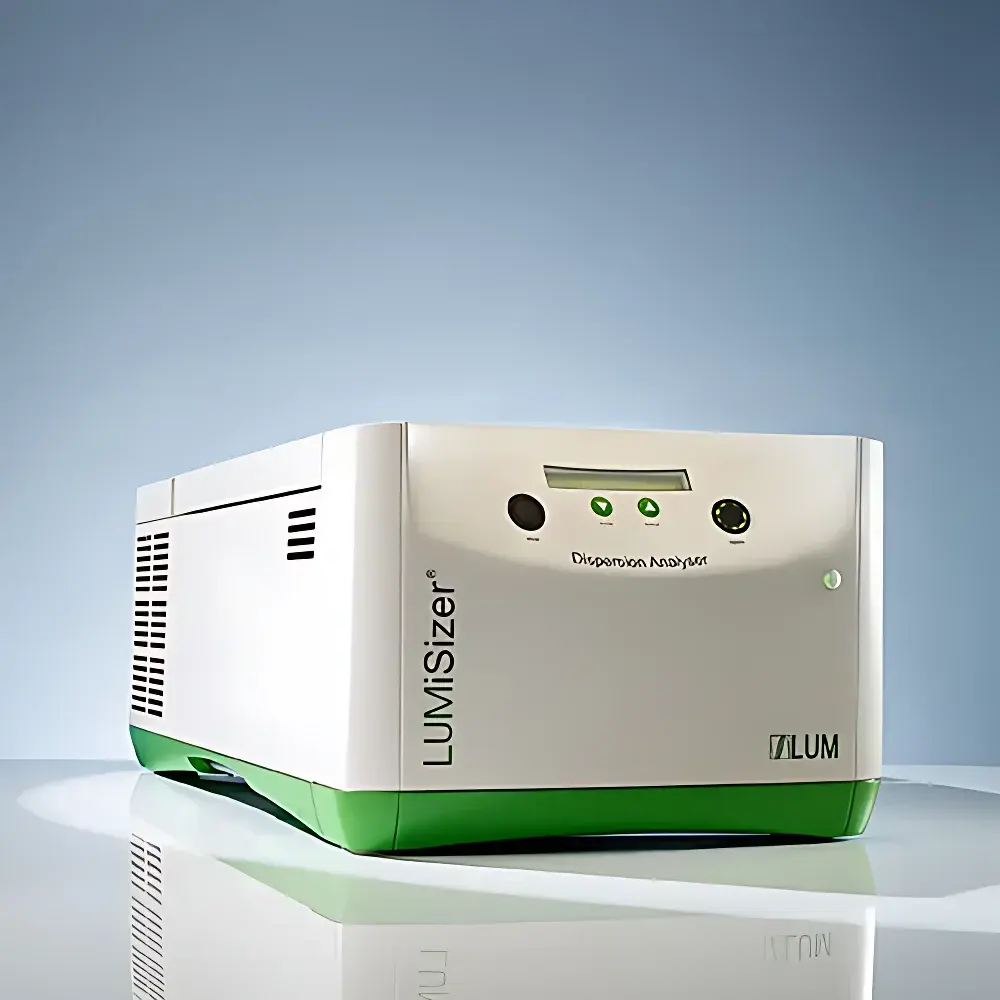
LUMiSizer Stability Analyzer
| Brand | LUM |
|---|---|
| Origin | Germany |
| Model | LUMiSizer |
| Measurement Principle | Spatial-Temporal Extinction Profiling (STEP) Technology |
| Sample Capacity | 12 positions |
| Temperature Control Range | 4 °C to 60 °C (±1 K) |
| Particle Size Range (Stability & Distribution) | 10 nm – 1000 μm |
| Concentration Range | 0.00015 % – 90 % w/w |
| Density Range | up to 22 g/cm³ |
| Viscosity Range | 0.8 – 10⁸ mPa·s |
| Optical Wavelengths | Multi-wavelength LED sources |
| Sample Volume per Cell | 0.05 – 2.0 mL |
| Dimensions (W×H×D) | 37 cm × 27 cm × 60 cm |
| Weight | 40 kg |
| Power Supply | 100/120/230 V, 50/60 Hz |
| Compliance | ISO 13318-2, ISO/TR 13097, FDA 21 CFR Part 11 (via SEPView software), GLP/GMP-ready audit trail |
Overview
The LUMiSizer Stability Analyzer is a benchtop analytical instrument engineered for high-resolution, real-time characterization of colloidal and particulate systems under accelerated gravitational stress. Unlike conventional light scattering or sedimentation methods relying on equilibrium assumptions or dilute suspensions, the LUMiSizer implements Spatial-Temporal Extinction Profiling (STEP) technology—a patented optical method that records full extinction profiles across the entire sample height (from meniscus to bottom) at user-defined time intervals. This enables simultaneous quantification of particle migration velocity, phase separation kinetics, and particle size distribution (PSD) without requiring prior knowledge of material constants such as refractive index, density difference, or viscosity. Its measurement principle conforms to ISO 13318-2 for centrifugal particle sizing and ISO/TR 13097 for dispersion stability assessment, making it suitable for regulatory-compliant R&D, QC, and formulation development in pharmaceuticals, coatings, food, cosmetics, and battery slurries.
Key Features
- Simultaneous analysis of 12 samples under identical or independently controlled temperature conditions (4 °C–60 °C, ±1 K stability)
- Multi-wavelength LED optical system enabling discrimination of absorbing vs. scattering contributions across diverse matrix types (aqueous, non-aqueous, Newtonian, and non-Newtonian)
- Direct measurement of particle velocity distributions—enabling identification of distinct instability mechanisms (e.g., creaming, sedimentation, flocculation, coalescence, Ostwald ripening)
- Full-sample-height resolution (up to 60 mm) with temporal sampling from 1 second to 99 hours, supporting both rapid screening and long-term shelf-life prediction
- No dilution required: validated for concentrated dispersions up to 90 % w/w and densities up to 22 g/cm³
- Integrated particle density calculation derived from sedimentation velocity and centrifugal field strength—eliminating need for external pycnometry
- STEP-based PSD determination in the range of 20 nm to 100 μm, compliant with ISO 13318-2 without calibration standards
- Acceleration factor adjustable from 6× to 2300× Earth’s gravity (g), enabling predictive stability testing within hours instead of months
Sample Compatibility & Compliance
The LUMiSizer accommodates a broad spectrum of dispersion types—including emulsions, suspensions, pastes, gels, and highly viscous slurries—with no requirement for sample dilution or pre-treatment. Its optical design supports measurements in opaque, colored, or high-absorption matrices where laser diffraction or DLS fail. Sample cells are available in multiple path lengths and materials (quartz, glass, polymer) to optimize signal-to-noise ratio across varying refractive index contrasts. All hardware and firmware comply with CE, EMC, and RoHS directives. When operated with SEPView software configured for electronic signatures and audit trail, the system meets FDA 21 CFR Part 11 requirements for data integrity in regulated environments. Full traceability—including raw extinction profiles, metadata timestamps, instrument calibration logs, and user activity history—is maintained per GLP/GMP guidelines.
Software & Data Management
SEPView software provides an integrated platform for instrument control, real-time visualization, automated data processing, and report generation. It supports custom workflow scripting (Python API), batch analysis of multi-parameter datasets, and comparative stability ranking using normalized instability indices (e.g., separation rate, interface velocity, turbidity gradient). Raw extinction profiles are stored in HDF5 format for long-term archival and third-party analysis. The software includes built-in modules for: (i) derivation of particle size distributions via inverse Laplace transformation of sedimentation velocity spectra; (ii) kinetic modeling of phase separation using exponential, power-law, or mechanistic models; (iii) shelf-life extrapolation based on Arrhenius or Q10 temperature acceleration; and (iv) compliance reporting aligned with ISO/TR 13097 Annex A. Each delivered LUMiSizer undergoes factory calibration against NIST-traceable reference standards, with calibration certificates provided and digitally embedded in instrument firmware.
Applications
- Formulation optimization of drug delivery systems (liposomes, nanosuspensions, microemulsions)
- Stability benchmarking of industrial pigments, ceramic slurries, and electrode coatings for Li-ion batteries
- Quantitative assessment of flocculation state in dairy products, plant-based beverages, and functional foods
- Accelerated aging studies for personal care emulsions (creams, lotions, sunscreens) under variable thermal stress
- Quality control of catalyst dispersions, polymer nanocomposites, and abrasive slurries
- Root-cause analysis of batch-to-batch variability in colloidal manufacturing processes
- Development of predictive models linking rheological behavior, interfacial chemistry, and macroscopic stability
FAQ
How does the LUMiSizer differ from traditional centrifugal analyzers?
It replaces point-sensor detection with full-height optical profiling, capturing spatial heterogeneity and transient phenomena missed by single-point transmittance instruments.
Can it measure particles smaller than 100 nm?
Yes—down to 10 nm in optimized aqueous systems, leveraging enhanced signal sensitivity and multi-wavelength deconvolution algorithms.
Is sample preparation required before analysis?
No centrifugation, filtration, dilution, or sonication is needed; native-state analysis preserves structure–property relationships.
Does it require reference standards for particle sizing?
No—size distribution is calculated directly from measured sedimentation velocities using first-principles physics, per ISO 13318-2.
How is temperature accuracy ensured during extended runs?
A dual-zone Peltier system with active feedback control maintains ±1 K uniformity across all 12 sample positions over durations exceeding 48 hours.
Can data be exported for statistical process control (SPC)?
Yes—CSV, XML, and HDF5 exports support integration with JMP, Minitab, Python pandas, and enterprise LIMS platforms.



