
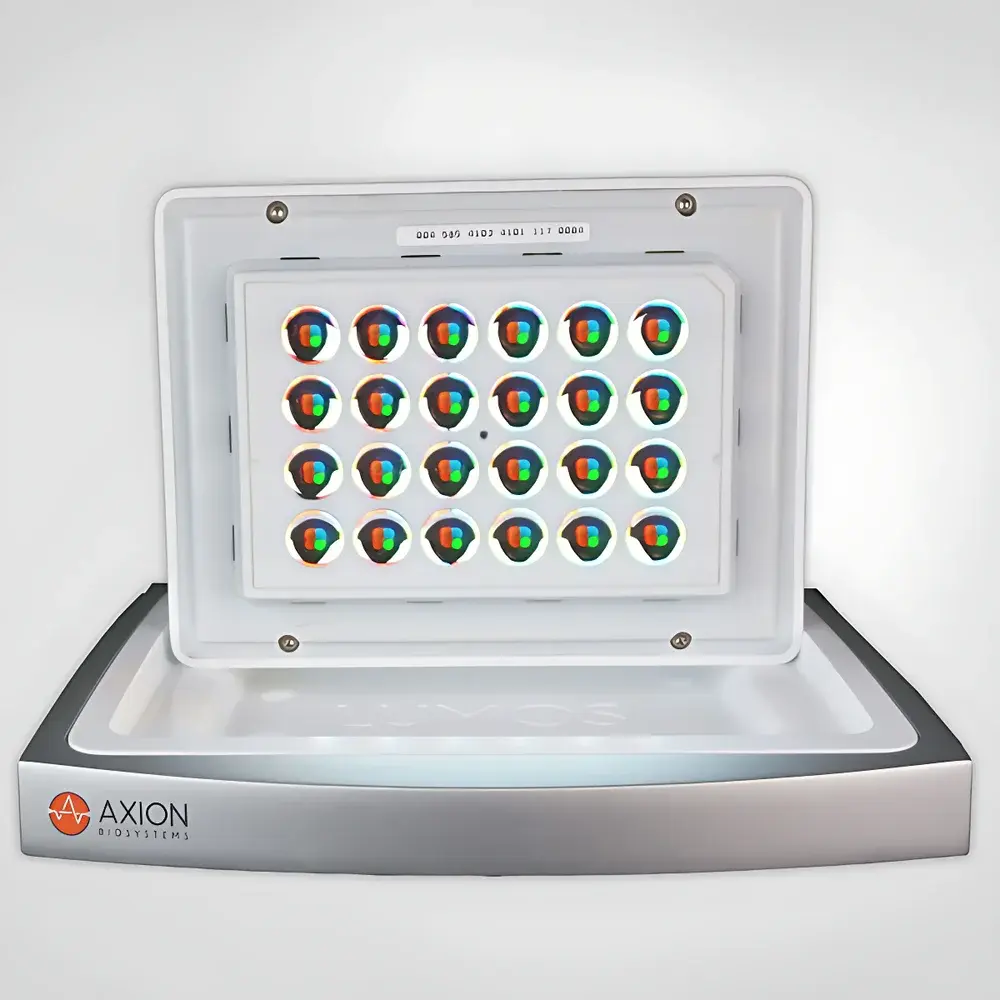
Lumos Photostimulation System for High-Throughput Microelectrode Array (MEA) Platforms
| Brand | Axion BioSystems |
|---|---|
| Origin | USA |
| Manufacturer | Axion BioSystems, Inc. |
| Model | Lumos |
| Instrument Type | Multiwell (24/48/96-well) |
| Application | In Vitro Electrophysiology |
| Compliance | Designed for GLP/GMP-aligned workflows, compatible with FDA 21 CFR Part 11–enabled software environments |
| Software Integration | Native interoperability with Maestro MEA acquisition and analysis platform |
Overview
The Lumos Photostimulation System is a purpose-built, high-throughput optogenetic stimulation platform engineered for seamless integration with Axion BioSystems’ Maestro multielectrode array (MEA) systems. It enables precise, spatiotemporally controlled optical activation of genetically encoded light-sensitive ion channels—such as Channelrhodopsin-2 (ChR2)—within live neural or cardiac co-cultures grown in standard multiwell MEA plates (24-, 48-, or 96-well formats). Unlike conventional LED arrays lacking wavelength specificity or temporal resolution, Lumos implements independent, per-well control of up to four discrete LED wavelengths (e.g., 470 nm blue, 530 nm green, 590 nm amber, 630 nm red), each adjustable in intensity (1–100%) and pulse duration (down to 100 ms). This architecture supports cell-type-specific interrogation in heterogeneous cultures—such as sympathetic vs. parasympathetic neuron–cardiomyocyte co-cultures—without physical intervention or pharmacological confounders. Its core measurement principle relies on concurrent optical perturbation and extracellular field potential (FP) recording via embedded microelectrodes, enabling causal inference between defined photostimuli and network-level electrophysiological responses.
Key Features
- Multiwell-compatible photostimulation: Supports 24-, 48-, and 96-well Axion MEA plates with uniform illumination across all wells.
- Four independently controllable LED wavelengths: Configurable spectral output optimized for common opsins (e.g., ChR2, Chrimson, NpHR) without cross-talk or thermal drift.
- Sub-second temporal precision: Pulse widths programmable from 100 ms to continuous illumination; inter-pulse intervals configurable to ≥100 ms.
- Per-well intensity modulation: Digital PWM-driven control ensures linear, repeatable irradiance (mW/mm²) across the full 1–100% range.
- Hardware-synchronized triggering: Tight timing alignment (<10 µs jitter) between optical stimulus onset and Maestro data acquisition timestamps.
- Embedded thermal management: Active heat dissipation maintains stable LED output and prevents sample heating-induced artifacts during extended protocols.
Sample Compatibility & Compliance
Lumos is validated for use with human induced pluripotent stem cell (iPSC)-derived neurons, cardiomyocytes, and their co-cultures plated on Axion’s proprietary CytoView MEA substrates. The system accommodates both monolayer and 3D microtissue configurations when mounted on compatible incubator-integrated Maestro platforms. All firmware and control logic comply with ISO 13485–aligned design controls. Data acquisition and stimulation logs are time-stamped, immutable, and exportable in HDF5 format—supporting audit trails required under GLP and 21 CFR Part 11 for preclinical assay development. No modifications to existing MEA plates or culture protocols are required; compatibility extends to standard laminin- or fibronectin-coated surfaces and common serum-free differentiation media.
Software & Data Management
Stimulation protocols are defined and executed through Axion’s Maestro Edge software (v3.0+), which provides a graphical protocol builder with nested loops, conditional branching, and real-time preview of optical output profiles. Each experiment generates a synchronized dataset comprising raw FP waveforms, photostimulus metadata (wavelength, intensity, duration, well ID), and environmental logs (temperature, CO₂, humidity if sensor-equipped). Data files include embedded provenance tags (user ID, instrument serial, calibration date) and support automated QC flagging based on signal-to-noise ratio (SNR) thresholds or spike train regularity metrics. Export options include MATLAB (.mat), Python (NumPy .npy), and CSV formats—with optional encryption and role-based access controls for shared lab deployments.
Applications
- Autonomic nervous system (ANS) circuit modeling: Selective activation of iPSC-derived sympathetic or parasympathetic neurons to modulate beating rate and conduction velocity in co-cultured cardiomyocytes—enabling mechanistic studies of arrhythmogenesis and neurocardiac coupling.
- Opsin characterization & screening: Quantitative assessment of activation kinetics, desensitization, and spectral sensitivity across opsin variants under physiological culture conditions.
- Network plasticity assays: Long-term potentiation/depression (LTP/LTD)-like protocols using paired photostimulation and electrophysiological readouts over days to weeks.
- Toxicity phenotyping: Detection of subtle, activity-dependent neurotoxicity or cardiotoxicity missed by endpoint assays—e.g., altered synaptic delay or burst synchrony following compound exposure.
- Drug mechanism-of-action studies: Differentiating direct ion channel blockade from indirect neuromodulatory effects via targeted photostimulation of defined neuronal subpopulations.
FAQ
Is Lumos compatible with non-Axion MEA plates?
No. Lumos is mechanically and optically calibrated exclusively for Axion’s CytoView MEA plates (24W, 48W, 96W formats) to ensure uniform irradiance distribution and electrode signal fidelity.
Can I use Lumos for in vivo or slice preparations?
No. Lumos is designed strictly for in vitro applications on adherent or microtissue cultures in multiwell MEA plates. It does not support stereotaxic mounting or fiber-optic coupling.
Does Lumos require separate calibration for each wavelength?
Yes. Factory-installed NIST-traceable photodiode sensors enable per-wavelength irradiance calibration, accessible via Maestro Edge’s Calibration Manager module.
How is data synchronization maintained between optical stimuli and electrophysiological recordings?
Hardware-level TTL triggering ensures sub-microsecond alignment; all timestamps originate from a shared FPGA clock domain within the Maestro-Lumos controller stack.
Is remote operation supported for regulated environments?
Yes. Maestro Edge supports secure remote desktop access via IT-approved VPNs, with full audit logging of user sessions, parameter changes, and data exports compliant with ALCOA+ principles.
Related Products



