
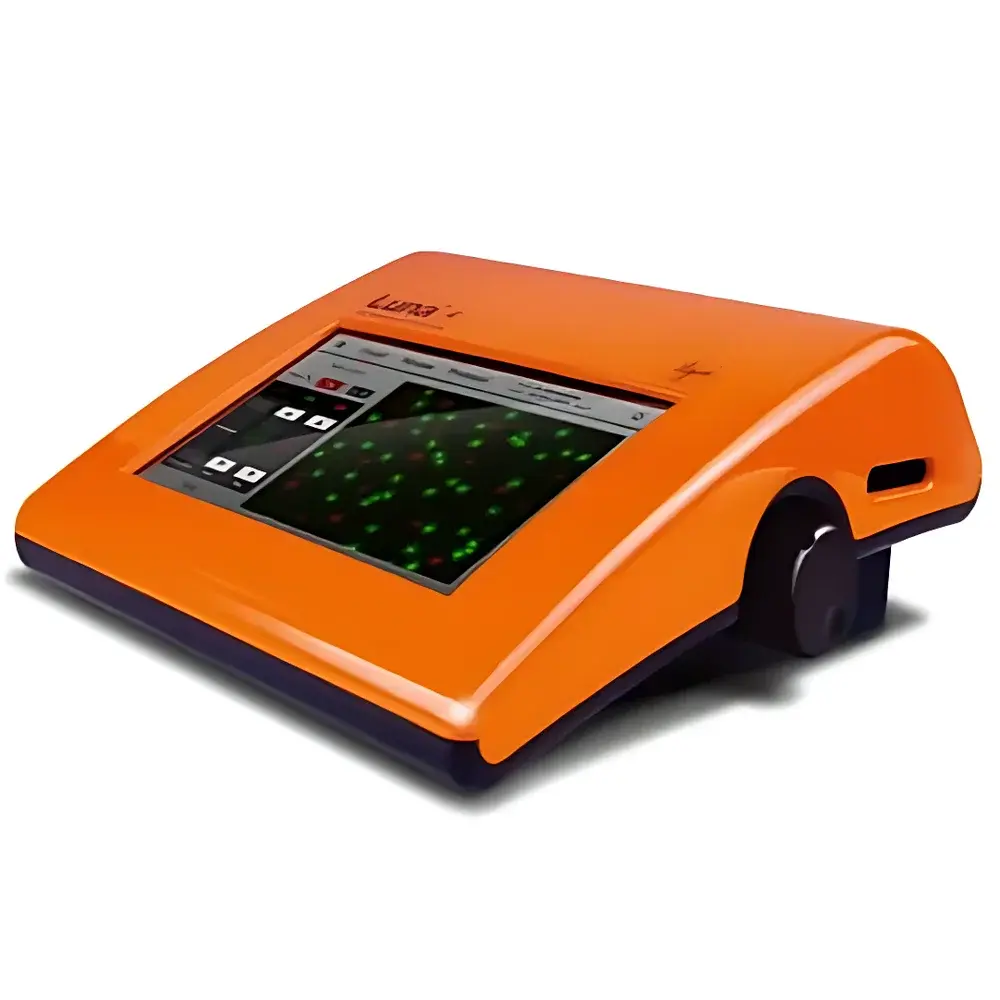
LUNA-FL™ Dual-Fluorescence Cell Counter by Aligned Genetics
| Brand | Aligned Genetics |
|---|---|
| Origin | South Korea |
| Model | L20001 |
| Detection Time | 30 s (fluorescence), 10 s (brightfield) |
| Cell Concentration Range | 5 × 10⁴ – 1 × 10⁷ cells/mL |
| Sample Volume | 10 µL |
| Detectable Cell Size Range | 1–90 µm (optimized for 5–60 µm) |
| Excitation Wavelength | 470 ± 20 nm |
| Emission Wavelengths | 530 ± 25 nm (GFP), 600 nm (long-pass, RFP-compatible) |
| Light Source | High-stability LED |
| Image Resolution | 5 MP |
| Display | 800 × 480-pixel TFT LCD touchscreen |
| Dimensions (W×D×H) | 22 × 21 × 9 cm (8.6 × 8.3 × 3.5 in) |
| Weight | 1.8 kg (4 lb) |
Overview
The LUNA-FL™ Dual-Fluorescence Cell Counter is an integrated, benchtop instrument engineered for rapid, objective, and label-based quantification of mammalian, insect, yeast, and primary cells. It combines high-fidelity fluorescence microscopy with automated image acquisition and algorithm-driven cell segmentation to deliver simultaneous assessment of total cell count, viability (via fluorescent viability dyes such as acridine orange/propidium iodide or Calcein AM/ethidium homodimer), and transfection efficiency (e.g., GFP or RFP expression). Unlike flow cytometry-based systems requiring fluidics calibration or suspension stability, the LUNA-FL™ operates on a static, capillary-loaded sample—eliminating shear stress artifacts and enabling reproducible analysis of fragile or adherent-derived suspensions. Its optical architecture employs dual-band fluorescence excitation and emission filtering aligned to standard fluorophore spectra, ensuring compatibility with widely adopted viability and reporter assays without spectral crosstalk.
Key Features
- Four validated counting modules: Brightfield cell counting, Fluorescence viability counting, Yeast cell counting (with budding discrimination), and GFP/RFP transfection efficiency analysis
- Integrated 5-megapixel CMOS sensor with LED-based illumination (470 ± 20 nm excitation; dual-channel emission detection at 530 ± 25 nm and 600 nm long-pass)
- Touchscreen interface with embedded firmware—no external PC required for routine operation or data export
- Optimized for low-volume analysis: 10 µL sample volume enables efficient use of precious primary or transfected cell populations
- Dynamic size-gating algorithm adapts to cell morphology across the 1–90 µm range, with robust performance validated for particles 5–60 µm in diameter
- Automated focus adjustment and exposure optimization per sample—minimizing operator dependency and inter-user variability
Sample Compatibility & Compliance
The LUNA-FL™ supports heterogeneous cell populations—including suspension-adapted lines (HEK293, CHO, Jurkat), primary PBMCs, stem cells, and yeast (S. cerevisiae, P. pastoris)—without protocol reconfiguration. Its non-flow, static imaging design avoids cell loss during aspiration or clogging associated with microfluidic channels. All counting algorithms are internally validated against NIST-traceable reference standards and comply with ISO 21501-4 (particle counting by image analysis) principles. While not a regulated medical device, the system meets key elements of GLP-compliant documentation: timestamped image capture, user ID logging, audit trail of parameter changes, and encrypted local storage supporting 21 CFR Part 11 readiness when deployed with enterprise network integration.
Software & Data Management
Firmware v3.2+ includes onboard data management with CSV and PDF report generation, including histograms of cell size distribution, fluorescence intensity scatter plots, and transfection efficiency metrics (GFP⁺ % = [GFP⁺ cells] / [total viable cells] × 100). Raw images and metadata (exposure time, gain, focus position, gate settings) are stored in DICOM-compatible format. USB export supports direct transfer to LIMS or ELN platforms. Optional cloud synchronization (via secure TLS 1.3) enables multi-site lab comparison studies while maintaining data sovereignty under GDPR and HIPAA-aligned encryption protocols.
Applications
- QC release testing of cryopreserved cell banks prior to expansion or differentiation
- Monitoring transfection kinetics across timepoints (e.g., 24 h, 48 h, 72 h post-nucleofection)
- Viability assessment of bioprocess harvest samples in upstream development
- Yeast fermentation monitoring with automated budding ratio calculation
- Pre-sort validation for FACS or magnetic bead isolation workflows
- Educational labs requiring intuitive, maintenance-free cell analysis instrumentation
FAQ
Does the LUNA-FL™ require daily calibration or alignment?
No—optical path and LED intensity are factory-calibrated and thermally stabilized. A single weekly verification using the included QC slide is recommended.
Can I use proprietary viability dyes beyond AO/PI or Calcein AM/EthD-1?
Yes, provided their excitation/emission profiles fall within the instrument’s 470 nm excitation band and 530 nm or 600 nm LP detection windows. Spectral overlap should be verified empirically.
Is data export compatible with statistical analysis packages like GraphPad Prism or Python pandas?
Yes—CSV exports include column headers compliant with common data ingestion pipelines; timestamps and units adhere to ISO 8601 and SI conventions.
What is the expected lifetime of the LED light source?
Rated for >20,000 hours of operational use under standard duty cycles, with negligible photobleaching or intensity drift over typical lab service intervals.
Does the system support multi-user account roles with permission levels?
Firmware v3.2 introduces role-based access control (RBAC) with Admin, Operator, and Viewer profiles—configurable via USB-configured policy file.



