
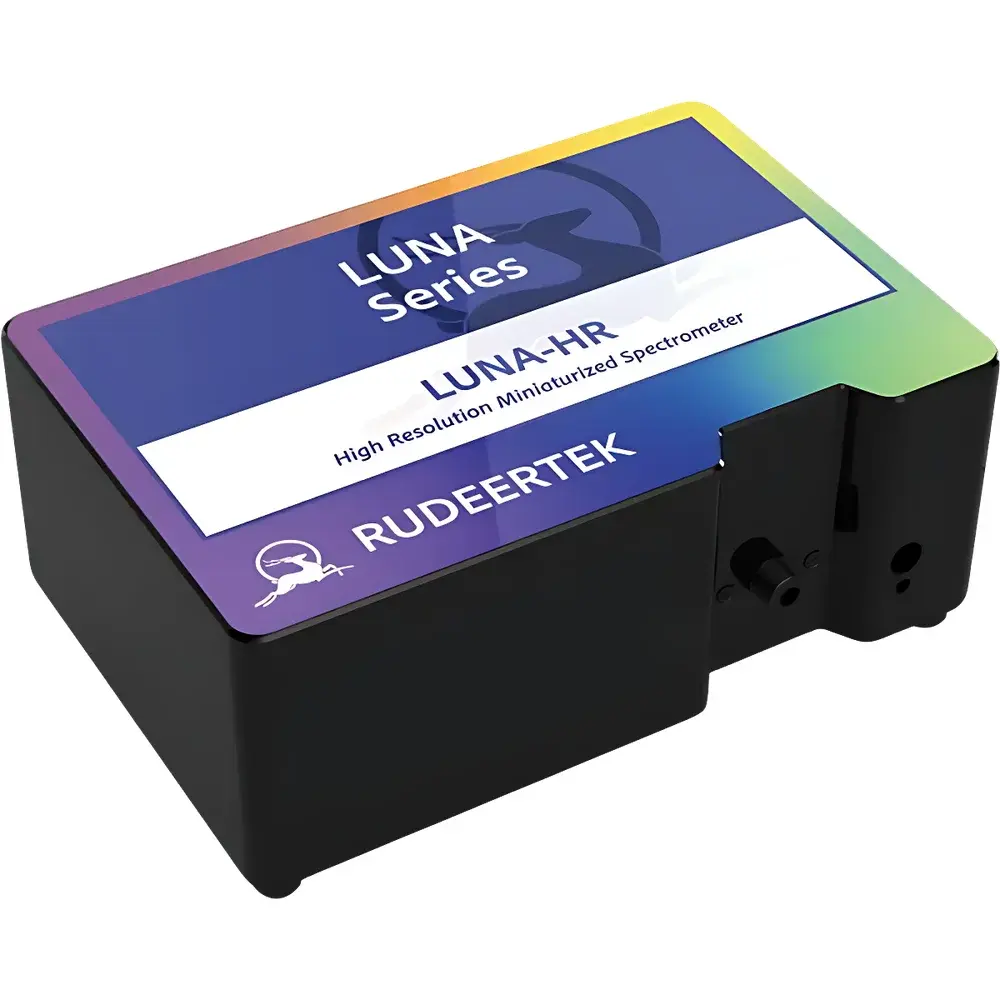
LUNA-HR High-Resolution Miniature Fiber Optic Spectrometer
| Brand | LUCHI Technology |
|---|---|
| Origin | Anhui, China |
| Manufacturer Type | OEM Manufacturer |
| Detector | CMOS Linear Array |
| Spectral Range | 200–1100 nm |
| Optical Resolution (FWHM) | 0.29–5.91 nm |
| Signal-to-Noise Ratio | 320:1 (full signal) |
| Dynamic Range | 1500:1 (single acquisition) |
| Stray Light | <1% |
| Pixel Count | 4096 × 1 |
| Pixel Size | 14 µm × 200 µm |
| Optical Design | Crossed Czerny-Turner |
| f-number | f/4 |
| Slit Options | 10 / 25 / 50 / 75 / 100 µm |
| Integration Time | 1 ms – 10 s |
| Linearity | ≥0.998 |
| A/D Resolution | 16-bit |
| Interface | USB 2.0 Type-B, Digital I/O |
| Fiber Connector | SMA905 |
| Weight | 460 g |
| OS Support | 32/64-bit Windows 7/10/11 |
Overview
The LUNA-HR High-Resolution Miniature Fiber Optic Spectrometer is an engineered solution for precision spectral analysis in resource-constrained or field-deployable environments. Based on the crossed Czerny-Turner optical architecture with an f/4 beam path, it delivers high optical throughput and minimized aberrations across its full 200–1100 nm spectral range. The instrument utilizes a 4096-pixel linear CMOS sensor with UV-enhanced responsivity and large vertical pixel dimension (200 µm), enabling superior quantum efficiency in the ultraviolet region—critical for applications such as halogen lamp characterization, LED spectral profiling, and UV-curable material monitoring. Its compact mechanical design (460 g) and integrated thermal stability features support consistent performance under ambient temperature fluctuations typical of mobile labs or inline process environments. Unlike CCD-based spectrometers, the CMOS detector offers faster readout speeds, lower power consumption, and immunity to blooming—making it suitable for time-resolved measurements including Laser-Induced Plasma Spectroscopy (LIPS) and pulsed-light source analysis.
Key Features
- 4096-pixel UV-optimized linear CMOS detector with 14 µm × 200 µm pixel geometry for enhanced UV sensitivity and dynamic linearity
- Adjustable entrance slits (10–100 µm) enabling user-selectable trade-offs between resolution and throughput
- Optical resolution ranging from 0.29 nm (at 10 µm slit, 400 nm) to 5.91 nm (at 100 µm slit, 800 nm), calibrated per ISO 14781:2019 guidelines
- Stray light suppression <1% (measured at 600 nm using tungsten-halogen source + notch filter method per ASTM E275)
- 16-bit analog-to-digital conversion with ≥0.998 linearity (R²) over full intensity range
- Dual interface architecture: high-speed USB 2.0 Type-B for spectral data streaming and opto-isolated digital I/O for external trigger synchronization and shutter control
- Robust aluminum housing with passive thermal management, compliant with IEC 60068-2 environmental stress testing profiles
Sample Compatibility & Compliance
The LUNA-HR supports direct coupling via standard SMA905 fiber optic connectors (core diameters 50–600 µm), enabling seamless integration with commercial probe assemblies, integrating spheres, cuvette holders, and remote sampling arms. It meets optical safety requirements per IEC 62471 for Class 1 LED-compatible operation and complies with electromagnetic compatibility standards EN 61326-1:2013 for laboratory and industrial use. While not certified for GMP-regulated environments out-of-the-box, its firmware architecture supports audit-ready metadata logging—including timestamped integration time, slit configuration, calibration ID, and detector temperature—facilitating alignment with FDA 21 CFR Part 11 electronic record controls when deployed with validated third-party software.
Software & Data Management
The spectrometer ships with a cross-platform SDK (C/C++, Python, LabVIEW, MATLAB) and a native Windows application supporting real-time spectrum visualization, multi-scan averaging, peak identification (with FWHM and centroid calculation), and reflectance/transmittance ratioing against reference scans. Raw spectral data is exported in CSV and HDF5 formats, preserving full 16-bit depth and metadata headers required for traceability. Batch processing workflows can be scripted to apply NIST-traceable wavelength and intensity calibrations (certified via factory-provided calibration reports per ISO/IEC 17025-accredited procedures). Optional add-ons include GLP-compliant report generation modules with digital signature fields and version-controlled calibration history tracking.
Applications
- Radiometric calibration of broadband sources (halogen, deuterium, xenon arc lamps) per CIE S 025/E:2015
- Colorimetric analysis (CIE XYZ, CIELAB) for display backlighting, pigment formulation, and textile quality control
- In-situ water quality monitoring (COD, nitrate, chlorophyll-a) using absorption spectroscopy in 200–400 nm and 600–800 nm bands
- Environmental emission screening (NO₂, SO₂, O₃) via differential optical absorption spectroscopy (DOAS) configurations
- Laser-Induced Plasma Spectroscopy (LIPS) for elemental mapping in metallurgy and geoscience, leveraging sub-millisecond triggering capability
- UV-curing process validation through real-time monomer conversion tracking at 254 nm and 365 nm bands
FAQ
What slit width should I select for optimal resolution in UV-VIS measurements?
For highest resolution below 400 nm, use the 10 µm slit; however, consider 25 µm for balanced SNR and resolution in routine halogen lamp or LED characterization.
Is the LUNA-HR compatible with third-party optical calibration standards?
Yes—the instrument accepts user-defined wavelength and radiometric calibration files in ASCII format, supporting NIST SRM 2036, 2068, and 2035 traceability chains.
Can multiple LUNA-HR units be synchronized for hyperspectral imaging?
Yes—via TTL-triggered acquisition over the digital I/O port, enabling precise temporal alignment across up to 8 spectrometers with <100 ns jitter.
Does the device require external cooling or thermoelectric stabilization?
No—its CMOS detector operates stably from 5 °C to 40 °C without active cooling; dark current drift remains <0.5% per °C within this range.
How is stray light quantified, and what test method is used?
Stray light is measured per ASTM E275 using a 600 nm bandpass filter and a deep-notch blocking filter; reported value (<1%) reflects worst-case ratio of out-of-band signal to in-band peak response.







