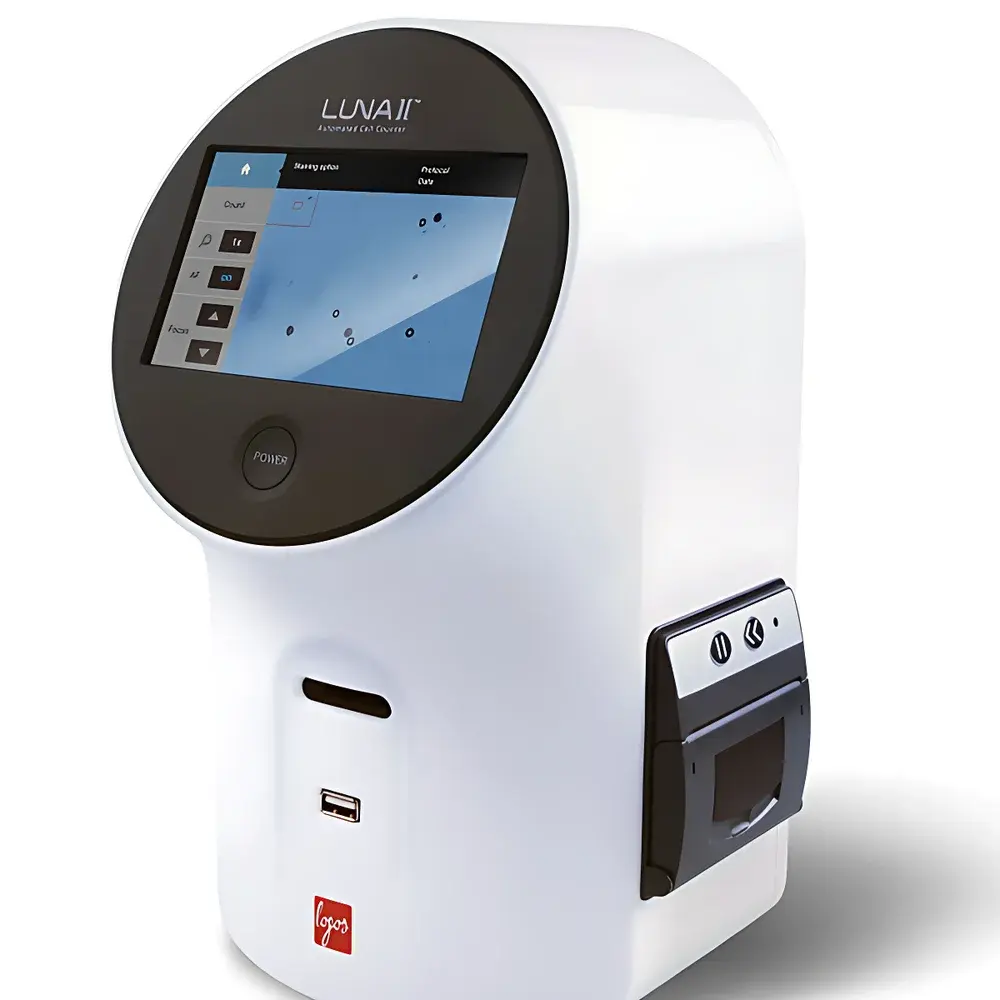
LUNA-II™ Automated Cell Counter
| Brand | Aligned Genetics |
|---|---|
| Origin | South Korea |
| Model | L10001 |
| Counting Time | <10 s (manual focus), <15 s (auto-focus) |
| Cell Concentration Range | 5 × 10⁴ – 1 × 10⁷ cells/mL |
| Cell Size Range | 3–60 µm (optimal: 8–30 µm) |
| Viability Range | 0–100% |
| Image Resolution | 5 MP |
| Output Formats | TIFF (annotated), PDF reports |
| Dimensions (W×D×H) | 16 × 18 × 28 cm |
| Weight | 1.6 kg |
| Power Input | 100–240 VAC, 50/60 Hz |
| DC output | 12 VDC, 3.3 A |
Overview
The LUNA-II™ Automated Cell Counter is a self-contained, benchtop instrument engineered for rapid, reproducible, and operator-independent quantification of mammalian, yeast, and insect cell suspensions. It employs high-contrast brightfield microscopy coupled with real-time digital image acquisition and proprietary segmentation algorithms to perform dual-parameter analysis—cell concentration and viability—based on differential staining (e.g., trypan blue or erythrosin B). Unlike flow-based systems, the LUNA-II™ uses static imaging of a fixed-volume sample chamber, eliminating shear stress artifacts and enabling direct visual verification of counting results. Its integrated liquid lens auto-focus system ensures consistent optical plane alignment across heterogeneous samples, while the onboard ARM-based processor executes image capture, analysis, and report generation without reliance on external computers. Designed for routine QC in bioprocessing, academic labs, and cell therapy workflows, the instrument meets foundational requirements for GLP-compliant documentation and supports audit-ready data integrity through timestamped, immutable PDF reporting.
Key Features
- Sub-15-second automated counting cycle with liquid lens autofocus—no manual calibration or z-stack acquisition required
- Proprietary de-clustering algorithm that resolves aggregated cells into individual objects using morphological watershed segmentation and intensity gradient analysis
- Viability assessment based on membrane integrity dyes, with configurable thresholding for size- and intensity-based gating
- Built-in thermal printer for immediate hardcopy output of concentration, viability, total count, coefficient of variation (CV), and annotated cell images
- USB 2.0 interface for exporting high-resolution TIFF images (with scale bar and metadata), CSV-formatted raw data, and searchable PDF reports
- Reusable quartz-glass slide option (L12011/L12012) validated for ≥50 cleanings with ethanol and deionized water—reducing consumable cost per run by >70% versus disposable slides
- On-device software interface with intuitive touch-responsive controls, multilingual support (EN/DE/FR/ES/KO), and real-time histogram visualization of cell size distribution
Sample Compatibility & Compliance
The LUNA-II™ accommodates standard trypan blue (0.4%), erythrosin B, and other FDA-approved viability dyes without hardware modification. It has been verified for use with primary human PBMCs, CHO-K1, HEK293, Jurkat, Sf9, and Saccharomyces cerevisiae suspensions. All counting protocols align with ASTM E2877-13 (Standard Guide for Cell Counting Method Validation) and support traceability under ISO/IEC 17025:2017 for testing laboratories. While not certified as a medical device under FDA 21 CFR Part 820, the system’s data export architecture—including embedded timestamps, user login logs, and non-editable PDF reports—facilitates compliance with internal SOPs for GMP-aligned cell banking and biomanufacturing release testing.
Software & Data Management
Firmware v3.2+ includes audit-trail functionality compliant with ALCOA+ principles: all actions (sample ID entry, dye selection, gate adjustments, report generation) are logged with user ID, timestamp, and parameter values. Data files retain EXIF metadata including exposure time, gain, focus position, and slide lot number. Reports embed digital signatures and are exportable in PDF/A-1b format for long-term archival. No cloud connectivity is enabled by default; all processing occurs locally to preserve data sovereignty—a critical requirement for EU GDPR and HIPAA-regulated environments. Optional USB drive (U10005, 16 GB) enables encrypted backup of up to 10,000 counting sessions.
Applications
- Bioreactor inoculum qualification and harvest titer estimation in upstream process development
- Post-thaw viability assessment of cryopreserved CAR-T and NK cell products
- Yeast fermentation monitoring in industrial biotechnology
- Transfection efficiency screening via pre- and post-transfection counts
- Educational laboratory instruction in cell culture fundamentals and assay validation
- QC release testing for cell-based therapeutics under ICH Q5D and USP <1043>
FAQ
Does the LUNA-II™ require daily calibration?
No. The system performs automatic optical self-check at power-on and validates focus consistency using built-in reference targets. Calibration-free operation is supported per manufacturer’s IQ/OQ documentation package.
Can I reanalyze previously captured images?
Yes. All TIFF images are stored with full metadata and can be reloaded into the instrument’s software to adjust gating parameters, change dye settings, or regenerate reports without re-running the sample.
Is the reusable slide compatible with all LUNA-II™ models?
Yes. The quartz reusable slide (L12011/L12012) is mechanically and optically identical across all LUNA-II™ configurations and validated for use with both trypan blue and erythrosin B.
What is the maximum allowable debris-to-cell ratio for accurate counting?
The instrument maintains ≤5% CV in concentration measurement when debris particles constitute <15% of total detected objects and exhibit mean intensity <40% of stained dead cells—verified per ISO 21501-4 Annex B guidelines.
How does the LUNA-II™ handle very low-concentration samples (e.g., <1×10⁵ cells/mL)?
It applies adaptive exposure control and dynamic background subtraction to maximize signal-to-noise ratio; however, statistical confidence decreases below 5×10⁴ cells/mL due to Poisson sampling error—users are advised to concentrate dilute samples prior to analysis.