
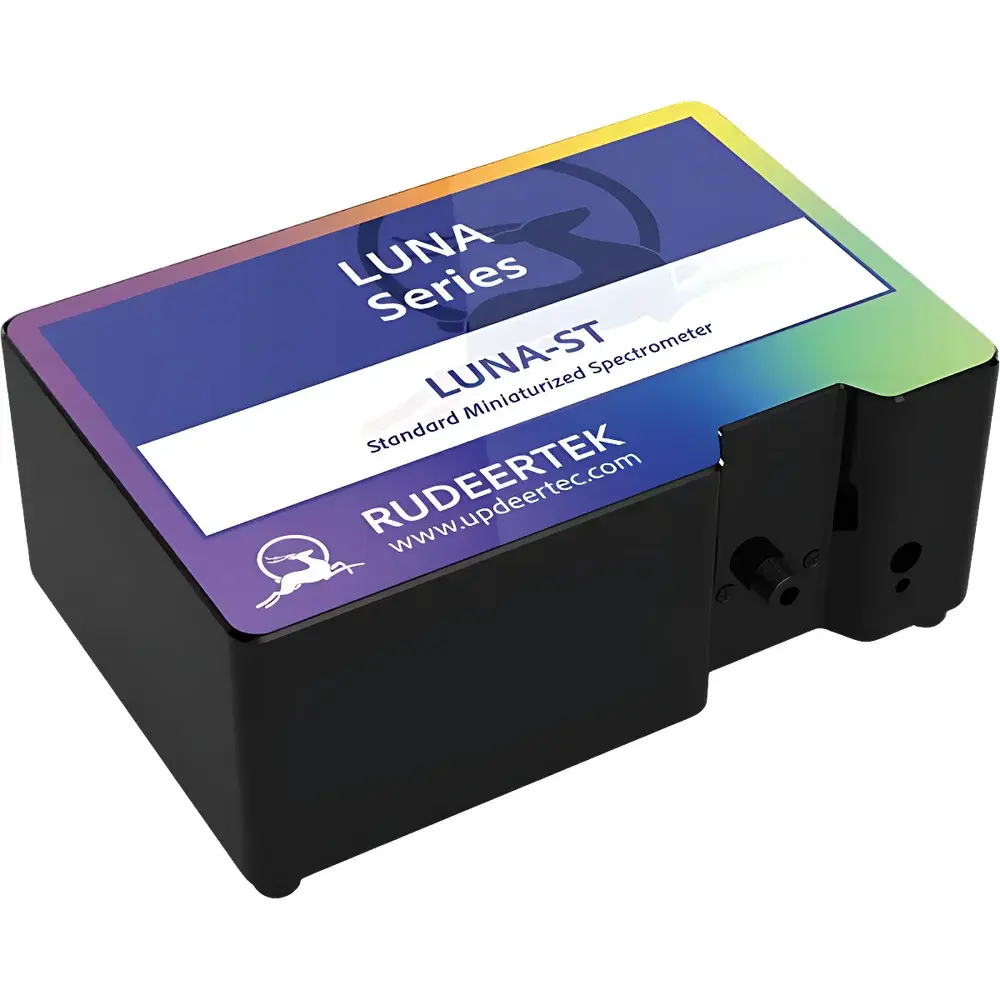
LUNA-ST High-Stability Miniature Fiber Optic Spectrometer
| Brand | LuQi Technologies |
|---|---|
| Origin | Anhui, China |
| Manufacturer Type | OEM/ODM Producer |
| Origin Category | Domestic (China) |
| Model | LUNA-ST |
| Pricing | Upon Request |
| Detector Type | Linear CCD Array |
| Spectral Range | 350–1100 nm |
| Optical Resolution (FWHM) | 0.39–6.6 nm |
| Signal-to-Noise Ratio | 300:1 (full signal) |
| Dynamic Range | 1300:1 (single acquisition) |
| Stray Light | <1% |
| Focal Ratio | f/4 |
| Slit Options | 10 / 25 / 50 / 75 / 100 µm |
| Integration Time | 1 ms – 10 s |
| Linearity | ≥0.998 |
| A/D Resolution | 16-bit |
| Pixel Count | 2048 × 1 |
| Pixel Size | 14 µm × 56 µm |
| Optical Design | Crossed Czerny-Turner |
| Weight | 460 g |
| Interfaces | USB 2.0 Type-B, Digital I/O, SMA905 fiber port |
| OS Compatibility | 32/64-bit Windows 7/10/11 |
Overview
The LUNA-ST High-Stability Miniature Fiber Optic Spectrometer is an engineered solution for embedded and portable spectral measurement applications requiring robust optical performance in a compact form factor. Based on the crossed Czerny-Turner optical architecture with an f/4 focal ratio, the LUNA-ST delivers high wavelength fidelity and minimal optical aberration across its full 350–1100 nm spectral range. Its core measurement principle relies on dispersion of incident light via a ruled or holographic grating, followed by spatially resolved detection using a 2048-pixel linear CCD array with 14 µm pixel pitch. Designed for integration into OEM analytical platforms—including handheld colorimeters, inline process monitors, environmental sensors, and portable photometric systems—the LUNA-ST prioritizes thermal and mechanical stability to ensure repeatability over extended operation cycles. Unlike benchtop spectrometers, the LUNA-ST achieves sub-1% stray light performance through optimized internal baffling and precision-aligned optical path geometry—critical for quantitative reflectance, absorbance, and emission measurements where background suppression directly impacts detection limits.
Key Features
- Compact footprint (125 × 85 × 40 mm) and lightweight design (460 g), enabling seamless integration into space-constrained instrumentation
- Thermally stabilized optical bench and low-drift electronics supporting long-term measurement consistency under ambient temperature fluctuations
- Selectable entrance slits (10–100 µm) allowing user-tuned trade-offs between resolution and throughput without hardware modification
- USB 2.0 Type-B interface with native support for isochronous data streaming at up to 1 kHz frame rate (dependent on integration time and ROI configuration)
- Digital I/O lines for hardware-triggered acquisition, external shutter control, and synchronization across multi-spectrometer arrays
- Full spectral stitching capability: multiple LUNA-ST units can be operated in master-slave mode with synchronized triggering and timestamp-aligned data capture
- Factory-calibrated wavelength and intensity response with NIST-traceable reference lamp validation documentation available upon request
Sample Compatibility & Compliance
The LUNA-ST interfaces exclusively via SMA905 fiber optic connectors, supporting standard 200–600 µm core diameter fibers with numerical apertures up to 0.22. It is compatible with common illumination sources including tungsten-halogen, deuterium, LED arrays, and pulsed lasers (with appropriate attenuation). The spectrometer meets CE marking requirements for electromagnetic compatibility (EN 61326-1) and safety (EN 61010-1). While not certified for intrinsic safety or hazardous area deployment, its low-power consumption (<2.5 W) and absence of high-voltage components make it suitable for Class I, Division 2 environments when housed in appropriate enclosures. For regulated industries, raw spectral data export supports audit-ready formats (CSV, HDF5) and optional firmware-level timestamping compliant with GLP/GMP documentation workflows. Though not FDA 21 CFR Part 11-certified out-of-the-box, the device’s deterministic trigger behavior and immutable metadata logging enable validation-ready integration into compliant analytical systems.
Software & Data Management
LuQi provides the LUNA Control Suite—a native Windows application supporting real-time spectrum visualization, batch acquisition, dark/baseline correction, and mathematical operations (e.g., derivative, smoothing, peak integration). SDKs are available for C/C++, Python (via ctypes), and LabVIEW, exposing low-level register access, programmable gain control, and hardware synchronization registers. All acquired spectra include embedded metadata: UTC timestamp, integration time, detector temperature (monitored via onboard thermistor), slit ID, and calibration file hash. Data files support optional password-protected encryption and SHA-256 checksum generation for integrity verification. Export options include ASCII (CSV), binary (IEEE 754 float32), and hierarchical HDF5—facilitating direct ingestion into MATLAB, Python (NumPy/Pandas), or LIMS platforms.
Applications
- Portable colorimetry and spectral reflectance analysis in textile, paint, and plastic quality control
- In-line monitoring of LED phosphor conversion efficiency and binning during manufacturing
- Environmental field spectroscopy for water quality assessment (e.g., chlorophyll-a, dissolved organic carbon estimation)
- UV-Vis absorption kinetics in microfluidic reaction chambers
- Calibration transfer between reference and field-deployed instruments using spectral matching algorithms
- Multi-channel fluorescence lifetime excitation profiling via gated acquisition with external TTL triggers
FAQ
What slit width should I select for optimal resolution in the visible range?
For nominal 0.39 nm resolution at 550 nm, a 10 µm slit is recommended; however, this reduces signal throughput by ~50% compared to a 25 µm slit. Trade-off analysis should consider your source brightness and required SNR.
Can the LUNA-ST operate in continuous scanning mode with external clock input?
Yes—digital I/O supports TTL-compatible external trigger frequencies from 1 Hz to 10 kHz, with jitter <100 ns. Frame-to-frame timing is hardware-gated and independent of USB latency.
Is spectral calibration traceable to NIST standards?
Each unit ships with a factory calibration certificate referencing traceable tungsten-halogen and mercury-argon line sources. Full calibration datasets (wavelength, linearity, sensitivity) are provided in machine-readable format.
How does the LUNA-ST maintain stability during temperature cycling?
The optical bench uses low-CTE aluminum alloy, and critical components (grating mount, detector carrier) are secured with athermal kinematic design. Internal temperature is monitored continuously, and optional software-based thermal drift compensation is available.
Does the device support OEM firmware customization?
Yes—LuQi offers contract firmware development for proprietary protocols, custom I/O logic, or accelerated acquisition pipelines, subject to NDA and minimum order volume.
Related Products






