
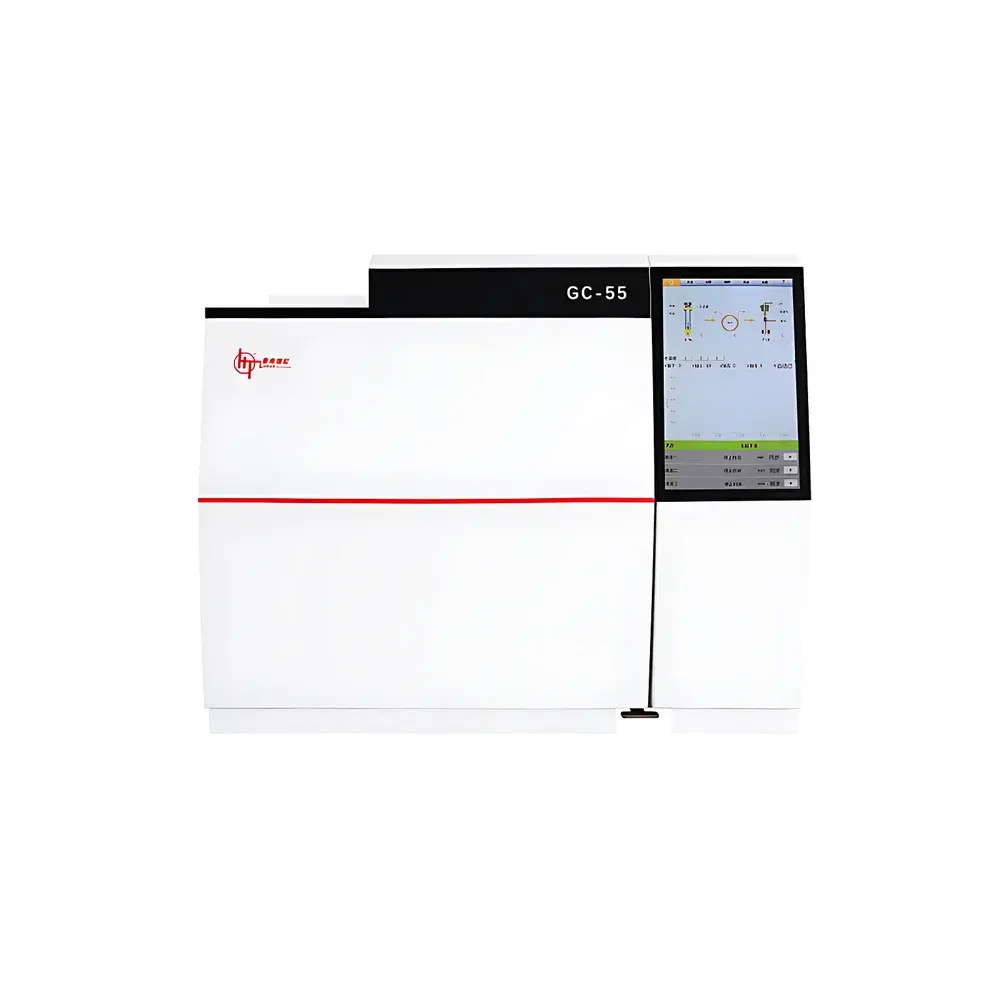
Lunan Ruihong GC-55 Gas Chromatograph
| Brand | Lunan Ruihong |
|---|---|
| Model | GC-55 |
| Type | Laboratory Gas Chromatograph |
| Temperature Control Range | 4 °C to 450 °C |
| Ramp Rate | 0.1–120 °C/min |
| Cool-down Time | ≤4 min (450 °C → 50 °C) |
| Carrier Gas Flow Range | 0–1000 mL/min |
| Carrier Gas Pressure Range | 0–100 psi |
| Injector Max Temp | 450 °C |
| Injector Pressure Setpoint Range | 0–100 psi |
| Injector Total Flow Setpoint Range | 0–500 mL/min |
| Temperature Zones | 8 independent zones |
| Programmed Temperature Steps | up to 100 steps |
| Temperature Resolution | 0.01 °C |
| Temperature Accuracy | ±0.01 °C |
| EPC/EFC Resolution | 0.001 psi / 0.001 mL/min |
| Maximum Split Ratio | 1:1000 |
| Detector Support | FID, TCD, ECD, FPD, NPD (up to 4 simultaneously) |
| Data Interface | Ethernet IEEE 802.3 (MODBUS/TCP compliant) |
| Display | 10.1″ capacitive color touchscreen |
Overview
The Lunan Ruihong GC-55 Gas Chromatograph is a high-performance, modular laboratory gas chromatography system engineered for precision separation, identification, and quantification of volatile and semi-volatile organic compounds. Based on the fundamental principle of differential partitioning between a mobile phase (inert carrier gas) and a stationary phase (capillary or packed column), the GC-55 delivers robust analytical performance across diverse sample matrices. Its architecture supports routine QC testing, method development, environmental monitoring, petrochemical analysis, food safety screening, and pharmaceutical impurity profiling. Designed for compliance-driven environments, the instrument integrates hardware-level temperature stability, digital pneumatic control, and networked data acquisition—enabling traceable, auditable, and reproducible chromatographic workflows in GLP- and GMP-aligned laboratories.
Key Features
- Digital Pneumatic Control System: Fully integrated Electronic Pressure Control (EPC) and Electronic Flow Control (EFC) modules provide real-time, closed-loop regulation of carrier gas pressure (0–100 psi) and flow (0–1000 mL/min) with 0.001 psi / 0.001 mL/min resolution—ensuring retention time stability and inter-run reproducibility.
- Advanced Thermal Management: Eight independently controlled temperature zones—including oven, injector(s), and detector(s)—support precise thermal programming from 4 °C above ambient to 450 °C. With 100-step programmable ramping (0.1–120 °C/min) and rapid cool-down (≤4 min from 450 °C to 50 °C), the system accommodates complex multi-analyte methods without thermal lag.
- Modular Detector Architecture: Supports simultaneous installation of up to four detectors—including Flame Ionization (FID), Thermal Conductivity (TCD), Electron Capture (ECD), Flame Photometric (FPD), and Nitrogen-Phosphorus (NPD)—with auto-ignition capability for FID and individual temperature/flow optimization per detector.
- Network-Ready Instrument Control: Embedded 10/100/1000 Mbps Ethernet interface complies with IEEE 802.3 and MODBUS/TCP protocols, enabling seamless integration into enterprise LIMS, DCS, or centralized chromatography data systems. Remote monitoring, firmware updates, and method deployment are performed over standard TCP/IP infrastructure.
- Human-Centric Operator Interface: A 10.1-inch high-resolution capacitive touchscreen provides intuitive navigation, real-time chromatogram visualization, and context-sensitive parameter entry—reducing training time and minimizing input errors.
- Hardware-Level Data Integrity: Onboard 24-bit analog-to-digital conversion with baseline storage and subtraction functionality ensures high signal fidelity. All temperature, pressure, and flow setpoints are logged with timestamps, satisfying ALCOA+ data integrity principles.
Sample Compatibility & Compliance
The GC-55 accepts a broad range of injection modalities—including split/splitless capillary, packed-column, gas-loop (6-port valve), and autosampler-compatible configurations—making it suitable for liquid, gaseous, and headspace samples. Its universal detector support enables selective detection across compound classes: hydrocarbons (FID), permanent gases (TCD), halogenated organics (ECD), sulfur/phosphorus-containing species (FPD), and nitrogen- or phosphorus-selective analytes (NPD). The system meets essential regulatory expectations for analytical instrumentation: temperature calibration traceability to NIST standards, EPC validation per ASTM E260 and ISO 17025 guidelines, and full audit trail generation compatible with FDA 21 CFR Part 11 requirements when paired with validated chromatography data software.
Software & Data Management
The GC-55 operates with a dedicated, Windows-based chromatography workstation capable of managing multiple instruments concurrently. The software supports method creation, sequence definition, real-time acquisition, peak integration using customizable algorithms (e.g., tangent skim, valley-to-valley), calibration curve generation (linear, quadratic, weighted), and report export in PDF, CSV, or XML formats. Raw data files include embedded metadata (instrument ID, operator, method version, audit events), and the system logs all user actions—including parameter changes, method loads, and run starts/stops—with immutable timestamps. Optional software modules extend functionality to include electronic signatures, role-based access control, and automated backup to network drives or cloud repositories—facilitating compliance with ISO/IEC 17025, USP , and ICH Q2(R2) validation frameworks.
Applications
- Environmental analysis: VOCs in air/water per EPA Method 8260/524.2; pesticide residues in soil per ISO 14501.
- Petrochemical QA/QC: Hydrocarbon type analysis (PIONA), benzene/toluene/xylenes (BTX), and sulfur speciation in fuels.
- Food & beverage safety: Residual solvents, flavor volatiles, mycotoxin derivatives, and packaging migrants.
- Pharmaceuticals: Assay of active ingredients, residual solvent testing per ICH Q3C, and degradation product profiling.
- Forensic toxicology: Detection and quantification of drugs of abuse, metabolites, and synthetic cannabinoids in biological matrices.
FAQ
Does the GC-55 support remote diagnostics and firmware updates?
Yes—via its embedded Ethernet interface and MODBUS/TCP stack, the instrument allows secure remote access for configuration review, diagnostic logging, and over-the-air firmware upgrades using standard network tools.
Can the GC-55 be validated for regulated pharmaceutical use?
The hardware design and data handling architecture meet foundational requirements for 21 CFR Part 11 compliance when deployed with qualified software, documented IQ/OQ/PQ protocols, and appropriate change control procedures.
What is the maximum number of temperature zones that can be actively controlled during a single run?
Eight independent temperature zones—including column oven, up to three injectors, and up to four detectors—are fully programmable and monitored in real time.
Is the system compatible with third-party autosamplers?
Yes—the GC-55 features standardized TTL and RS-232 trigger interfaces, supporting integration with major OEM autosamplers (e.g., CTC PAL, Gerstel MPS) via configurable event timing and handshake protocols.
How is data integrity ensured during power interruption or unexpected shutdown?
All critical operational parameters and acquisition states are written to non-volatile memory at 1-second intervals; upon restart, the system resumes acquisition from the last valid data point without loss of chromatographic continuity.






