
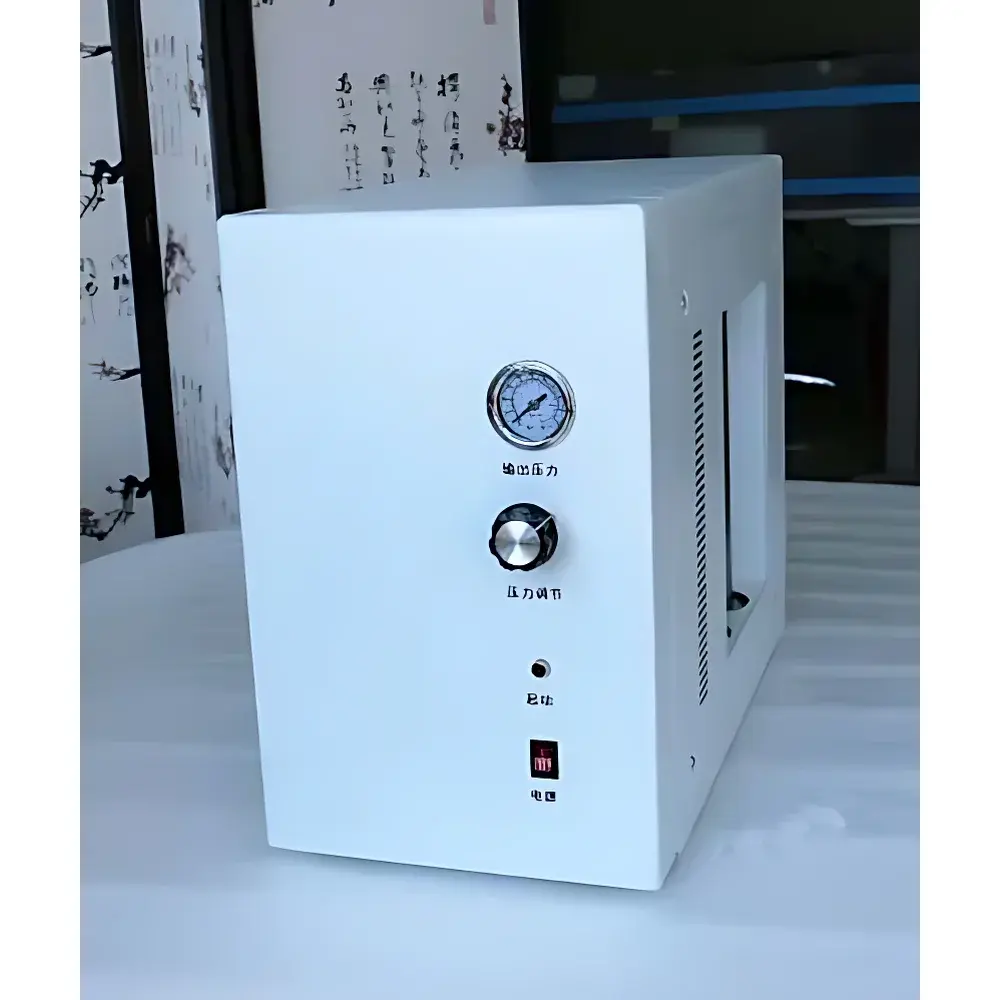
Lunan Ruihong RHA-2L / RHA-5L Air Generator
| Brand | Lunan Ruihong |
|---|---|
| Origin | Shandong, China |
| Model | RHA-2L (0–2 L/min) / RHA-5L (0–5 L/min) |
| Output Pressure | A Port 0–0.4 MPa, B Port 0–0.5 MPa |
| Hydrocarbon Content | <0.1 ppm (as total C1–C4, measured by GC-FID per ISO 8573-5) |
| Dew Point | −15 °C to +40 °C (adjustable via integrated refrigerated dryer and desiccant stage) |
| Noise Level | ≤42 dB(A) at 1 m |
| Power Consumption | 150 W (RHA-2L), 170 W (RHA-5L) |
| Dimensions (L×W×H) | 470 × 230 × 375 mm |
| Weight | 22 kg (RHA-2L), 23 kg (RHA-5L) |
| Input Power | 220 V AC, 50 Hz |
| Operating Ambient | 15–40 °C, RH ≤70%, non-corrosive, low-dust environment |
| Filtration Stages | Three-stage oil-free purification (particulate → coalescing → activated carbon + molecular sieve) |
Overview
The Lunan Ruihong RHA-2L and RHA-5L Air Generators are compact, oil-free laboratory-grade compressed air sources engineered for continuous or intermittent operation in analytical instrumentation environments. These generators produce clean, dry, hydrocarbon-scrubbed air via a multi-stage purification architecture—eliminating reliance on high-pressure cylinders while maintaining strict compliance with instrument inlet specifications for gas chromatography (GC), elemental analyzers, FTIR, and other air-dependent lab systems. Air intake is drawn from ambient laboratory air, then processed through particulate pre-filtration, coalescing filtration to remove aerosols and condensed moisture, and a final dual-bed adsorption stage comprising activated carbon and molecular sieve media—ensuring consistent removal of hydrocarbons (C1–C4), residual oil vapors, and water vapor. The integrated refrigerated dryer and desiccant polishing stage enables adjustable dew point control across a range of −15 °C to +40 °C, supporting both ambient-temperature applications and moisture-sensitive detectors.
Key Features
- Oil-free, maintenance-optimized design with no lubricated compression elements—ensuring zero risk of oil contamination to downstream instruments.
- Two independently regulated output ports: Port A delivers 0–0.4 MPa (60 psi), Port B delivers 0–0.5 MPa (72 psi), each with precision diaphragm-type pressure regulators and built-in overpressure protection (mechanical relief valve set at 0.6 MPa).
- Three-stage purification system certified to ISO 8573-1:2010 Class 2:2:2 (solid particles, water, oil) when operated within specified ambient conditions.
- Automatic condensate drainage via float-actuated solenoid valve—prevents manual intervention and ensures uninterrupted flow stability.
- Soft-start circuitry enabling atmospheric-pressure startup, reducing mechanical stress on compressor components and extending service life beyond 10,000 hours MTBF.
- Low-noise operation (<42 dB[A] at 1 meter) achieved through acoustic enclosure, vibration-dampened mounting, and optimized airflow routing—suitable for shared lab spaces and QA/QC environments.
Sample Compatibility & Compliance
The RHA series is validated for use with GC FID/TCD detectors, ICP-OES plasma support gas lines, TOC combustion modules, and nitrogen generator feed-air streams. Its hydrocarbon content (<0.1 ppm total volatile hydrocarbons, verified per ISO 8573-5 using calibrated GC-FID) meets ASTM D6245 requirements for instrumental air purity. Units comply with IEC 61000-6-3 (EMC emission standards) and GB 4793.1–2007 (Chinese safety standard for lab equipment). While not FDA 21 CFR Part 11–compliant out-of-the-box (no electronic audit trail or user access control), the analog control interface supports integration into GLP/GMP workflows when paired with external data loggers meeting Annex 11 requirements.
Software & Data Management
The RHA-2L/5L operates via a fully analog front-panel interface—power switch, pressure gauges (dual-scale 0–1.0 MPa), and status LEDs (Power, Pressure OK, Drain Active). No embedded firmware or digital connectivity is provided; this architecture prioritizes reliability, electromagnetic immunity, and long-term calibration stability over networked functionality. All operational parameters—including flow rate, pressure, and dew point—are manually adjustable and stable under load variation (±1.5% full-scale repeatability). Maintenance logs and filter replacement records must be retained externally per ISO/IEC 17025 Clause 8.3.
Applications
- Carrier and detector gas supply for benchtop and floor-standing gas chromatographs requiring ultra-low hydrocarbon air.
- Combustion air for TOC analyzers and elemental CHNS/O instruments where trace organics compromise oxidation efficiency.
- Pneumatic actuation and purge gas for FTIR spectrometers, laser alignment systems, and optical benches sensitive to particulate or moisture ingress.
- Feed-air source for membrane-based nitrogen generators—reducing dew point variability and extending PSA column lifetime.
- General-purpose lab air for pipetting stations, vacuum manifolds, and cleanroom blow-off—where cylinder logistics pose safety or space constraints.
FAQ
What is the maximum allowable ambient temperature for continuous operation?
Continuous operation is rated for ambient temperatures between 15 °C and 40 °C. Above 35 °C, output flow may decrease by up to 8% due to reduced compressor volumetric efficiency.
How often must the filter cartridges be replaced?
Under typical lab conditions (22 °C, 50% RH), the three-stage filter set requires replacement every 6,000 operating hours or annually—whichever occurs first. Replacement intervals shorten in high-humidity or dusty environments.
Can the RHA-5L supply two GCs simultaneously?
Yes—provided combined instrument demand remains ≤4.5 L/min at ≤0.4 MPa. For dual high-flow FID applications (>2.5 L/min each), we recommend verifying pressure drop across the distribution manifold.
Is the dew point adjustable in real time?
Dew point is set via manual adjustment of the refrigerated dryer’s thermostat and desiccant bypass ratio. No digital PID control or remote setpoint interface is included.
Does the unit include a pressure regulator for each outlet?
Yes—both A and B ports feature independent, factory-calibrated diaphragm regulators with lockable knobs and dual-range analog gauges (0–0.6 MPa / 0–1.0 MPa).
Related Products



