
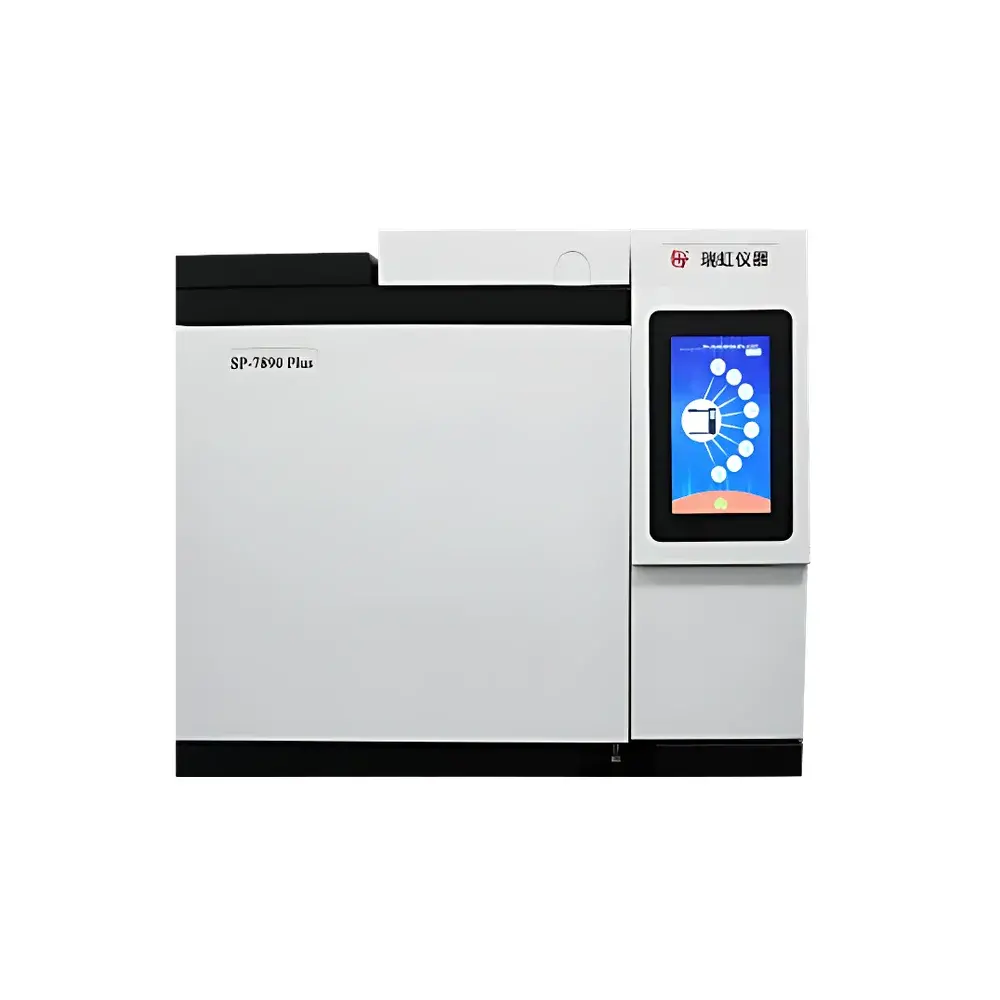
Lunan Ruihong SP-7890Plus High-Performance Gas Chromatograph
| Brand | Lunan Ruihong |
|---|---|
| Origin | Shandong, China |
| Model | SP-7890Plus |
| Instrument Type | Laboratory Gas Chromatograph |
| Application Scope | General-Purpose |
| Temperature Control Range | 4°C above ambient to 450°C |
| Heating Rate | 0.1–80°C/min |
| Cooling Rate | ≤2 min from 200°C to 100°C |
| Carrier Gas Flow Range & Control | 0–1000 mL/min |
| Carrier Gas Pressure Range & Control | 0–100 psi |
| Injector Maximum Operating Temperature | 450°C |
| Total Injector Flow Setting Range | 0–1000 mL/min |
Overview
The Lunan Ruihong SP-7890Plus High-Performance Gas Chromatograph is a modular, network-enabled analytical instrument engineered for precision separation and quantitative analysis of volatile and semi-volatile organic compounds. Based on capillary or packed column gas chromatography principles, it utilizes carrier gas-driven solute partitioning between a mobile phase (inert gas) and a stationary phase (coated capillary or packed column) to achieve high-resolution component elution. Designed for routine QC, environmental monitoring, petrochemical screening, and pharmaceutical impurity profiling, the SP-7890Plus integrates robust thermal management, multi-detector flexibility, and industrial-grade digital infrastructure—making it suitable for ISO/IEC 17025-accredited laboratories and GLP-compliant environments.
Key Features
- Eight independent temperature-controlled zones—including oven, up to three detectors, and up to four inlets—with programmable 16-step ramp profiles and ±0.1°C thermal accuracy (incremental setpoint resolution: 0.5°C)
- Dual-mode thermal management: rapid heating (0.1–80°C/min) and accelerated cooling (≤2 min from 200°C to 100°C), enabled by an automated column oven rear-door system for enhanced near-ambient retention control
- Integrated 7-inch full-color capacitive touchscreen with hot-swap capability—functions as both local HMI and portable controller for remote instrument operation
- Multi-processor architecture ensuring real-time data acquisition stability, synchronized event handling (8 external TTL inputs), and dual auxiliary analog outputs for peripheral device integration
- Triple-detector capacity supporting simultaneous FID, TCD, ECD, FPD, or NPD configurations; FID includes auto-ignition logic and logarithmic amplification for extended dynamic range (10⁷)
- Gigabit Ethernet interface compliant with IEEE 802.3 and embedded TCP/IP stack—enables secure LAN/WAN connectivity, DCS integration via MODBUS/TCP, and remote diagnostics without additional gateways
- 24-bit low-noise ADC with baseline storage and real-time baseline subtraction algorithms—optimized for trace-level quantitation and long-duration unattended runs
Sample Compatibility & Compliance
The SP-7890Plus accommodates diverse injection modalities: split/splitless capillary, packed column, gas-tight syringe, six-port valve, and optional autosampler interfaces (e.g., CTC PAL or equivalent). It supports standard GC columns (0.1–0.53 mm ID, up to 60 m length) and common carrier gases (He, H₂, N₂) with fully electronic pressure and flow control (EPC/EFC) across 0–100 psi and 0–1000 mL/min ranges. The system meets functional requirements aligned with ASTM D3606, EPA Method 8021B, USP , and ISO 17025 clause 5.9 for method validation and instrument qualification. Its firmware architecture supports audit trail generation, user access levels, and electronic signature readiness per FDA 21 CFR Part 11 when paired with validated chromatography data systems (CDS).
Software & Data Management
The dedicated workstation software supports concurrent connection to multiple SP-7890Plus units, enabling centralized method deployment, sequence scheduling, and cross-instrument data aggregation. It provides bidirectional communication for real-time parameter adjustment, run initiation, and hardware status polling. Raw data files adhere to AIA/ANDI standards (netCDF-based), ensuring interoperability with third-party CDS platforms including OpenLab CDS, Chromeleon, and Empower. Built-in reporting tools generate PDF/Excel-compliant compliance reports with integrated calibration verification logs, peak purity assessment, and system suitability metrics (e.g., tailing factor, resolution, %RSD). All data modifications are timestamped and attributed to user IDs, satisfying GLP documentation integrity requirements.
Applications
- Environmental analysis: BTEX, PAHs, chlorinated hydrocarbons, and pesticide residues in water, soil, and air matrices
- Petrochemical QA/QC: Hydrocarbon group-type analysis (PIONA), sulfur compound profiling, and refinery gas composition
- Pharmaceutical testing: Residual solvent quantitation (ICH Q3C), extractables/leachables screening, and chiral separation validation
- Food & flavor chemistry: Volatile aroma compound fingerprinting, fatty acid methyl ester (FAME) profiling, and adulterant detection
- Forensic toxicology: Blood alcohol, drug metabolite identification, and accelerant residue characterization
FAQ
Does the SP-7890Plus support 21 CFR Part 11 compliance out of the box?
No—compliance requires configuration of user authentication, audit trail logging, and electronic signatures within the connected CDS environment. The instrument’s firmware provides the necessary data integrity primitives (e.g., immutable timestamps, user ID binding), but full validation must be performed per organizational SOPs.
Can I operate the instrument without the touchscreen interface?
Yes—the unit is fully controllable via Ethernet-connected PC using the native workstation or any MODBUS/TCP-compatible SCADA system. The touchscreen is optional for local interaction.
What is the maximum column bleed temperature limit for standard fused-silica capillaries?
While the oven reaches 450°C, standard 5%-phenyl methylpolysiloxane columns are typically rated to 325°C continuous use; column-specific temperature limits must be observed to maintain resolution and longevity.
Is EPC calibration traceable to NIST standards?
Factory calibration uses reference mass flow controllers certified to ISO/IEC 17025; end-user recalibration kits and procedures are provided for periodic verification against traceable gas standards.
How many methods can be stored internally on the instrument?
The onboard flash memory retains up to 100 method files; additional storage is managed externally via the workstation or network file server.
Related Products





