
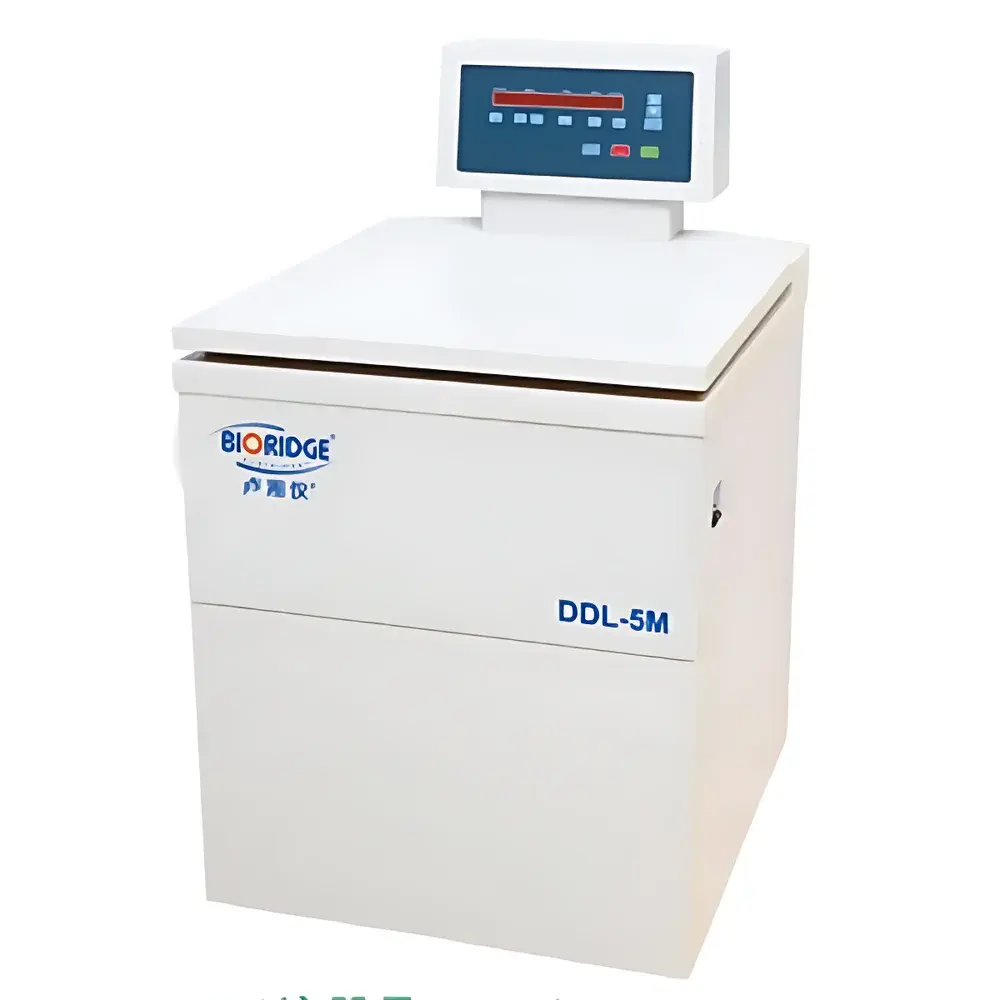
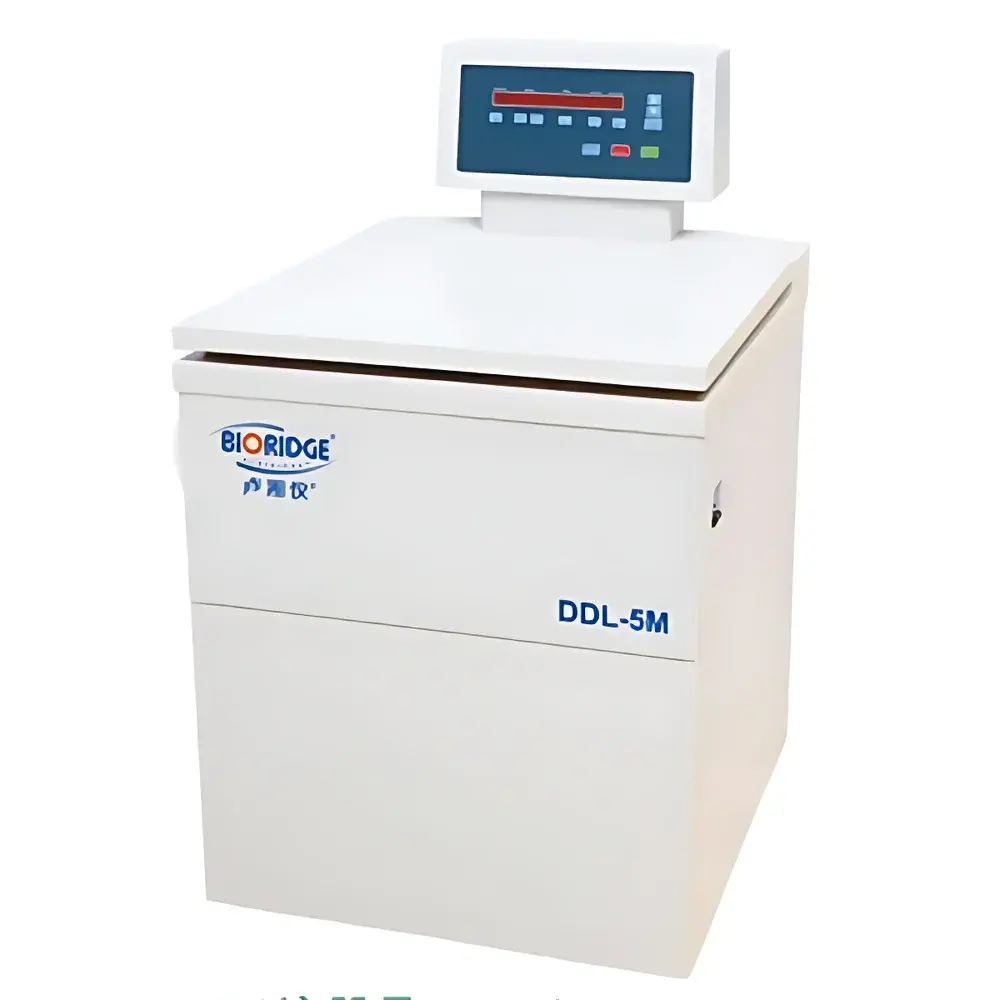
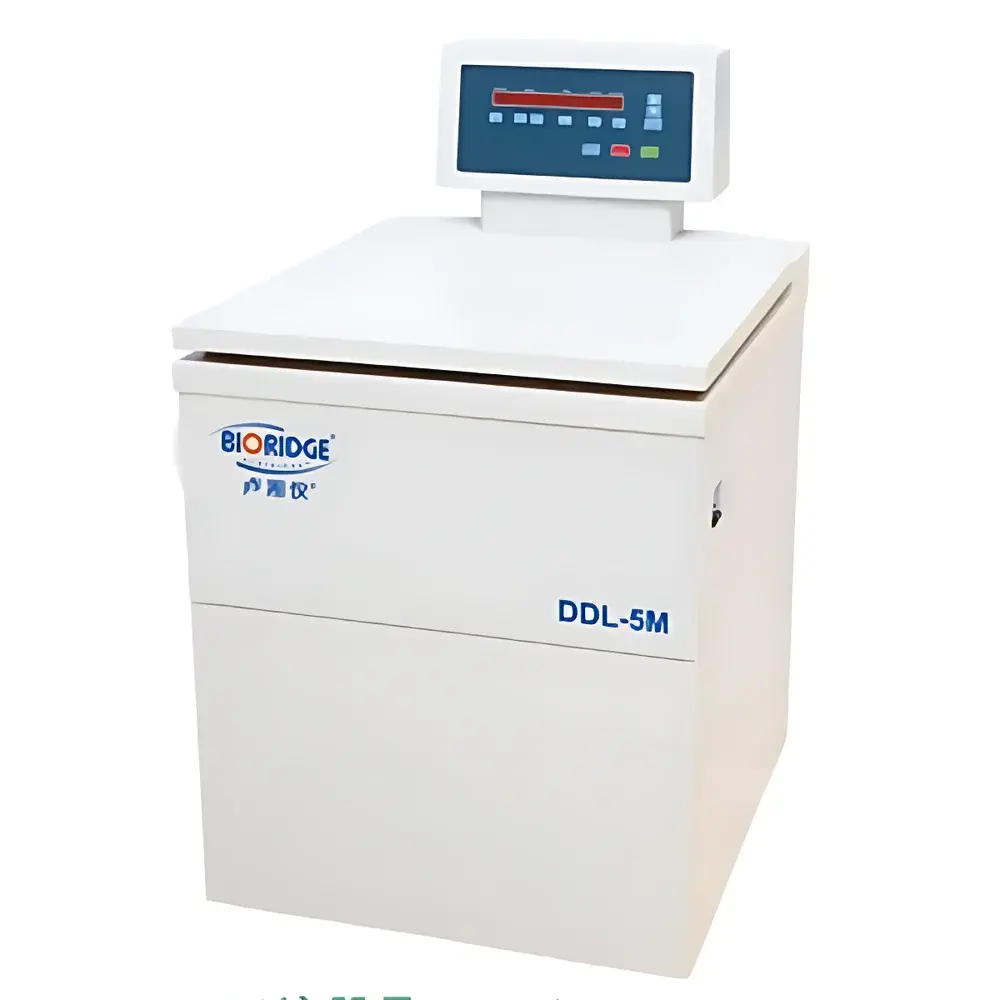
LuoXiangYi DDL-5M Low-Speed Refrigerated Centrifuge
| Brand | LuoXiangYi / BIORIDGE |
|---|---|
| Origin | Shanghai, China |
| Model | DDL-5M |
| Centrifuge Type | Benchtop Refrigerated Centrifuge |
| Maximum Speed | 5000 rpm |
| Maximum RCF | 3780 × g |
| Maximum Capacity | 4 × 750 mL |
| Temperature Range | −20 °C to +40 °C |
| Temperature Accuracy | ±1 °C |
| Speed Accuracy | ±50 rpm |
| Timer Range | 1–99 min |
| Noise Level | <65 dB(A) |
| Dimensions (L×W×H) | 650 × 710 × 1100 mm |
| Net Weight | 170 kg |
| Refrigerant | R404a |
| Power Supply | AC 220 V, 50 Hz, 20 A |
Overview
The LuoXiangYi DDL-5M Low-Speed Refrigerated Centrifuge is an engineered benchtop separation platform designed for reproducible, temperature-controlled sedimentation of large subcellular particles—including nuclei, mitochondria, lysosomes, and viral particles—in clinical, academic, and biopharmaceutical laboratories. Operating on the principle of differential centrifugation under precisely regulated thermal conditions, the DDL-5M delivers stable rotor dynamics at speeds up to 5000 rpm and a maximum relative centrifugal force (RCF) of 3780 × g. Its refrigerated architecture—featuring a high-efficiency imported compressor and environmentally compliant R404a refrigerant—maintains sample integrity during extended runs by sustaining temperature setpoints from −20 °C to +40 °C with ±1 °C accuracy. The unit employs a brushless AC frequency-controlled motor, ensuring low mechanical drift, minimal vibration, and acoustic output below 65 dB(A), thereby supporting operation in shared laboratory environments without compromising workflow continuity or personnel comfort.
Key Features
- Microprocessor-based control system with real-time RPM/RCF interconversion display and programmable parameter storage for up to 10 user-defined protocols.
- Intuitive capacitive touch interface with backlit digital LCD screen, enabling rapid navigation and parameter entry without physical key wear.
- Programmable acceleration/deceleration profiles: 10 selectable ramp curves allow precise kinetic control over sedimentation onset and pellet compaction—critical for fragile organelles or aggregated biologics.
- Comprehensive safety architecture: electronic lid lock with auto-engagement, overspeed detection, imbalance sensing, overtemperature cutoff, and self-diagnostic alarm reporting.
- Robust mechanical design: heavy-duty cast-aluminum housing, reinforced rotor chamber, and vibration-dampened suspension system ensure long-term operational stability and alignment retention.
- Energy-efficient refrigeration cycle with rapid cooldown (<20 min from ambient to −20 °C) and consistent thermal uniformity across all rotor positions.
Sample Compatibility & Compliance
The DDL-5M accommodates standard horizontal rotors compatible with 4 × 750 mL bottles (e.g., polypropylene or stainless-steel canisters), as well as swing-bucket configurations for tubes ranging from 15 mL to 500 mL. It supports common biosafety-level 2 (BSL-2) workflows involving human plasma, whole blood, cell culture supernatants, clarified lysates, and vaccine intermediates. While not certified to ISO 13485 or FDA 21 CFR Part 11 out-of-the-box, its programmable audit trail capability (via optional data logging module), password-protected parameter editing, and automatic error code generation align with GLP/GMP documentation requirements for method validation and equipment qualification. The unit complies with IEC 61010-1:2010 for electrical safety and IEC 61326-1:2013 for electromagnetic compatibility.
Software & Data Management
The embedded firmware enables full protocol recall, run history logging (timestamped start/stop, final speed, temperature, duration), and fault-code archiving. Optional RS-232 or USB-C connectivity permits integration with LIMS or ELN systems for automated metadata capture. All user-modifiable parameters—including speed, time, temperature, and ramp profiles—are subject to access-level control (operator vs. administrator). When paired with validated third-party software, the DDL-5M meets ALCOA+ principles (Attributable, Legible, Contemporaneous, Original, Accurate, Complete, Consistent, Enduring, Available) for raw data preservation in regulated environments.
Applications
- Clinical diagnostics: isolation of PBMCs, platelet-rich plasma (PRP), and serum exosomes from whole blood via density-gradient or direct low-speed pelleting.
- Biopharmaceutical manufacturing: clarification of mammalian cell culture harvests prior to downstream chromatography; recovery of viral vectors or extracellular vesicles.
- Academic research: fractionation of tissue homogenates for mitochondrial or nuclear enrichment; preparation of antigen-antibody complexes in immunoassay development.
- Public health labs: concentration of waterborne pathogens (e.g., Cryptosporidium oocysts) for PCR-based detection.
- Vaccine R&D: stabilization and purification of adjuvant-emulsion formulations requiring controlled thermal input during centrifugal phase separation.
FAQ
What rotor types are compatible with the DDL-5M?
The DDL-5M accepts standard horizontal (swing-out) rotors rated for ≤5000 rpm and ≥3780 × g, including 4-place carriers for 750 mL bottles and multi-angle adapters for conical tubes (15–500 mL). Custom rotor certification requires mechanical verification against manufacturer torque and balance specifications.
Does the DDL-5M support continuous operation at −20 °C?
Yes—the compressor and heat-exchange system are rated for sustained operation across the full temperature range (−20 °C to +40 °C), provided ambient room temperature remains ≤30 °C and ventilation clearances (≥10 cm on all sides) are maintained.
Is remote monitoring or network integration possible?
Native Ethernet or Wi-Fi is not included; however, serial (RS-232) or USB-C output enables connection to external PCs running custom or vendor-supported data acquisition software for real-time telemetry and event logging.
How is calibration traceability established for speed and temperature?
Speed calibration follows ISO 21501-4 using NIST-traceable tachometers; temperature verification uses calibrated PT100 probes per ISO/IEC 17025 guidelines. Factory calibration certificates are supplied; field recalibration intervals are recommended every 12 months or after 500 operational hours.
Can the DDL-5M be used for GMP-compliant production processes?
As delivered, it meets foundational engineering controls for Class C/D cleanroom-adjacent use. Full GMP compliance requires documented IQ/OQ/PQ protocols, version-controlled firmware, and integration into a validated data management ecosystem—typically implemented via site-specific qualification packages.



