
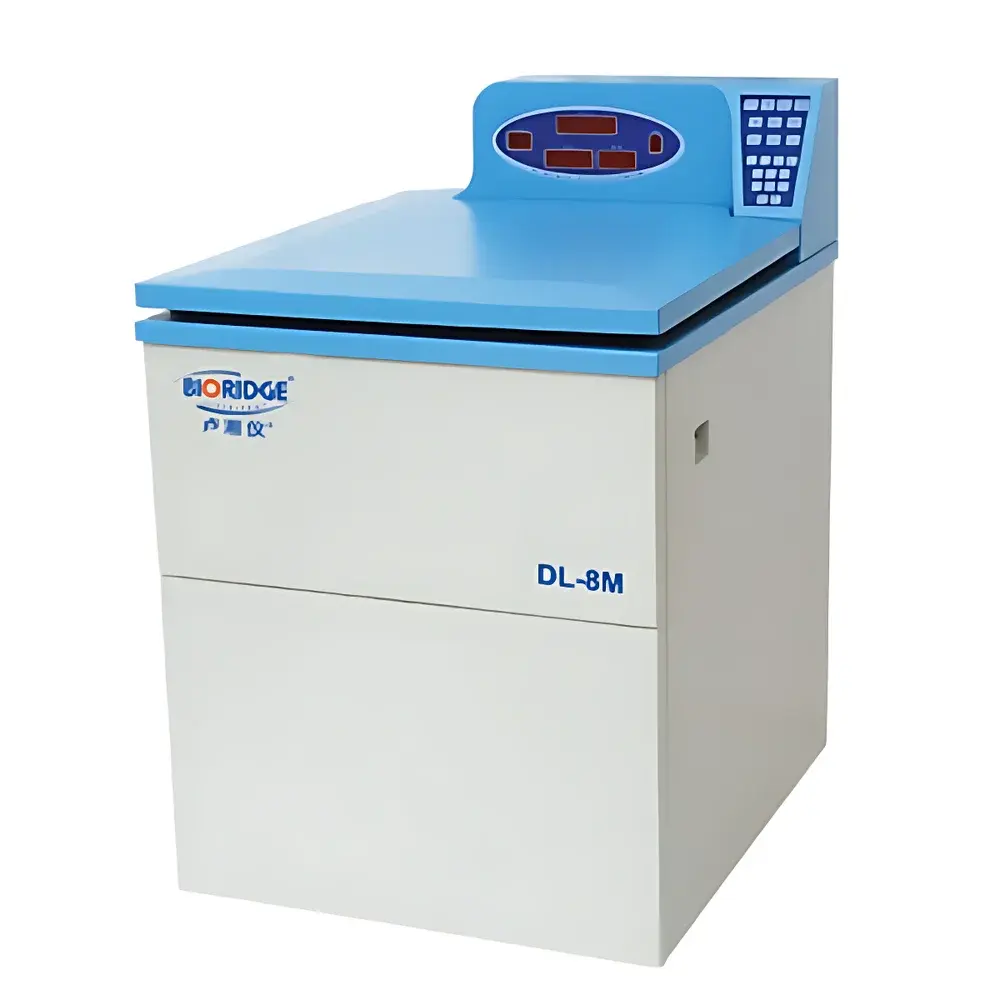
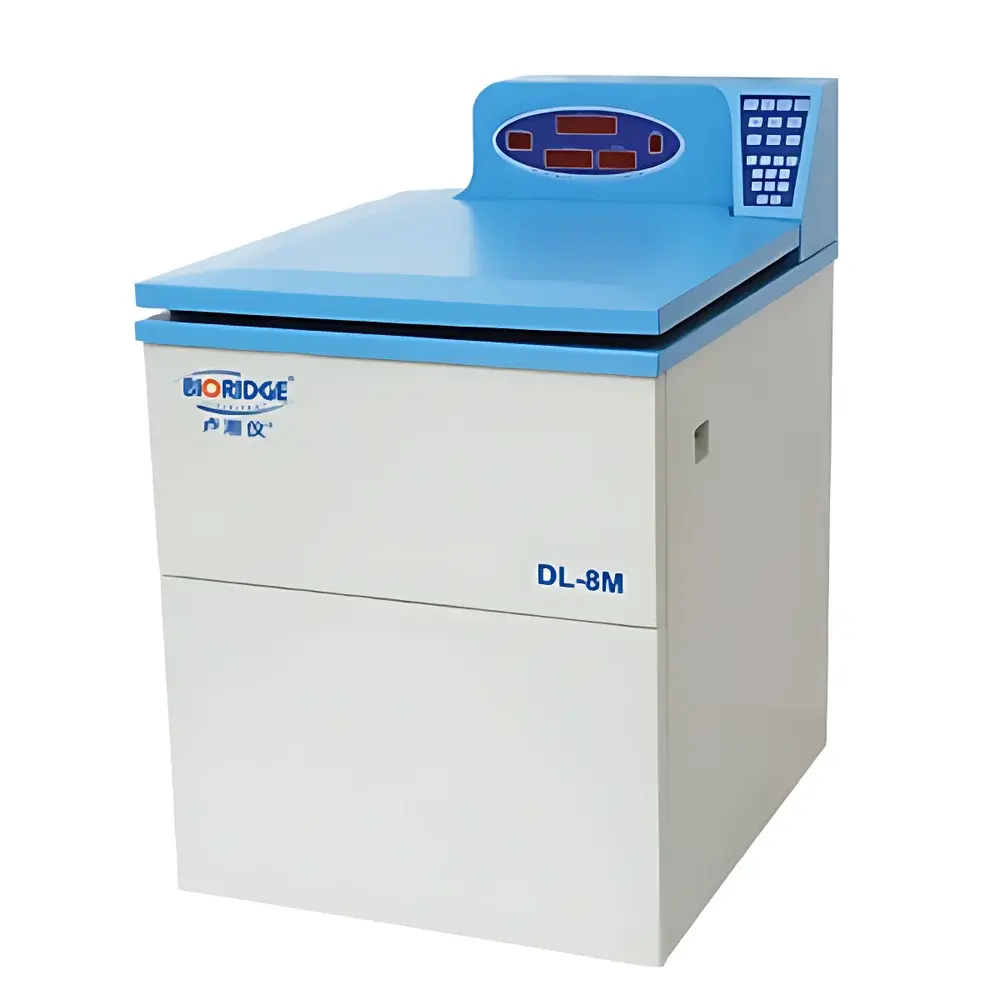
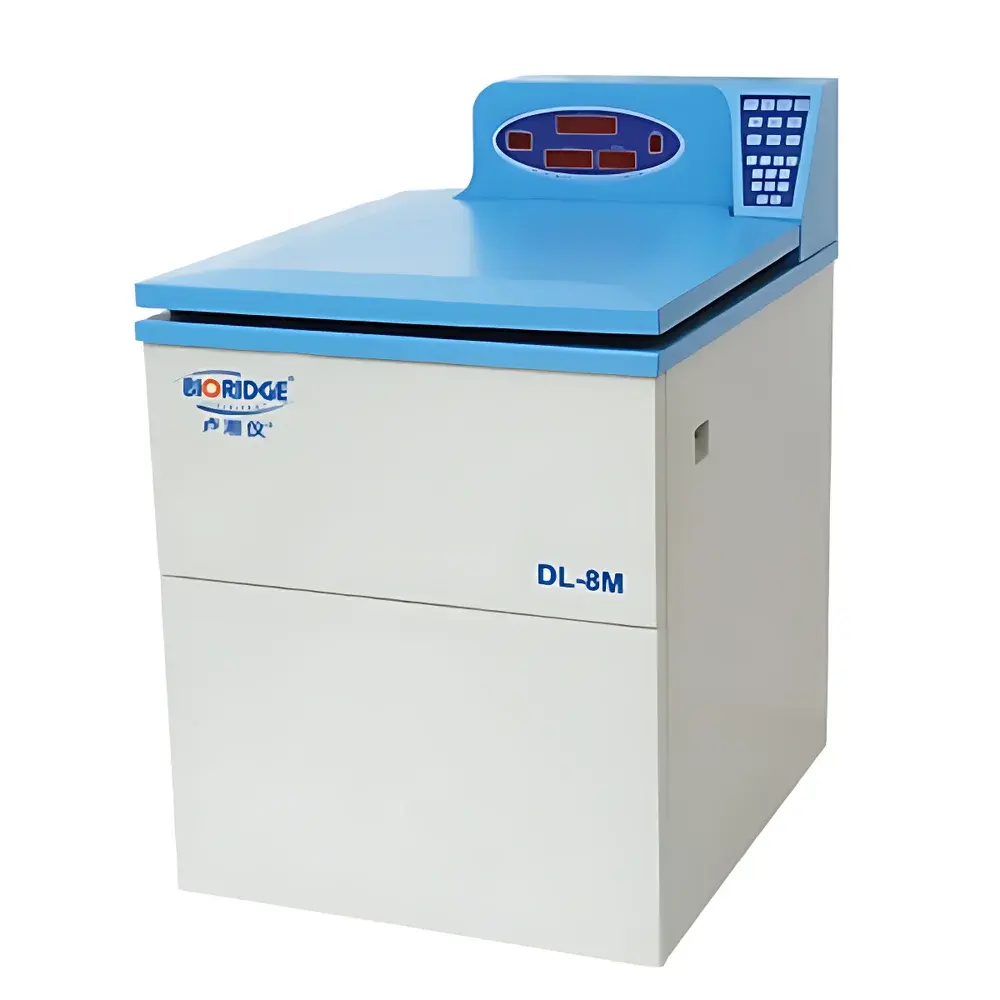
LUXIANGYI DL-8M High-Capacity Refrigerated Centrifuge
| Brand | LUXIANGYI / BIORIDGE |
|---|---|
| Origin | Shanghai, China |
| Model | DL-8M |
| Instrument Type | Benchtop Refrigerated Centrifuge |
| Speed Range | Up to 8,000 rpm |
| Max RCF | 11,260 × g |
| Max Capacity | 6 × 2,400 mL (14,400 mL total) |
| Temperature Range | –20 °C to +40 °C |
| Temp. Accuracy | ±1 °C |
| Speed Accuracy | ±50 rpm |
| Timer Range | 1 min – 99 h 59 min |
| Refrigerant | R404a (non-ozone-depleting) |
| Noise Level | <70 dB(A) |
| Power Supply | AC 380 V, 50 Hz, 40 A |
| Dimensions (L×W×H) | 900 mm × 1000 mm × 1300 mm |
| Compliance | CE-marked per IEC 61010-1 |
Overview
The LUXIANGYI DL-8M High-Capacity Refrigerated Centrifuge is an engineered solution for large-volume, temperature-sensitive separation tasks in centralized blood banks, biopharmaceutical manufacturing, and upstream bioprocessing facilities. Designed around a robust horizontal rotor architecture, it operates on the principle of sedimentation-based separation under controlled low-temperature conditions—enabling high-yield recovery of plasma, platelets, peripheral blood mononuclear cells (PBMCs), and other thermolabile biological fractions. Its 6 × 2,400 mL capacity supports batch processing of up to 14,400 mL per run—making it uniquely suited for clinical-scale blood component preparation, including simultaneous centrifugation of twelve 400 mL triple-bag systems. The unit integrates a high-torque brushless AC frequency-controlled motor, precision-engineered for stable rotational dynamics at up to 8,000 rpm, with real-time RCF/rpm interconversion and closed-loop refrigeration using R404a—a zero-ozone-depletion-potential (ODP) refrigerant compliant with international environmental directives.
Key Features
- High-capacity horizontal rotor configuration supporting six 2,400 mL bottles or twelve 400 mL blood bags per run—optimized for blood bank throughput and GMP-aligned process validation.
- Microprocessor-based control system with programmable run profiles, including 10 customizable acceleration/deceleration ramp curves to minimize shear stress on fragile biological matrices.
- Imported high-efficiency compressor assembly with precise thermal regulation (–20 °C to +40 °C, ±1 °C accuracy), ensuring consistent sample integrity during extended runs.
- Intuitive digital interface (DL-8M) or optional large-format LCD display (DL-8MS), enabling direct parameter entry, automatic protocol recall, and real-time monitoring of speed, RCF, temperature, time, and elapsed run status.
- Comprehensive safety architecture: electronic lid lock with auto-engagement, dynamic imbalance detection, overspeed cutoff, overtemperature shutdown, and fault-code-based diagnostics with audible/visual alerts.
- Acoustically damped cabinet design achieving <70 dB(A) operational noise—critical for installation in shared laboratory or cleanroom-adjacent environments.
Sample Compatibility & Compliance
The DL-8M accommodates standard ISO-certified 2,400 mL polypropylene centrifuge bottles, medical-grade PVC blood collection bags (including triple-bag configurations), and custom-fit horizontal rotors compatible with ASTM D4169 and EN 14220 packaging performance standards. Its mechanical and thermal stability meets IEC 61010-1 requirements for laboratory equipment safety, while its firmware architecture supports audit-ready operation under GLP and GMP frameworks. Data logging includes timestamped records of setpoints, actual values, alarms, and user actions—facilitating 21 CFR Part 11–aligned traceability when paired with validated networked storage solutions.
Software & Data Management
Although the DL-8M operates as a standalone instrument, its embedded controller stores up to 10 user-defined protocols with full parameter retention—including ramp profiles, hold times, and temperature setpoints. All runtime data (speed, RCF, temperature, duration, error logs) are retained in non-volatile memory and exportable via RS-232 or optional USB interface. When integrated into enterprise laboratory information management systems (LIMS), the device supports structured data exchange using HL7-compatible metadata tagging for sample tracking and QC documentation. Firmware updates are performed via secure authenticated channels to maintain regulatory compliance continuity.
Applications
- Large-scale plasma fractionation and cryoprecipitate harvesting in blood transfusion centers.
- Harvesting of mammalian cell cultures (e.g., CHO, HEK293) at pilot scale prior to downstream purification.
- Clarification of fermentation broths containing recombinant proteins or viral vectors.
- Isolation of extracellular vesicles (EVs) and lipoprotein subfractions from pooled human serum.
- Stabilized separation of temperature-sensitive enzyme complexes and nucleic acid-binding proteins.
- Preparative centrifugation for vaccine adjuvant formulation and particulate antigen recovery.
FAQ
What is the maximum certified load configuration for the DL-8M?
The unit is validated for simultaneous operation of six 2,400 mL centrifuge bottles or twelve 400 mL blood bags—both configurations require use of the factory-calibrated horizontal rotor (part no. HR-DL8M-2400) and must observe strict mass balance protocols.
Does the DL-8M support remote monitoring or network connectivity?
Standard configuration includes RS-232 serial output; optional Ethernet or Wi-Fi modules enable integration with central facility monitoring systems and LIMS—subject to site-specific cybersecurity validation.
Is the refrigeration system compliant with current environmental regulations?
Yes—the R404a refrigerant complies with EU F-Gas Regulation (EU) No 517/2014 and EPA SNAP Program requirements for non-ozone-depleting alternatives in laboratory equipment.
Can the DL-8M be used for regulatory submissions under FDA or EMA guidelines?
When operated within defined SOPs—including routine calibration, preventive maintenance, and electronic record archiving—it fulfills technical prerequisites for inclusion in IND, BLA, or MAA dossiers, particularly for process validation studies in biologics manufacturing.
What maintenance intervals are recommended for long-term reliability?
Compressor performance verification every 12 months, rotor lifetime tracking per ANSI/AAMI ST79, and annual certification of temperature uniformity and speed accuracy by an ISO/IEC 17025-accredited service provider are strongly advised.



