
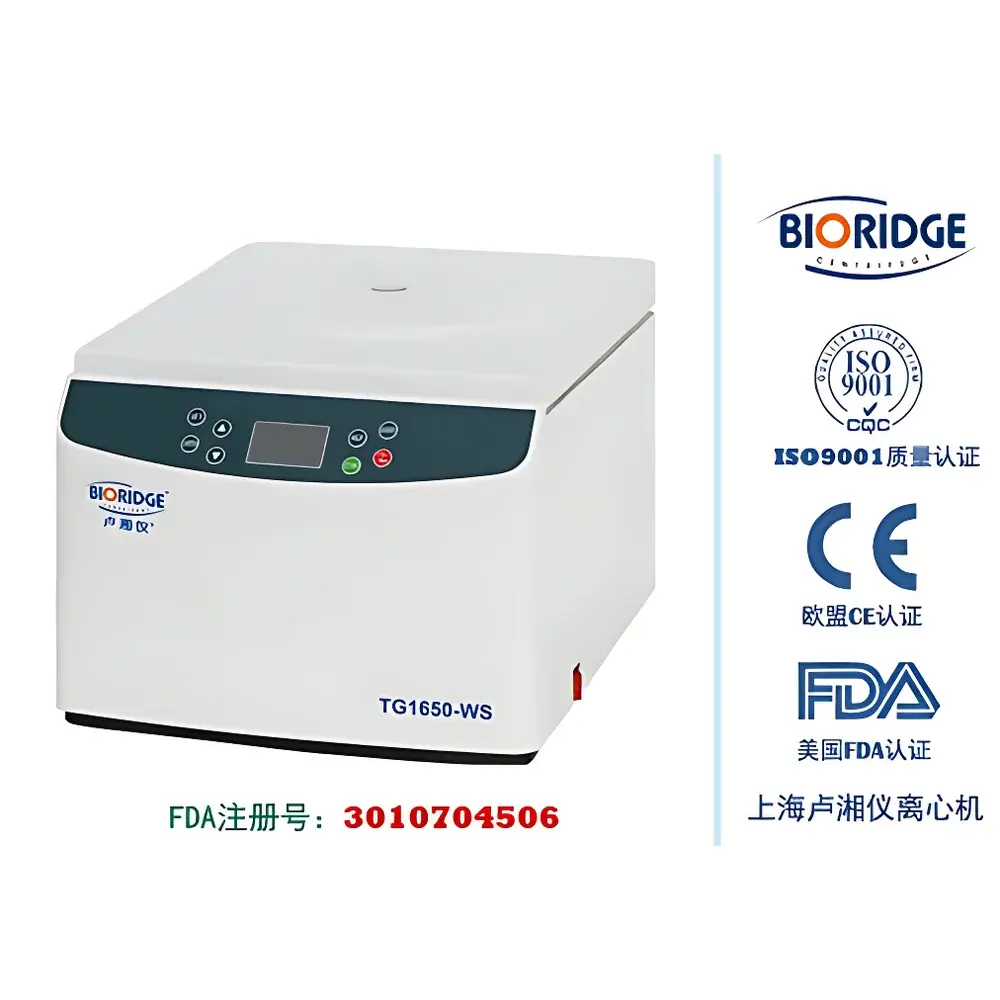
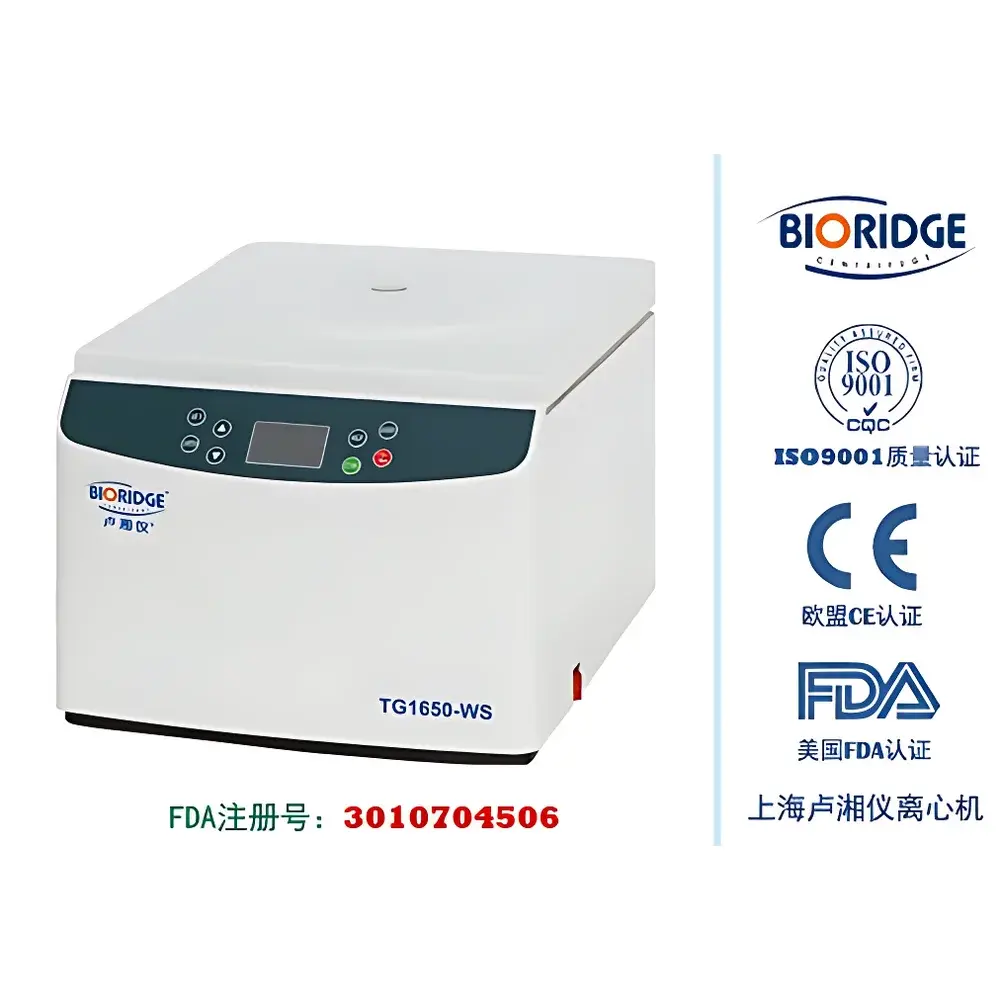
LuXiangYi TG1650-WS Benchtop High-Speed Centrifuge
| Brand | LuXiangYi / BIORIDGE |
|---|---|
| Origin | Shanghai, China |
| Model | TG1650-WS |
| Instrument Type | Benchtop Centrifuge |
| Speed Range | 300–16,500 rpm |
| Max RCF | 23,669 × g |
| Max Capacity | 4 × 100 mL |
| Dimensions (L×W×H) | 330 × 420 × 280 mm |
| Noise Level | <65 dB(A) |
| Power Supply | AC 220 V, 50 Hz, 10 A |
| Net Weight | 20 kg |
| Rotor Compatibility | Horizontal swing-out rotors, fixed-angle rotors, PCR strip rotors, microplate carriers |
| Speed Accuracy | ±30 rpm |
| Timer Range | 1–99 min |
| Acceleration/Deceleration Profiles | 9 programmable ramp curves |
| Safety Features | Electronic lid lock, overspeed protection, automatic fault alarm, rotor imbalance detection |
Overview
The LuXiangYi TG1650-WS Benchtop High-Speed Centrifuge is an engineered solution for routine and demanding separation tasks in life science laboratories. Designed around a brushless DC motor drive system, it delivers precise rotational control, low mechanical vibration, and acoustically optimized operation—critical for maintaining sample integrity during high-g force protocols. Its operational envelope spans 300 to 16,500 rpm, generating up to 23,669 × g, making it suitable for pelleting subcellular organelles, precipitating nucleic acids, clarifying cell lysates, and concentrating viral particles. Unlike general-purpose centrifuges, the TG1650-WS is specifically validated for applications requiring reproducible high-speed performance at the benchtop scale—without compromising footprint or safety compliance.
Key Features
- Microprocessor-Controlled Drive System: Equipped with a brushless DC motor and closed-loop speed regulation, ensuring stable rotation under variable load conditions and long-term operational consistency.
- Intuitive Touch Interface & LCD Display: Real-time dual-unit readout (rpm and RCF) with on-screen conversion; parameter settings—including speed, time, acceleration/deceleration profiles—are stored automatically upon power-down.
- Programmable Ramp Control: Nine independent acceleration and deceleration curves enable fine-tuned control over shear-sensitive samples (e.g., intact mitochondria or exosome preparations), minimizing resuspension and thermal stress.
- Comprehensive Safety Architecture: Integrated electronic lid interlock prevents operation with an unlatched rotor chamber; overspeed cutoff, imbalance detection, and real-time fault diagnostics meet IEC 61010-2-020 requirements for laboratory centrifuges.
- Low-Noise Engineering: Acoustic enclosure design and dynamic rotor balancing reduce operational noise to <65 dB(A) at 1 m distance—enabling placement in shared lab spaces without acoustic interference.
Sample Compatibility & Compliance
The TG1650-WS supports a broad range of tube formats and plate types via interchangeable rotor systems—including horizontal swing-out rotors (max 4 × 100 mL), fixed-angle rotors (up to 48 × 0.5 mL at 16,000 rpm), 2 × 48-well microplates, and dedicated PCR strip carriers. All rotors are precision-balanced and certified for maximum rated speeds per ISO 15197:2021 Annex C (rotor safety validation). The instrument complies with electromagnetic compatibility (EMC) standards EN 61326-1 and electrical safety standard EN 61010-1. While not inherently 21 CFR Part 11 compliant, audit-trail-ready data export (via USB) supports GLP/GMP-aligned documentation workflows when paired with validated SOPs.
Software & Data Management
No proprietary software is required for basic operation—the integrated interface handles all configuration and execution. For traceability, the TG1650-WS logs run history (date/time, rotor ID, speed, duration, RCF) to internal memory (retains ≥100 cycles). Export is supported via USB flash drive in CSV format, enabling integration into LIMS or ELN platforms. Timestamped logs include error codes and event flags (e.g., “lid open during run”, “imbalanced load detected”), facilitating root-cause analysis during QA audits.
Applications
- Isolation of plasma membrane vesicles and synaptic terminals from brain homogenates (12,000–16,500 rpm, 20–30 min)
- High-yield plasmid DNA purification using alkaline lysis followed by 13,200 rpm centrifugation (15 min, 4 °C)
- Clarification of bacterial culture supernatants prior to protein chromatography (10,000 rpm, 10 min)
- Concentration of lentiviral vectors (12,000 rpm, 2 h, 4 °C, SW40-equivalent protocol)
- Routine blood fractionation in clinical labs (serum/plasma separation at 3,000 rpm, 10 min)
- PCR plate centrifugation to eliminate bubble formation pre-thermal cycling (3,000 rpm, 1 min)
FAQ
What rotor configurations are included standard with the TG1650-WS?
The base configuration includes one horizontal swing-out rotor (4 × 100 mL capacity) and a set of universal adapters (0.2–15 mL). Additional rotors—including fixed-angle, PCR strip, and microplate carriers—are available as optional accessories.
Is refrigeration available on this model?
No—the TG1650-WS is a non-refrigerated benchtop unit. For temperature-sensitive separations, ambient lab control (≤25 °C) and pre-chilled rotors/tubes are recommended.
Can the centrifuge be operated in a biosafety cabinet?
Yes—its compact footprint (330 × 420 × 280 mm) and low electromagnetic emissions allow safe placement inside Class II BSCs, provided adequate clearance for heat dissipation and lid clearance is maintained.
Does the device support continuous-run mode?
No—it operates exclusively in timed mode (1–99 min); unattended continuous operation is disabled by design to comply with IEC 61010 safety mandates.
How is rotor lifetime tracked and managed?
Rotor usage is not electronically logged; users must maintain manual records of total run hours and maximum speed history per rotor. Rotors are rated for ≥10,000 cycles at rated speed or 5 years—whichever occurs first—per manufacturer’s service bulletin LX-TG-2023-07.



