
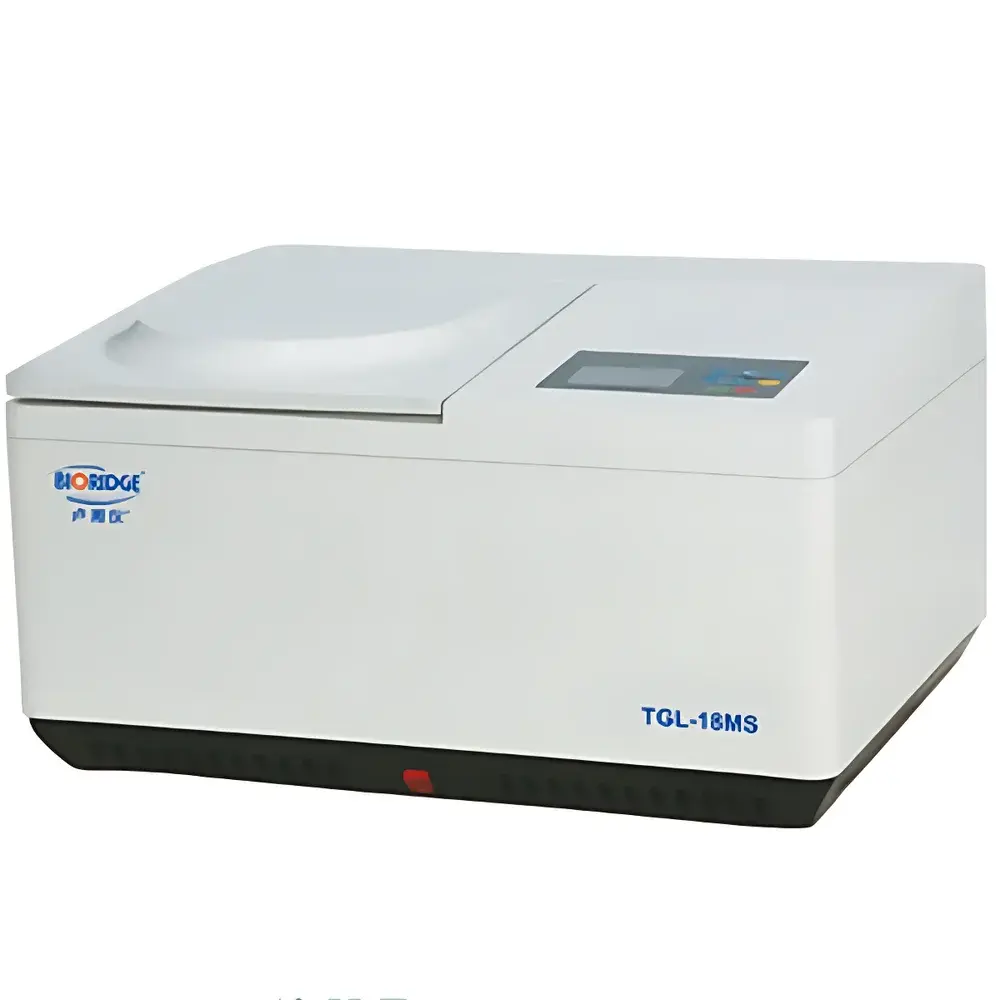
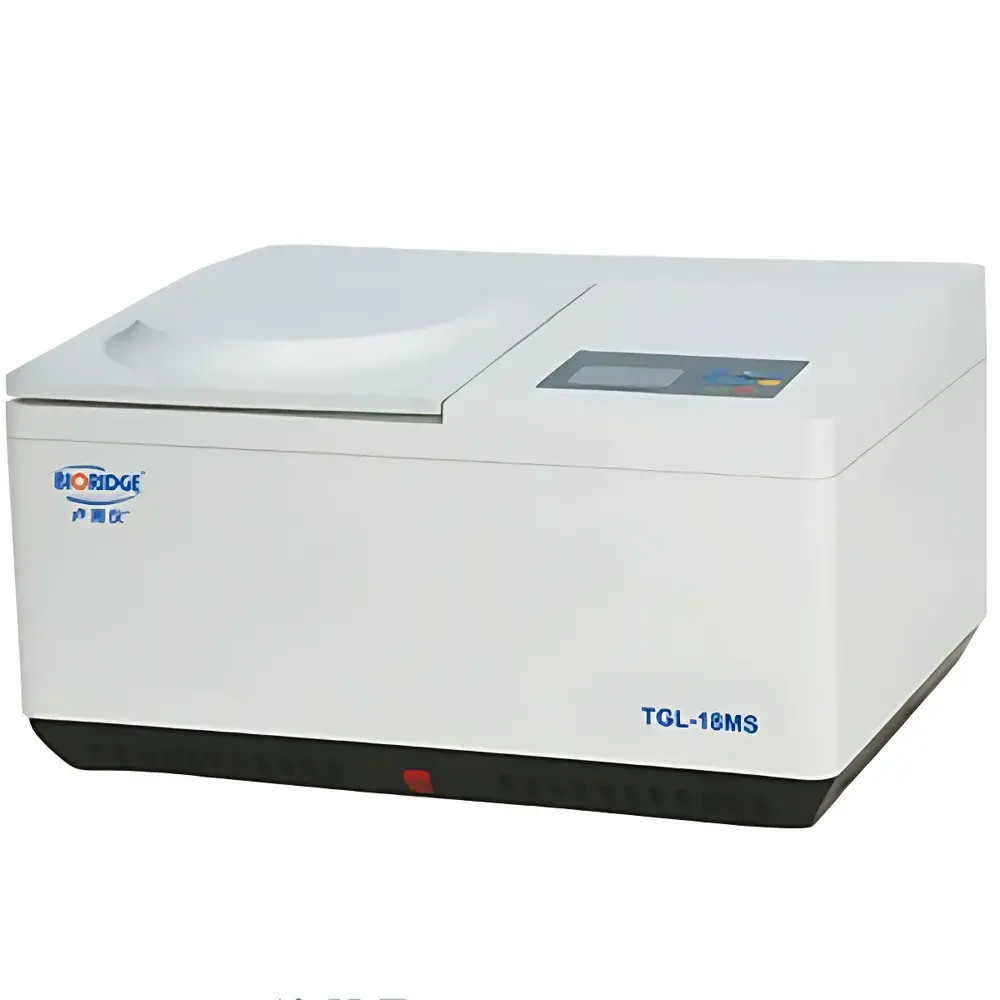
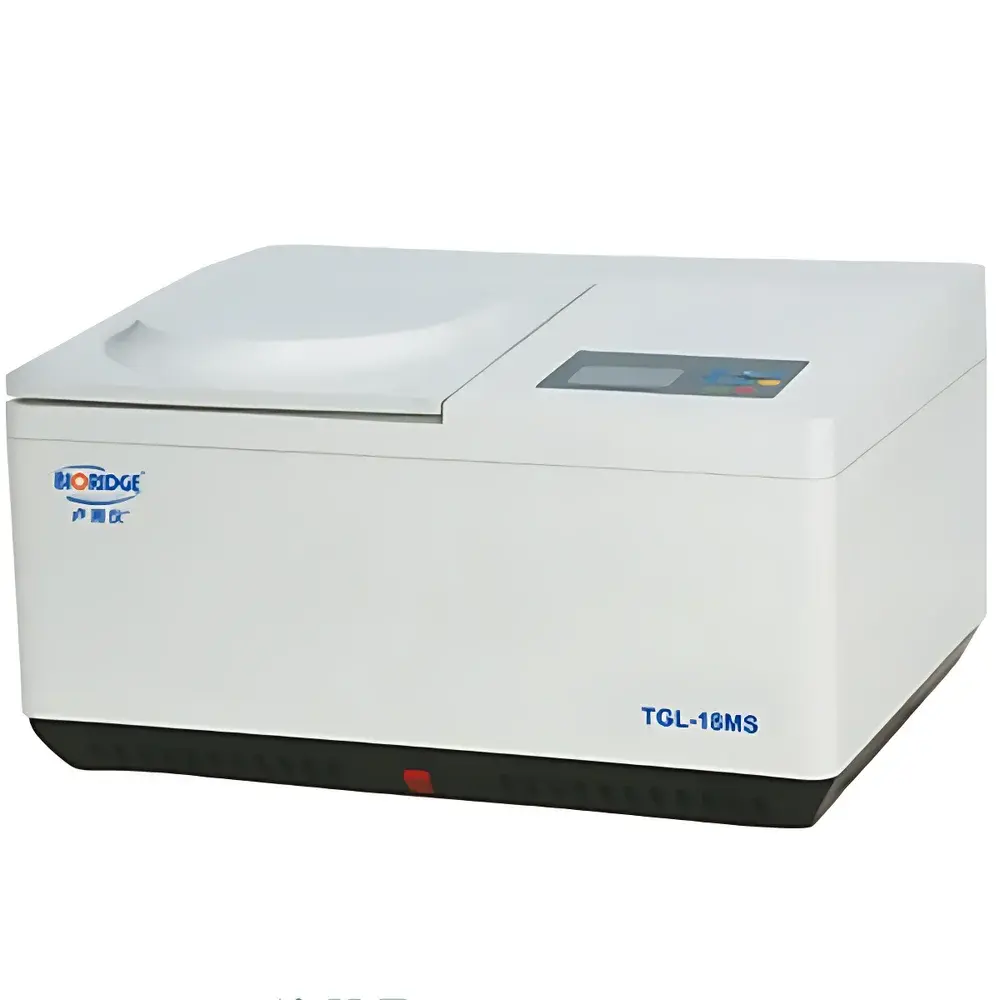
LUXIANGYI TGL-18MS Benchtop High-Speed Refrigerated Centrifuge
| Brand | LUXIANGYI / BIORIDGE |
|---|---|
| Origin | Shanghai, China |
| Model | TGL-18MS |
| Type | Benchtop Refrigerated Centrifuge |
| Max Speed | 18,000 rpm |
| Max RCF | 23,755 × g |
| Max Capacity | 4 × 100 mL (horizontal rotor) |
| Temperature Range | −20 °C to +40 °C |
| Temp. Accuracy | ±1 °C |
| Speed Accuracy | ±30 rpm |
| Timer Range | 1 min–9 h 59 min (or 1 min–99 min) |
| Noise Level | <65 dB(A) |
| Dimensions (L×W×H) | 600 × 470 × 330 mm |
| Net Weight | 50 kg |
| Refrigerant | R134a |
| Power Supply | AC 220 V, 50 Hz, 15 A |
Overview
The LUXIANGYI TGL-18MS Benchtop High-Speed Refrigerated Centrifuge is engineered for precision separation of biological macromolecules—including nucleic acids, proteins, subcellular organelles, and viral particles—under controlled thermal conditions. Utilizing a high-torque brushless AC frequency-controlled motor and microprocessor-based closed-loop control architecture, the system delivers stable rotational dynamics across its full speed range (up to 18,000 rpm), minimizing mechanical drift and ensuring reproducible sedimentation profiles. Its integrated refrigeration system—featuring an imported compressor and environmentally compliant R134a refrigerant—maintains sample integrity during extended runs by actively regulating chamber temperature between −20 °C and +40 °C with ±1 °C accuracy. Designed for routine use in clinical diagnostics laboratories, academic research facilities, and biotechnology QC environments, the TGL-18MS complies with fundamental safety and electromagnetic compatibility requirements per IEC 61010-1 and meets structural robustness standards appropriate for ISO/IEC 17025-accredited testing workflows.
Key Features
- Microprocessor-controlled operation with real-time RPM/RCF interconversion display on a large backlit LCD panel, enabling rapid parameter verification and method transfer.
- Programmable acceleration/deceleration profiles: nine user-definable ramp curves allow optimization of shear-sensitive separations (e.g., plasmid prep or exosome isolation) and reduction of pellet resuspension risk.
- Electronic lid lock with auto-engagement mechanism, combined with dual redundant safety interlocks (overspeed, overtemperature, imbalance, and door-open detection) to meet Class II biosafety expectations for BSL-2 applications.
- Low-noise acoustic design (<65 dB[A] at maximum speed) achieved through dynamic rotor balancing, vibration-damping chassis construction, and optimized airflow management—critical for shared laboratory spaces.
- Non-volatile memory stores up to nine complete protocols, including speed, temperature, time, and ramp settings, supporting GLP-compliant documentation when paired with external lab notebook systems.
Sample Compatibility & Compliance
The TGL-18MS accommodates standard horizontal rotors compatible with 100 mL conical tubes (4-place configuration), as well as optional adaptors for smaller formats (15 mL, 50 mL). Its certified RCF output of 23,755 × g enables efficient pelleting of mitochondria, lysosomes, and ribosomal subunits, while maintaining thermal stability essential for enzyme activity preservation. The unit conforms to key regulatory touchpoints relevant to life science instrumentation: it supports audit-ready operation under GxP-aligned workflows when used with documented SOPs; its temperature control performance aligns with USP environmental monitoring guidance for sterile compounding support; and its electrical safety certification satisfies national requirements equivalent to EN 61010-1:2010.
Software & Data Management
While the TGL-18MS operates via embedded firmware without proprietary PC software, all operational parameters—including start/stop timestamps, final rotor speed, actual chamber temperature, and error logs—are retained in internal memory and accessible via front-panel navigation. For traceability, users may manually record session data into electronic lab notebooks (ELNs) or LIMS platforms. The system’s programmable timer and automatic parameter recall reduce operator-dependent variability, enhancing consistency across shifts—a foundational requirement for ISO 15189 medical laboratory accreditation. Optional RS-232 or USB interfaces (subject to regional configuration) permit basic data export for external logging, though native FDA 21 CFR Part 11 compliance requires third-party validation of any connected digital infrastructure.
Applications
- Clinical microbiology: concentration of low-abundance pathogens from blood or cerebrospinal fluid prior to PCR amplification.
- Proteomics: differential centrifugation steps in membrane protein extraction protocols requiring precise RCF and temperature control.
- Virology: purification of enveloped viruses using sucrose gradient ultracentrifugation preps where pre-chill stability is critical.
- Cell biology: isolation of nuclei and cytosolic fractions from cultured mammalian cells under chilled conditions to inhibit protease activity.
- Biopharmaceutical QC: clarification of monoclonal antibody harvest streams prior to chromatographic purification.
FAQ
What rotor configurations are supported by the TGL-18MS?
The standard configuration includes a fixed-angle 4 × 100 mL horizontal rotor. Optional swing-out rotors for 15 mL and 50 mL tubes are available upon request.
Is calibration documentation provided with the instrument?
Factory calibration certificates for speed and temperature sensors are included; users are advised to perform periodic verification using NIST-traceable tachometers and thermocouples per internal quality procedures.
Can the TGL-18MS operate continuously for >4 hours?
Yes—the refrigeration system and motor cooling design permit uninterrupted operation within the specified temperature range, though prolonged high-speed runs (>12,000 rpm for >2 h) should be validated for thermal load in individual lab environments.
Does the unit support remote monitoring or network connectivity?
No native Ethernet or Wi-Fi capability is integrated; however, analog signal outputs (e.g., 4–20 mA temperature feedback) can be added via OEM customization for building management system integration.
What maintenance intervals are recommended?
Compressor oil inspection every 24 months; rotor lifetime tracking per manufacturer’s logbook; annual verification of door lock integrity and thermal sensor response time.



