
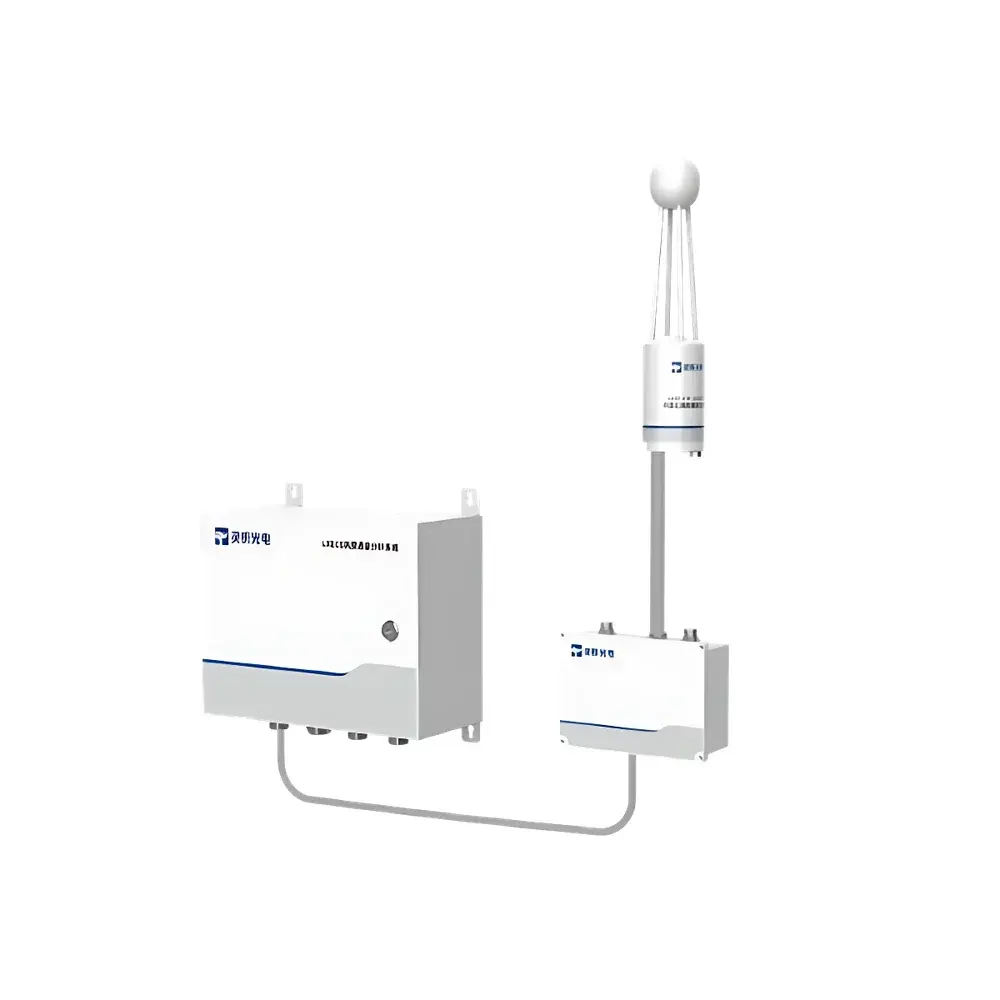
LXEC-210 Open-Path Eddy Covariance CO₂/H₂O Flux Analyzer
| Brand | LINGXI Optoelectronics |
|---|---|
| Model | LXEC-210 |
| Measurement Principle | Non-Dispersive Infrared (NDIR) Spectroscopy |
| Target Gases | CO₂, H₂O |
| Origin | Zhejiang, China |
| Gas Detection Configuration | Open-path, in-situ |
| Power Consumption | Low-power design, no pump required |
| Compliance Context | Designed for field-deployable eddy covariance (EC) flux measurements per AmeriFlux/ICOS protocols |
| Sample Interface | Direct atmospheric sampling, no inlet tubing or sample cell |
Overview
The LXEC-210 Open-Path Eddy Covariance CO₂/H₂O Flux Analyzer is an engineered solution for high-temporal-resolution, in-situ measurement of vertical turbulent fluxes of carbon dioxide and water vapor in the planetary boundary layer. It operates on the principle of non-dispersive infrared (NDIR) spectroscopy, utilizing dual-wavelength absorption detection at characteristic vibrational bands—4.26 µm for CO₂ and 2.6 µm for H₂O—to quantify gas concentrations at kilohertz sampling rates. As a true open-path system, it eliminates sample transport delay, adsorption/desorption artifacts, and frequency attenuation associated with closed-path configurations. This architecture enables direct optical path interrogation of ambient air, supporting flux calculations compliant with eddy covariance methodology as defined by the AmeriFlux, ICOS, and FLUXNET standards. The analyzer integrates seamlessly with three-dimensional sonic anemometers and data acquisition systems to compute covariance between vertical wind velocity (w′) and scalar concentration fluctuations (c′), yielding net ecosystem exchange (NEE) and latent heat flux estimates with high reproducibility.
Key Features
- In-situ open-path optical design: No inlet tubing, pump, or gas cell—eliminates lag time, pressure-induced spectral broadening, and surface adsorption effects on CO₂ and H₂O molecules.
- High-speed NDIR detection: Dual-channel synchronized acquisition at ≥10 Hz native sampling rate, optimized for turbulence-resolving eddy covariance applications.
- Thermally stabilized optical bench: Precision temperature control of detector and source modules ensures long-term baseline stability and minimizes drift under diurnal thermal cycling.
- Low-power electronics architecture: Integrated microcontroller-based signal processing consumes <5 W average power, enabling solar-battery operation in remote field sites for extended deployments (≥6 months).
- Ruggedized aluminum housing with IP65-rated enclosure: Engineered for continuous outdoor exposure across temperate, arid, and humid climatic zones without active climate control.
- Modular integration interface: Standard RS-485 and Ethernet ports support synchronization with third-party sonic anemometers (e.g., Gill WindMaster, Metek uSonic-3 Class A) and data loggers (e.g., Campbell Scientific CR6, LI-COR LI-1000).
Sample Compatibility & Compliance
The LXEC-210 is designed exclusively for atmospheric sampling under ambient pressure conditions (70–106 kPa) and temperatures ranging from −25 °C to +50 °C. It does not require calibration gases during routine operation due to its inherent zero-stability and dual-beam referencing architecture. While not certified to ISO/IEC 17025 for metrological traceability, its measurement protocol aligns with widely adopted eddy covariance best practices documented in the *AmeriFlux Technical Note #5* and *ICOS Carbon Portal QA/QC Guidelines*. Data outputs conform to standard NetCDF-4 format with CF-1.8 metadata conventions, facilitating ingestion into FLUXNET2015 and global synthesis databases. The system supports GLP-aligned field documentation through embedded timestamping (NTP-synchronized) and hardware-level diagnostic logging.
Software & Data Management
The LXEC-210 interfaces with the optional LINGXI EC-Studio software suite—a cross-platform application for real-time visualization, spectral quality assessment, and post-processing using standard eddy covariance corrections ( Webb-Pearman-Leuning density correction, coordinate rotation, spike removal, and planar fit). Raw time-series data (CO₂, H₂O, temperature, pressure, and auxiliary analog inputs) are stored in binary-packed format with lossless compression. The firmware implements audit-trail functionality: all configuration changes, firmware updates, and calibration events are logged with UTC timestamps and user identifiers. Export options include CSV, HDF5, and EddyPro-compatible .dat files. Remote diagnostics and parameter reconfiguration are supported via secure SSH or HTTPS API endpoints.
Applications
- Ecosystem-scale carbon and water flux quantification across forests, grasslands, wetlands, and agricultural croplands.
- Validation of satellite-derived gross primary production (GPP) and evapotranspiration (ET) products (e.g., MODIS, Sentinel-3 SLSTR).
- Urban boundary layer studies assessing anthropogenic CO₂ emissions and ventilation efficiency.
- Long-term climate observatories monitoring interannual variability in carbon sink strength under drought or warming treatments.
- Soil-atmosphere exchange investigations requiring high-frequency H₂O response to precipitation pulses and freeze-thaw cycles.
- Model-data fusion initiatives integrating flux tower observations into land surface models (e.g., CLM, ORCHIDEE) and inverse atmospheric transport frameworks.
FAQ
Does the LXEC-210 require regular span calibration with certified gas standards?
No—its open-path NDIR architecture relies on stable optical references and temperature-compensated detectors; field calibration is limited to periodic zero checks using nitrogen purge or ambient air filtering, per AmeriFlux recommendations.
Can the LXEC-210 be deployed alongside a closed-path CH₄ analyzer in the same EC setup?
Yes—its electrical isolation, low EMI emission profile, and flexible mounting geometry allow co-location with complementary analyzers, provided spatial separation and flow distortion criteria are met per EC tower design guidelines.
What is the minimum recommended fetch-to-height ratio for valid flux measurements?
A minimum 100:1 fetch-to-instrument-height ratio is advised for homogeneous terrain; site-specific footprint modeling using tools like Flux Footprint Prediction (FFP) is strongly recommended prior to installation.
Is raw data accessible for custom post-processing outside LINGXI EC-Studio?
Yes—binary packet dumps and ASCII exports support full transparency; all variables are mapped to standard CF-compliant names and units (e.g., “co2_mole_fraction” in µmol/mol, “h2o_mole_fraction” in mmol/mol).
Related Products







