
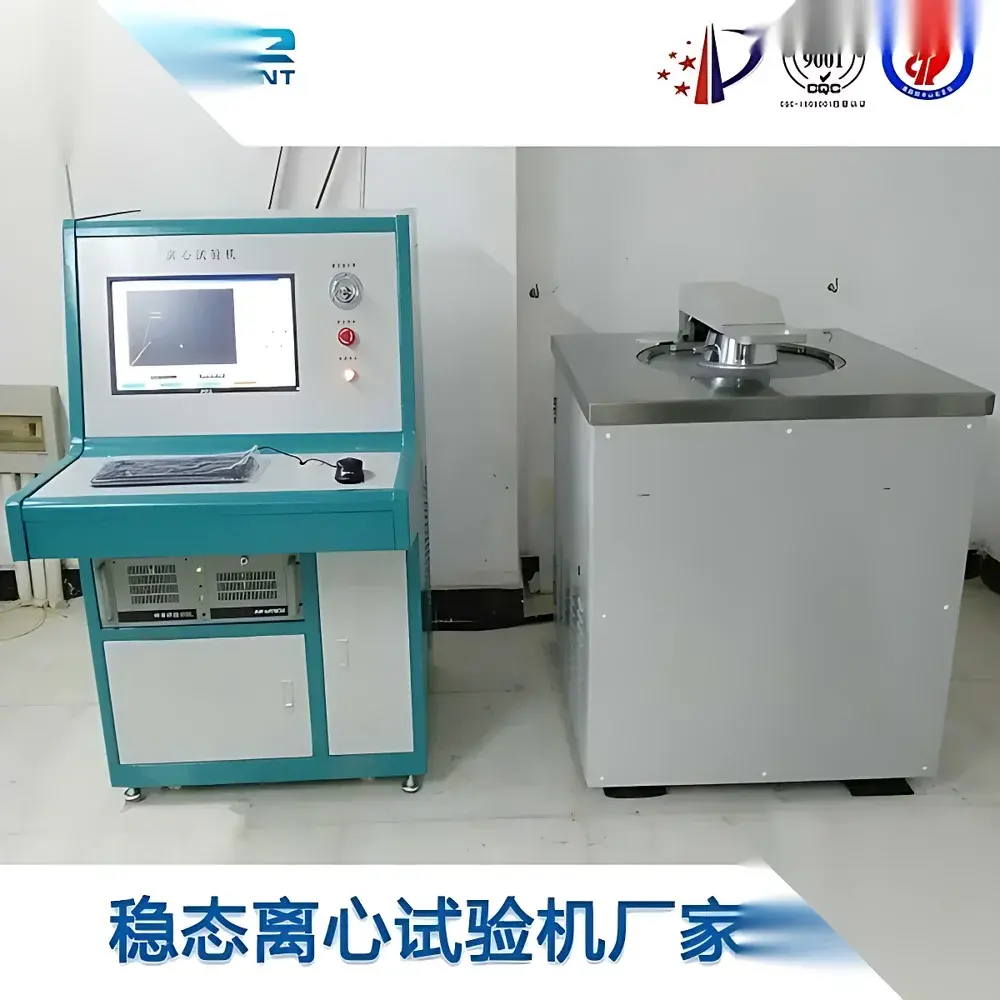
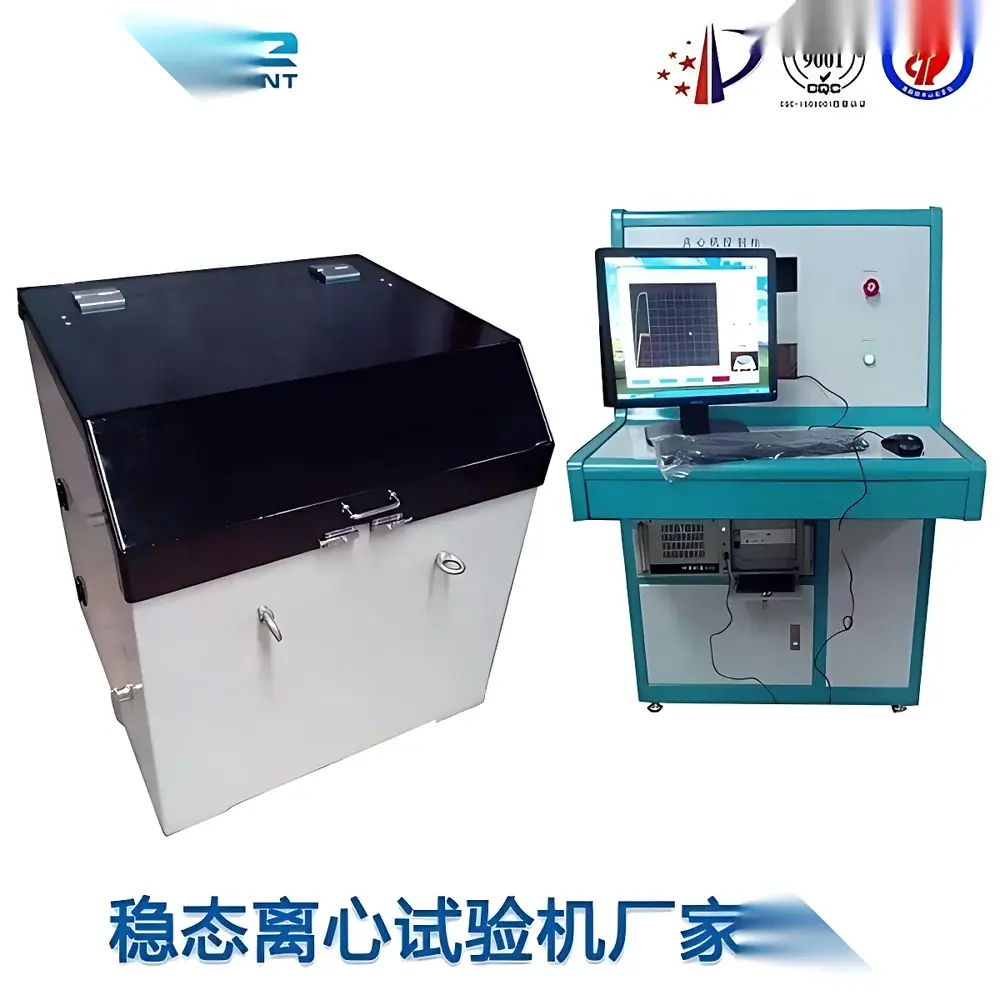
LXJ-Series Steady-State Acceleration Centrifugal Testing System
| Brand | Other Brands |
|---|---|
| Origin | Imported |
| Manufacturer Type | General Distributor |
| Model | LXJ-Capacity |
| Price | USD 14,000 (approx.) |
| Compliance | MIL-STD-810F, MIL-STD-883C, GJB150, GJB360, GB/T 2423, IEC 60068-2-27 |
| Max Load Capacity | 35–200 kg |
| Acceleration Range | 30–400,000 g (0.3–3920 kN/m² equivalent) |
| Test Axes | X, Y, Z orthogonal directions |
| Specimen Height Limit | 200–300 mm |
| Installation Radius | 200–1000 mm |
| Power Supply | AC 380 V, 1.5–6.5 kVA |
| Continuous Operation Time | 30–60 min |
| Control System | Industrial PC with Real-Time Data Acquisition |
| Slip Ring Configuration | Up to 15 channels, 500 V / 5 A |
| Dimensions (L×W×H) | 924×910×1242 mm to 1953×470×993 mm |
| Weight | 1000–2300 kg |
Overview
The LXJ-Series Steady-State Acceleration Centrifugal Testing System is an electromechanical high-g centrifuge engineered for structural integrity validation and dynamic overloading evaluation of electronic components, microelectromechanical systems (MEMS), avionics modules, and miniature electro-mechanical assemblies. Unlike conventional laboratory centrifuges designed for sample separation, this system operates on the principle of controlled radial acceleration generation via high-speed rotation—applying precisely calibrated inertial forces (expressed in multiples of gravitational acceleration, g) to test specimens mounted at defined radii. It replicates sustained acceleration environments encountered during launch, re-entry, or high-G maneuvering in aerospace, defense, and automotive safety-critical applications. The system delivers repeatable, traceable, and programmable acceleration profiles compliant with military and international environmental stress testing standards.
Key Features
- Real-time industrial PC-based control with closed-loop feedback for acceleration setpoint accuracy ±1.5% of full scale
- Multi-step acceleration profile programming—including ramp-up, dwell, and step-change sequences—with automatic transition logic
- Integrated safety architecture: hardware-enforced overspeed cutoff, thermal overload protection, open-circuit detection, and emergency mechanical braking
- Dual-mode operation: fully automated test sequencing or manual override with jog/hold functionality for setup verification
- Modular slip-ring assembly supporting up to 15 independent current/voltage signal paths (500 V / 5 A per channel) for real-time telemetry from instrumented DUTs
- Triaxial mounting interface enabling sequential or concurrent testing along X, Y, and Z axes per MIL-STD-810F paragraph 513.6 requirements
- Onboard data acquisition synchronized to encoder position and motor torque signals for time-stamped force history reconstruction
Sample Compatibility & Compliance
The LXJ system accommodates specimens ranging from surface-mount resistors (0402–2512 footprints) to compact flight computers (≤300 mm height, ≤200 kg mass). Mounting fixtures are configurable for standard test trays, custom mandrels, or vibration-isolated platforms. All operational modes meet the mechanical shock and steady-state acceleration test criteria specified in MIL-STD-883C Method 2001, GJB150.15A, and IEC 60068-2-27 (Shock). Calibration procedures follow ISO/IEC 17025 guidelines, with annual traceability to national metrology institutes. System documentation supports GLP-compliant audit trails, including operator ID, calibration date, environmental conditions, and raw sensor logs.
Software & Data Management
The embedded control software provides a Windows-based GUI with dual-panel visualization: left-side real-time plotting of acceleration vs. time (with user-defined tolerance bands), right-side parameter configuration and status monitoring. Test reports are auto-generated in PDF and CSV formats, embedding metadata such as test standard reference, specimen ID, load cell calibration coefficients, and pass/fail determinations per defined acceptance thresholds. Exported datasets conform to ASTM E2917-22 data exchange conventions and support post-processing in MATLAB, Python (NumPy/Pandas), or LabVIEW. Audit logging complies with FDA 21 CFR Part 11 requirements when configured with electronic signatures and role-based access control.
Applications
- Qualification testing of inertial sensors, accelerometers, and gyroscopes under sustained g-load conditions
- Evaluation of solder joint reliability and wire bond integrity in PCBAs subjected to launch-phase acceleration
- Structural margin assessment of MEMS actuators and piezoelectric transducers
- Verification of latch mechanism robustness in satellite deployment systems
- Accelerated life testing of battery packs and thermal interface materials under centrifugal stress
- Development validation of miniature UAV autopilot housings and gimbal assemblies
FAQ
What acceleration ranges are supported across different LXJ configurations?
The LXJ platform offers five standardized variants: 30–2000 g, 50–1000 g, 1000–200,000 g, 5000–400,000 g, and custom high-rpm rotor options. Maximum g-level depends on specimen radius and rotational speed; all models maintain ±1.5% acceleration fidelity across their operating envelope.
Can the system perform combined environmental tests (e.g., acceleration + temperature)?
The base LXJ configuration does not integrate thermal chambers; however, it features standardized mechanical interfaces and signal routing provisions compatible with third-party environmental chambers. Users commonly integrate external temperature-controlled enclosures with feedthrough-rated slip rings for concurrent thermal-acceleration profiling.
Is remote operation and monitoring supported?
Yes—via secure Ethernet connection using TCP/IP protocol. Remote clients can view live plots, initiate/abort tests, and download archived datasets without local console access. Firewall rules and TLS 1.2 encryption ensure network security in regulated lab environments.
How is calibration maintained and documented?
Each unit ships with NIST-traceable calibration certificates for angular velocity, radial displacement, and torque sensors. Annual recalibration is recommended; onboard self-diagnostics verify encoder linearity and motor response prior to every test sequence.
What mounting standards does the test fixture adhere to?
Standard fixtures comply with MIL-STD-1377 mounting hole patterns and IEEE 1116-2020 PCB anchoring guidelines. Custom adapters are available for JEDEC tray, Eurocard, or proprietary carrier plate interfaces.



