
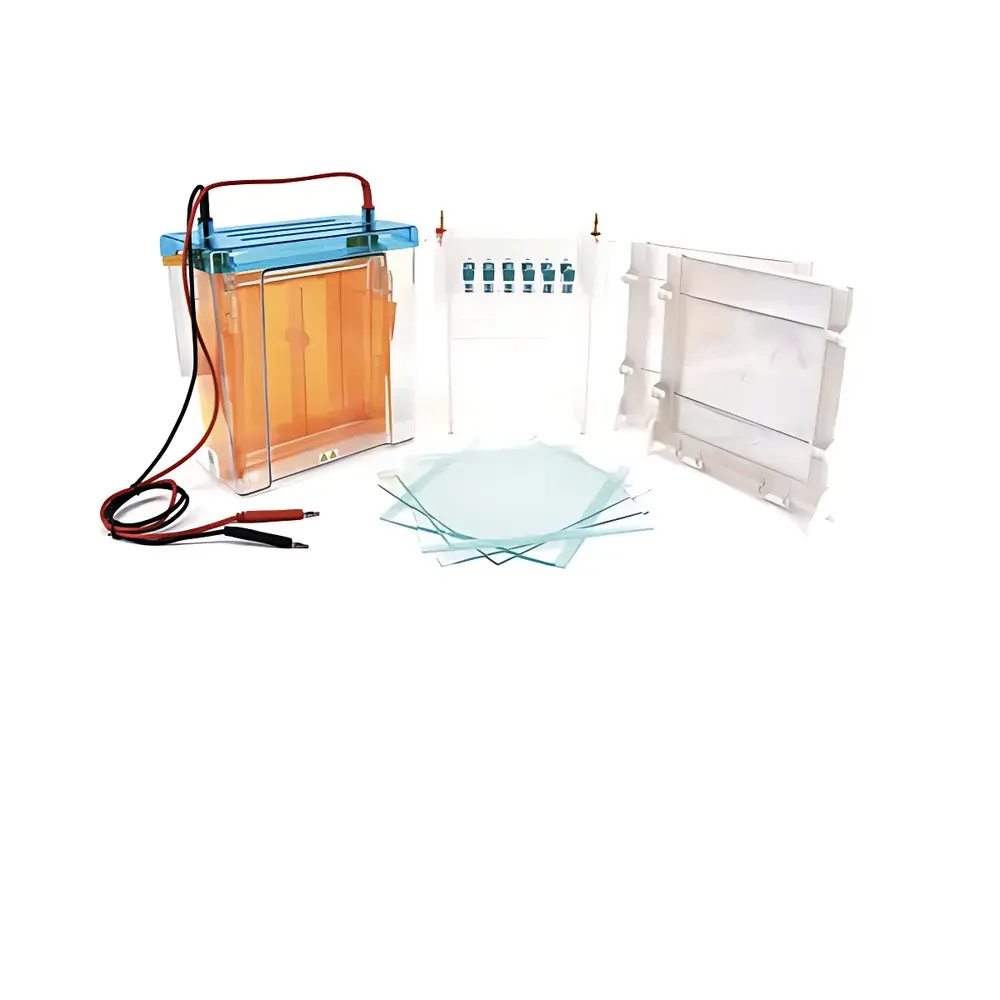
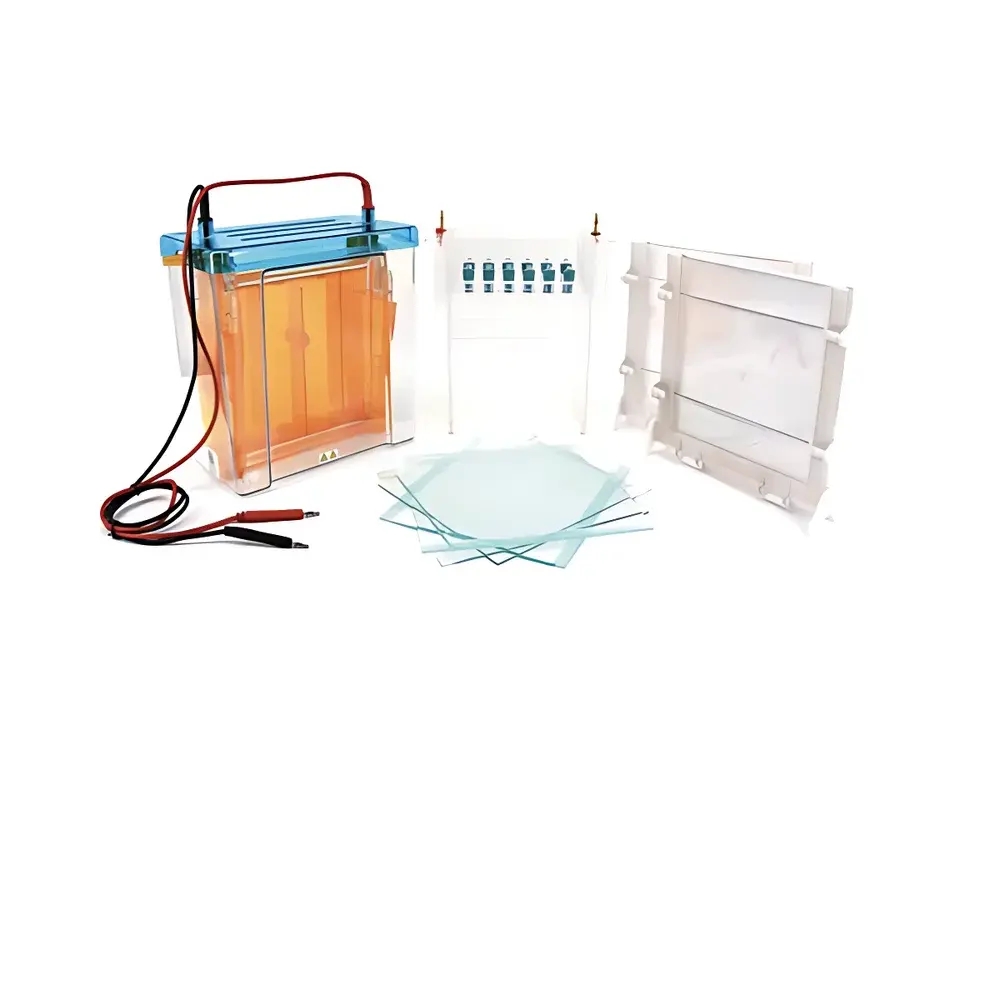
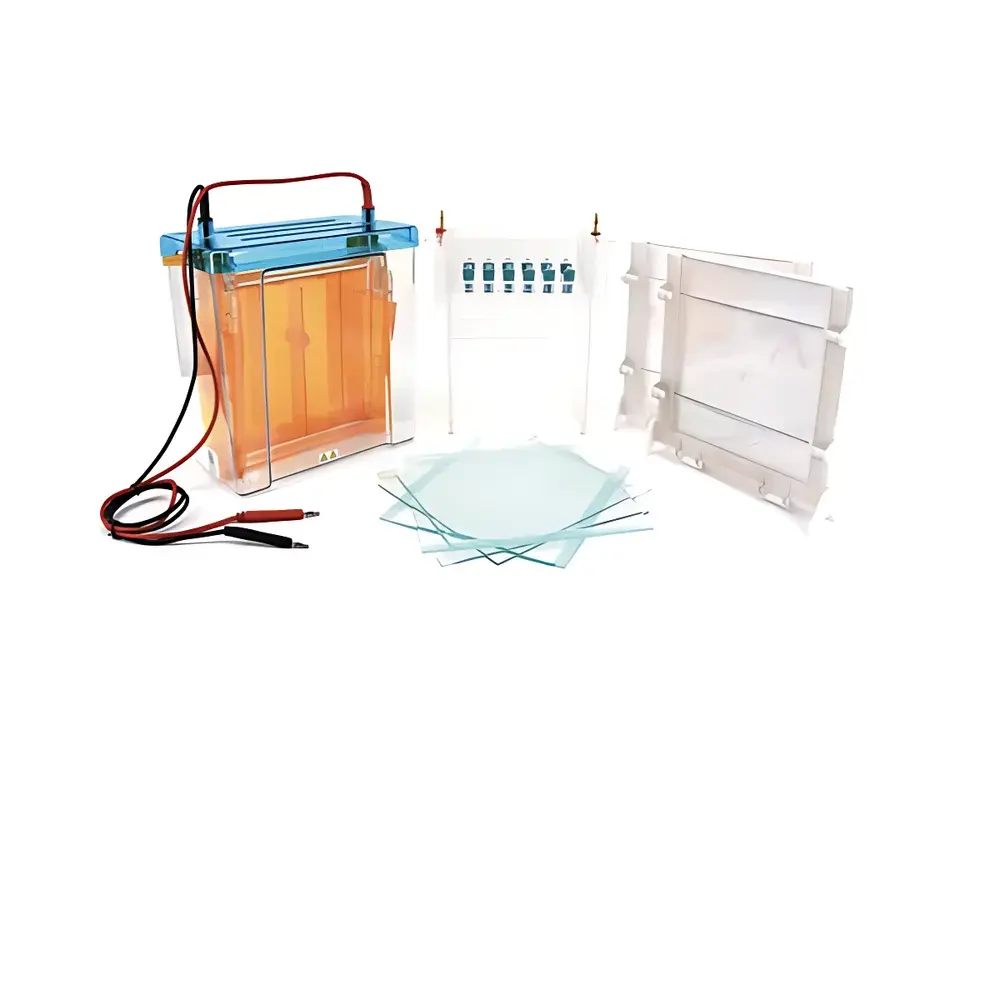
LY DYCZ-26C Dual-Dimensional Electrophoresis System (Model 121-2630)
| Brand | LY |
|---|---|
| Origin | Beijing, China |
| Manufacturer Type | Authorized Distributor |
| Instrument Category | Domestic |
| Model No. | 121-2630 |
| Instrument Type | Isoelectric Focusing (IEF) Electrophoresis System |
| Primary Configuration | Complete Electrophoresis Apparatus with Integrated IEF and SDS-PAGE Modules |
| Gel Format | Cylindrical polyacrylamide gels (φ2.5 mm × 90 mm or φ2.5 mm × 170 mm), 12-gel capacity per run |
| Sample Capacity | 12 independent IEF gel tubes per first dimension |
| Overall Dimensions (L×W×H) | 300 mm × 160 mm × 300 mm |
| Total Buffer Volume Capacity | ~3500 mL |
| Net Weight | 9.5 kg |
| First-Dimension Gel Tube Holder | Precision-machined glass tube rack for 12 × φ2.5 mm tubes |
| Second-Dimension Gel Casting System | Dual-plate (200 mm × 175 mm) vertical slab gel apparatus with 1.0 mm spacers |
| Safety Features | Lid-actuated power cutoff, mechanical position limiters, high-flexibility insulated leads |
| Compliance | Designed to support GLP-aligned workflows |
Overview
The LY DYCZ-26C Dual-Dimensional Electrophoresis System (Model 121-2630) is a purpose-engineered platform for high-fidelity two-dimensional polyacrylamide gel electrophoresis (2D-PAGE), specifically optimized for comprehensive protein separation in proteomics research. It implements the canonical 2D-PAGE workflow: isoelectric focusing (IEF) as the first dimension—using carrier ampholyte–containing cylindrical polyacrylamide gels—and sodium dodecyl sulfate–polyacrylamide gel electrophoresis (SDS-PAGE) as the second dimension. This orthogonal separation strategy resolves complex protein mixtures based on both isoelectric point (pI) and molecular weight, enabling downstream identification via mass spectrometry or immunoblotting. The system’s modular architecture integrates IEF tube gel casting, equilibration, and second-dimension slab gel assembly into a single compact footprint, minimizing cross-contamination risk and facilitating reproducible inter-laboratory transfer of protocols.
Key Features
- Structural integrity: Mainframe fabricated from high-transparency, impact-resistant polycarbonate via precision injection molding—ensuring optical clarity during gel monitoring and long-term chemical resistance to common electrophoresis buffers (e.g., Tris-HCl, glycine, urea, CHAPS).
- Dedicated first-dimension tooling: Includes a reusable glass tube rack accommodating exactly 12 × φ2.5 mm × 90/170 mm capillary gels, paired with a calibrated gel extrusion device for clean, bubble-free removal post-IEF.
- Controlled equilibration environment: Four-position stainless-steel balance trays (412-6312) maintain consistent redox and alkylation conditions during IEF gel incubation in SDS equilibration buffer—critical for preserving disulfide bond reduction fidelity prior to second-dimension loading.
- Second-dimension casting reliability: Dual-plate vertical gel mold (200 mm × 175 mm active area) with pre-assembled 1.0 mm spacers and leak-proof sealing system minimizes polymerization failure and buffer leakage—validated across >500 consecutive runs under routine QC testing.
- Operational safety and repeatability: Mechanical lid interlock interrupts high-voltage supply (>500 V DC) upon cover opening; positional limiters ensure precise alignment of tube gels onto SDS-PAGE stacking gels; ultra-flexible silicone-insulated leads reduce strain-induced conductor fatigue.
Sample Compatibility & Compliance
The DYCZ-26C supports native and denatured protein samples ranging from 5 kDa to >200 kDa, including membrane-enriched fractions when combined with appropriate solubilization buffers (e.g., 7 M urea, 2 M thiourea, 4% CHAPS). Its cylindrical IEF format eliminates horizontal pH gradient distortion common in IPG strips, enhancing pI resolution in low-abundance basic proteins. The system conforms to standard electrophoresis practice guidelines outlined in ISO 13843:2021 (Electrophoresis—General requirements) and supports traceable protocol execution required under GLP (Good Laboratory Practice) frameworks. While not FDA-cleared, its design permits full audit trail generation when paired with validated laboratory information management systems (LIMS) for regulated environments requiring 21 CFR Part 11–compliant electronic records.
Software & Data Management
The DYCZ-26C operates as a hardware platform without embedded firmware or proprietary control software. All operational parameters—including voltage ramping profiles, current limits, and run duration—are set externally via standard DC power supplies (e.g., Bio-Rad PowerPac HC, Thermo Fisher Ettan EPS 3501 XL). This open-architecture approach ensures compatibility with third-party imaging systems (e.g., Azure Biosystems Sapphire, GE Typhoon) and analysis software suites such as PDQuest, ImageMaster 2D Platinum, or open-source alternatives like OpenMS and Progenesis SameSpots. Experimental metadata—including gel dimensions, buffer composition, equilibration times, and staining protocols—can be systematically logged using LIMS-integrated templates aligned with MIAME (Minimum Information About a Proteomics Experiment) reporting standards.
Applications
- Comparative proteomics: Differential expression profiling of tissue lysates, cell culture supernatants, or biofluids (e.g., serum, CSF) under disease vs. control conditions.
- Post-translational modification (PTM) mapping: Detection of charge variants arising from phosphorylation, deamidation, or glycosylation through pI shifts in the first dimension.
- Biomarker discovery: High-resolution separation of low-abundance plasma proteins following depletion of albumin and immunoglobulins.
- Quality control of recombinant biopharmaceuticals: Assessment of charge heterogeneity and aggregation state in monoclonal antibodies and fusion proteins.
- Teaching laboratories: Structured 2D-PAGE training modules emphasizing fundamental principles of electrophoretic mobility, pH gradient formation, and gel handling technique.
FAQ
What voltage range is recommended for the first-dimension IEF step?
Typical IEF protocols employ constant-voltage operation: 500 V for 30 min (rehydration), followed by 1000 V for 1 hr, then 3500 V for 3–5 hrs. Exact settings depend on sample complexity and gel length.
Can the system accommodate longer IEF gels beyond 170 mm?
No—the mechanical guide rails and electrode spacing are engineered exclusively for φ2.5 mm × 90 mm and φ2.5 mm × 170 mm tube formats. Longer gels would compromise electrical field uniformity and thermal dissipation.
Is the second-dimension gel cassette compatible with precast commercial gels?
No—the DYCZ-26C requires hand-cast gels using its included dual-plate mold and spacer system. Precast gels lack the dimensional tolerances needed for seamless transfer of focused tube gels.
How is buffer recirculation managed during IEF?
The system does not include active buffer circulation; instead, it relies on passive diffusion and periodic manual buffer replacement in the upper and lower chambers to maintain pH stability and prevent electrolysis product accumulation.
What maintenance procedures are required for long-term reliability?
Monthly inspection of silicone tubing integrity, quarterly cleaning of electrode contacts with 70% ethanol, and annual calibration of power supply output against a certified digital multimeter are recommended.




