
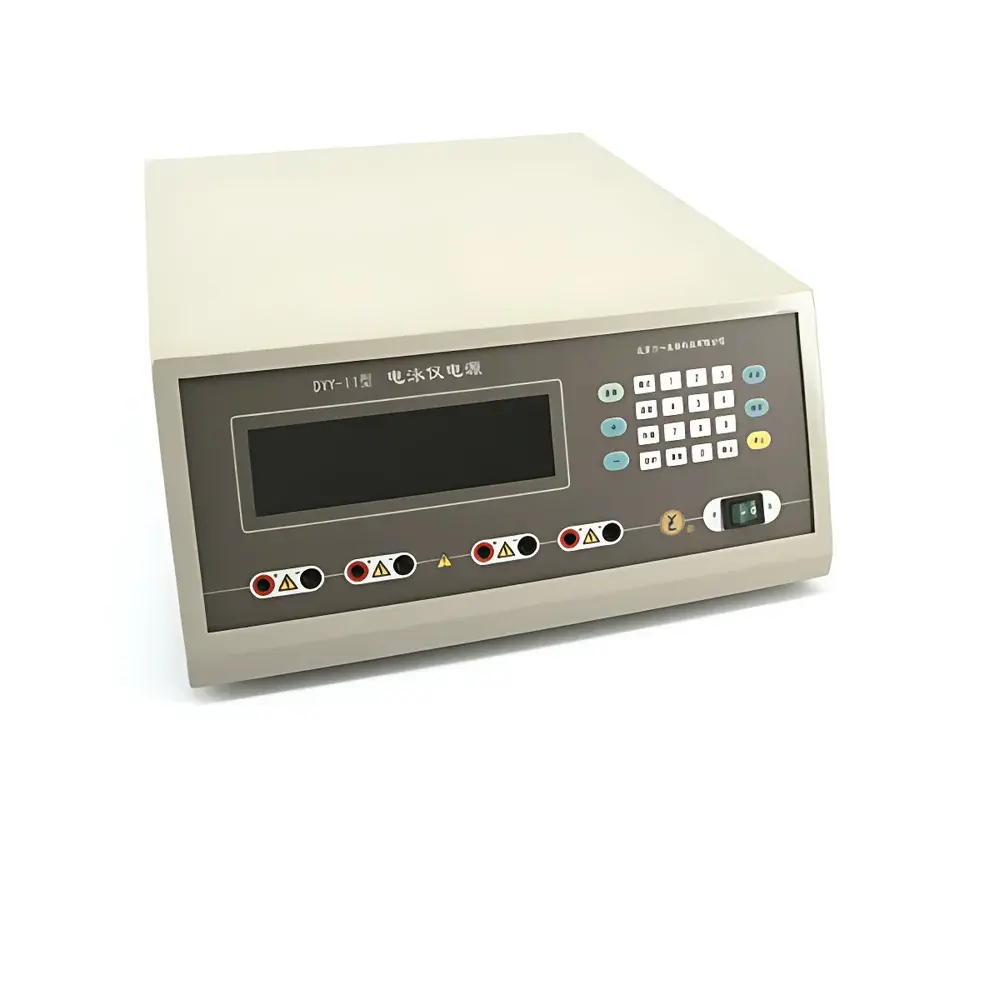
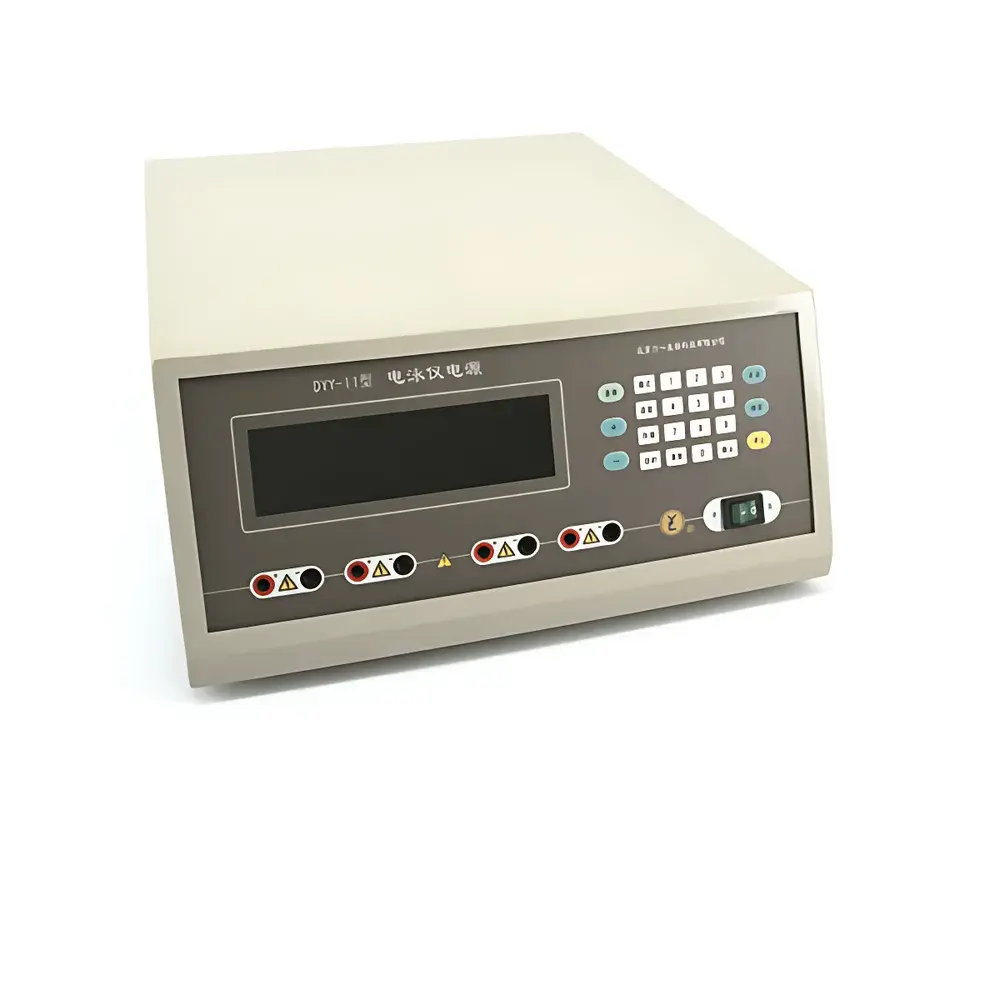
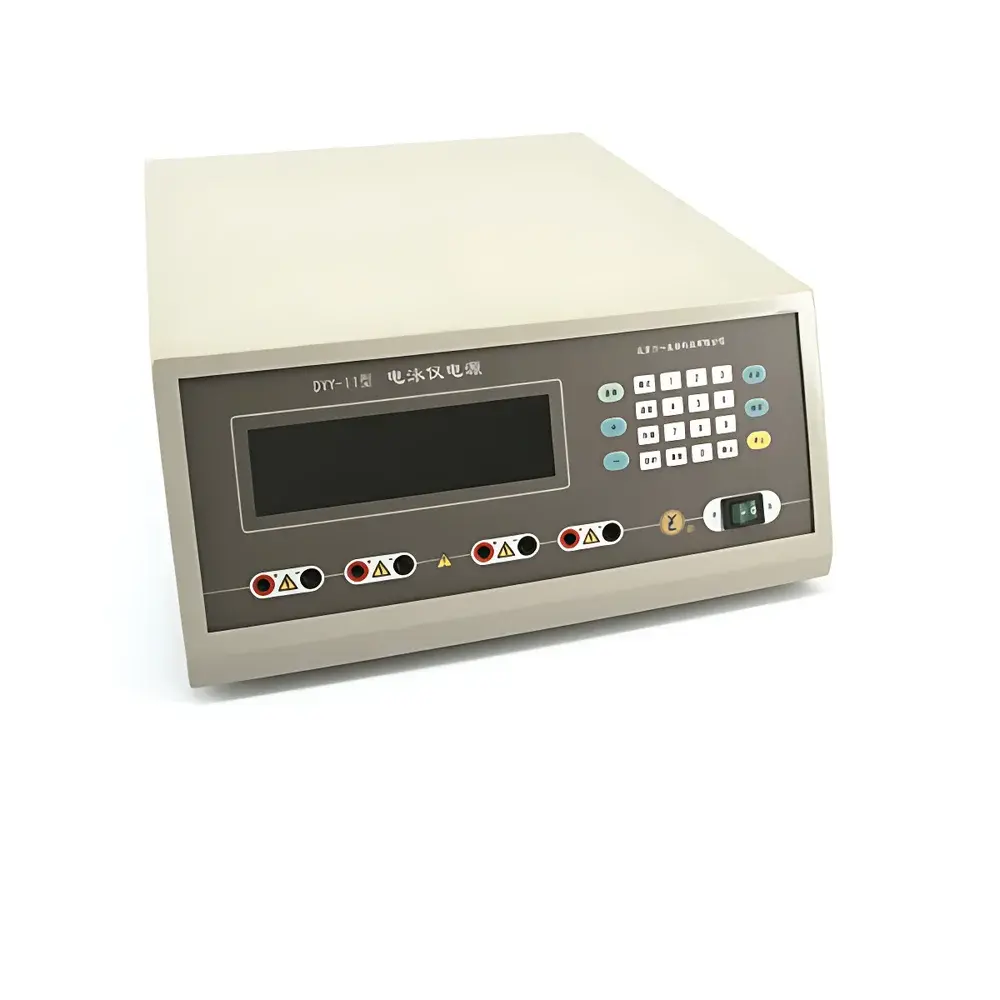
LY DYY-11 Computer-Controlled Triple-Constant Electrophoresis Power Supply
| Brand | LY (Beijing Liuyi) |
|---|---|
| Origin | Beijing, China |
| Model | DYY-11 |
| Output Channels | 4 independent parallel outputs |
| Voltage Range | 4–1000 V (1 V resolution) |
| Current Range | 4–500 mA (1 mA resolution) |
| Power Range | 4–300 W (1 W resolution) |
| Dimensions (W×D×H) | 303 × 364 × 137 mm |
| Weight | 7.5 kg |
| Display | Large LCD with real-time parameter monitoring |
| Control Modes | Constant Voltage / Constant Current / Constant Power |
| Programming | 10 stored protocols, up to 9 steps per protocol |
| Protection Features | Over-voltage, over-current, over-load, load variation, and no-load detection with automatic shutdown |
| Memory | Non-volatile program storage |
| Cooling | Integrated forced-air cooling system |
| Compliance | Designed for laboratory electrophoresis applications per IEC 61010-1 safety standards |
Overview
The LY DYY-11 Computer-Controlled Triple-Constant Electrophoresis Power Supply is an engineered solution for precise, reproducible electrophoretic separation in molecular biology and biochemistry laboratories. Based on regulated DC power delivery architecture, it supports three fundamental operational modes—constant voltage (CV), constant current (CC), and constant power (CP)—each optimized for distinct electrophoretic techniques including SDS-PAGE, native PAGE, agarose gel electrophoresis, isoelectric focusing (IEF), and DNA sequencing applications. Unlike basic benchtop power supplies, the DYY-11 integrates real-time digital feedback control, enabling dynamic stabilization of electrical parameters despite fluctuations in gel resistance, buffer conductivity, or ambient temperature. Its quad-channel parallel output design allows simultaneous operation of multiple electrophoresis units—such as horizontal and vertical systems—without cross-interference, enhancing throughput in high-volume core facilities.
Key Features
- Triple-constant operation (CV/CC/CP) with automatic mode selection logic based on user-defined setpoints and real-time load analysis
- Four independently regulated DC output channels, each with isolated ground reference and individual status indication
- High-resolution digital control: 1 V (0–1000 V), 1 mA (0–500 mA), and 1 W (0–300 W) adjustable increments for fine-tuned experimental optimization
- Large backlit LCD display showing real-time output values, active mode, elapsed time, step progress, and system status alerts
- Programmable multi-step protocols: up to 10 user-stored methods, each supporting up to 9 sequential stages with variable voltage/current/power and duration settings
- Comprehensive protection suite: hardware-level over-voltage, over-current, over-power, no-load, and rapid load-change detection, triggering immediate shutdown and visual/audible alarm
- Non-volatile memory retains all settings and protocols after power cycle; no reconfiguration required between sessions
- Forced-air thermal management system with thermally monitored fan ensures stable performance during extended runs (>8 h continuous operation)
Sample Compatibility & Compliance
The DYY-11 is compatible with standard electrophoresis apparatuses—including mini- and maxi-gel tanks, blotting modules, and capillary electrophoresis accessories—from major manufacturers (e.g., Bio-Rad, Thermo Fisher, C.B.S. Scientific). It delivers stable DC output across a wide range of gel matrices (agarose: 0.5–4%; polyacrylamide: 4–20%) and common running buffers (TAE, TBE, Tris-Glycine, CAPS). The unit conforms to IEC 61010-1:2010 for electrical safety in laboratory equipment and meets EMC requirements per IEC 61326-1. While not certified for GMP or GLP environments out-of-the-box, its programmable logging capability (via optional RS-232 interface) supports traceability when integrated into validated workflows compliant with ISO/IEC 17025 or FDA 21 CFR Part 11 (with third-party audit-ready software).
Software & Data Management
The DYY-11 operates as a standalone instrument with embedded firmware—no PC dependency required for routine use. All configuration, execution, and monitoring occur via front-panel controls and the integrated LCD. For advanced data capture, an optional RS-232 serial interface enables connection to external PCs or LIMS platforms. When paired with LY-provided terminal software (Windows-compatible), users can export timestamped output logs (voltage, current, power, time) in CSV format for QC documentation, method validation reports, or troubleshooting analysis. Audit trails—including parameter changes, program starts/stops, and fault events—are retained in device memory for ≥1000 cycles, satisfying basic traceability needs in academic and industrial research labs.
Applications
- Denaturing and non-denaturing protein electrophoresis (SDS-PAGE, BN-PAGE, 2D-PAGE)
- Nucleic acid separation: genomic DNA, plasmid prep verification, PCR product analysis, RNA integrity assessment
- Isoelectric focusing (IEF) and tube gel electrophoresis requiring precise voltage ramping
- Electroblotting (wet and semi-dry transfer) with programmable voltage decay profiles
- Preparative electrophoresis for protein purification and fraction collection
- Teaching labs requiring robust, intuitive instrumentation with fail-safe operation
FAQ
Does the DYY-11 support remote control via USB or Ethernet?
No—only RS-232 serial communication is supported; USB or Ethernet interfaces are not built-in.
Can output channels be synchronized or triggered simultaneously?
Yes—channels operate in parallel with identical timing and parameter sets when initiated from a single program; no inter-channel skew is observed.
What is the maximum continuous duty cycle at full rated power?
Rated for continuous operation at ≤250 W per channel under ambient temperatures ≤30 °C with unobstructed ventilation.
Is calibration traceable to national standards?
Factory calibration uses NIST-traceable multimeters; field recalibration requires authorized LY service center and documented calibration certificate.
How does the “step programming” function improve reproducibility?
Multi-step protocols eliminate manual intervention during complex runs (e.g., initial low-voltage focusing followed by high-voltage separation), reducing operator-induced variability and ensuring inter-experimental consistency.



