
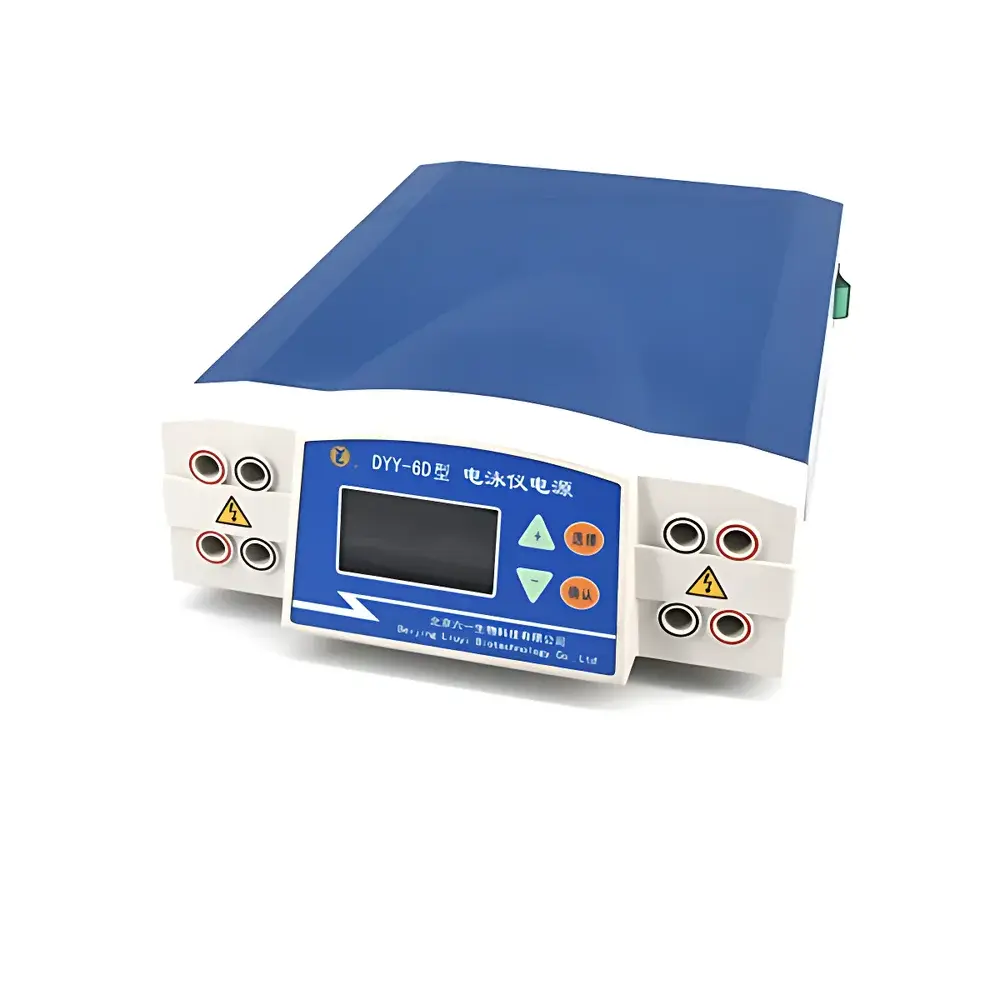
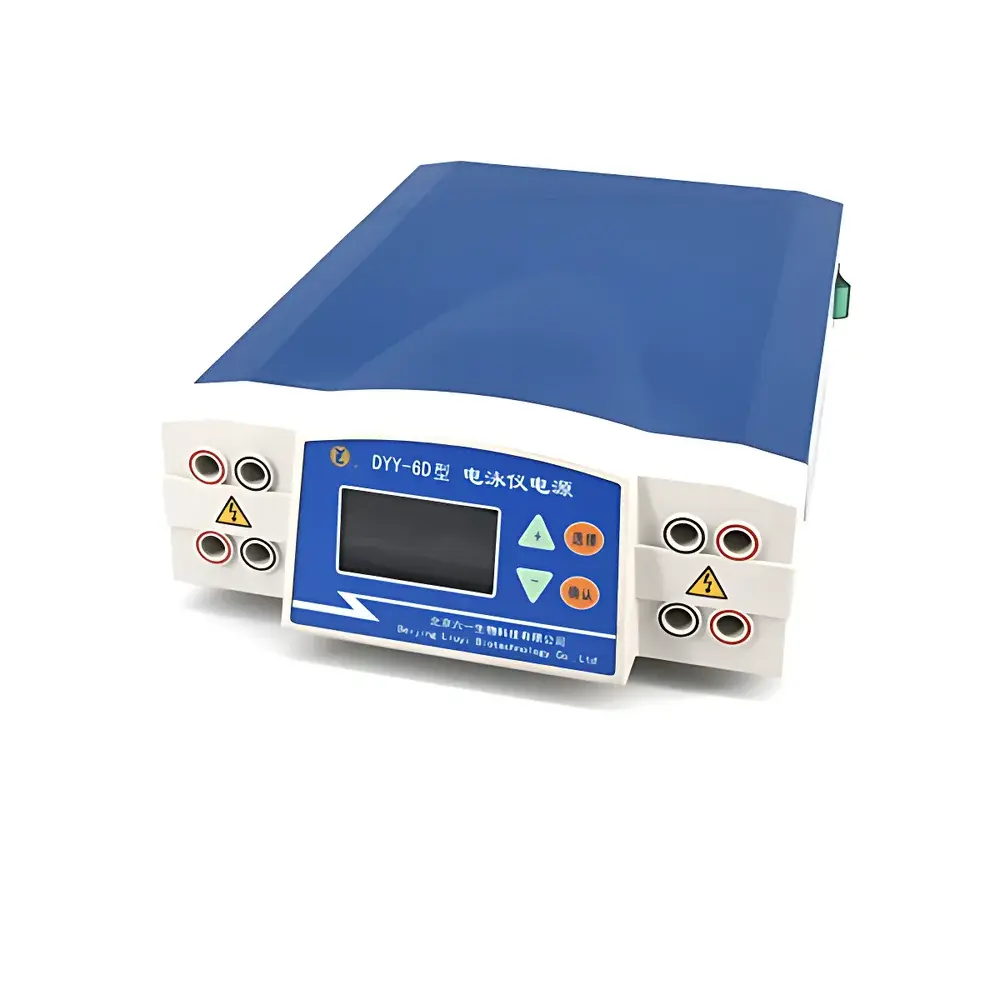
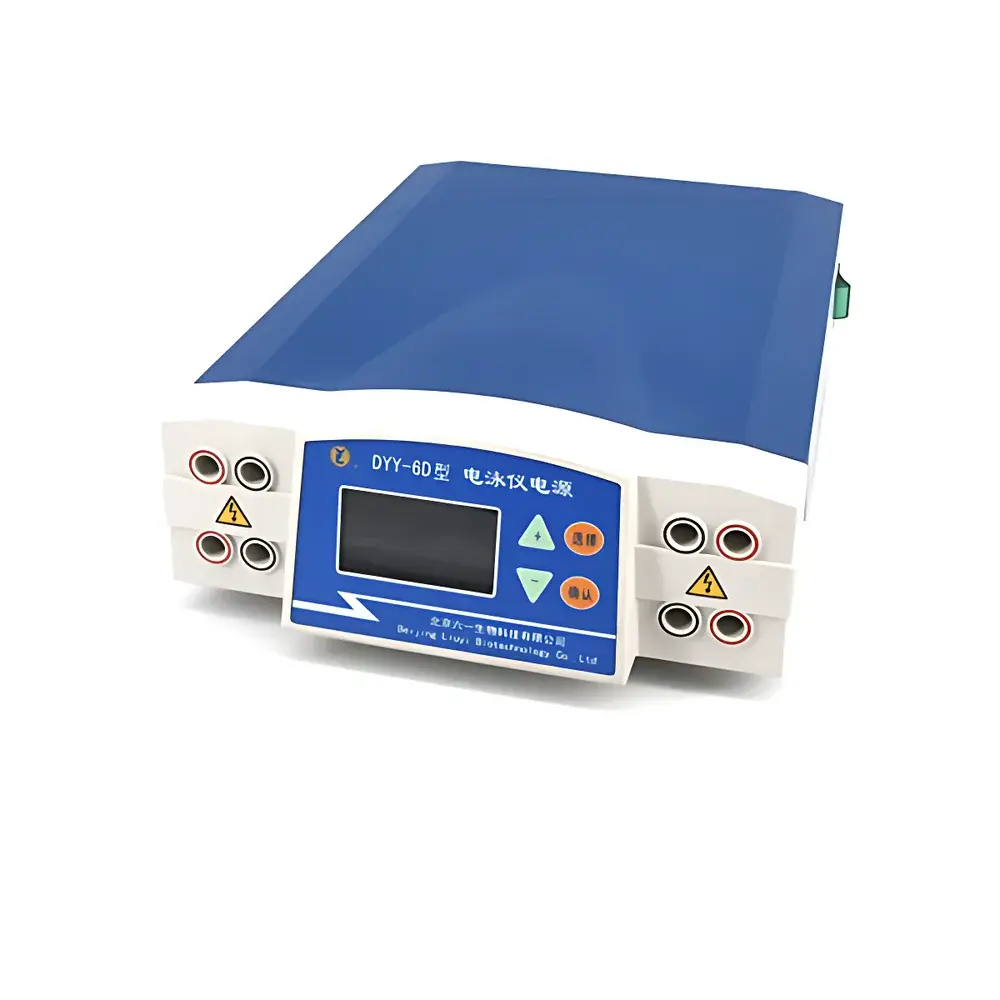
LY DYY-6D Computer-Controlled Triple-Constant Electrophoresis Power Supply
| Brand | LY (Beijing Liuyi) |
|---|---|
| Model | DYY-6D |
| Output Channels | 4 independent parallel outputs |
| Voltage Range | 6–600 V (1 V resolution) |
| Current Range | 4–600 mA (1 mA resolution) |
| Power Range | 1–300 W (1 W resolution) |
| Display | Large LCD showing real-time V, I, P, and timer |
| Memory | 10 user-programmable 3-step protocols |
| Control | Microprocessor-based with continuous parameter adjustment |
| Safety | Overload, short-circuit, over-temperature, and automatic shutdown protection |
| Dimensions (W×D×H) | 246 × 360 × 80 mm |
| Weight | 3.2 kg |
| Compliance | Designed for GLP-compliant electrophoresis workflows in molecular biology labs |
Overview
The LY DYY-6D Computer-Controlled Triple-Constant Electrophoresis Power Supply is a precision-engineered DC power source specifically designed for laboratory-scale electrophoretic separation techniques. It operates on the fundamental principle of applying a controlled electric field across a gel or capillary matrix to drive charged biomolecules—such as DNA, RNA, and proteins—based on their size-to-charge ratio. Unlike generic benchtop power supplies, the DYY-6D implements triple-constant regulation: simultaneous, independent control of voltage, current, and power output. This architecture ensures stable field strength during extended runs—even under variable load conditions caused by buffer depletion, gel heating, or electrode polarization—thereby preserving band resolution, reproducibility, and quantitative integrity across replicates. Its design targets routine and high-throughput electrophoresis applications in academic research, clinical diagnostics, and quality control laboratories where regulatory traceability and operational consistency are essential.
Key Features
- Triple-constant operation mode: Selectable voltage-, current-, or power-limited output with automatic cross-mode switching to maintain setpoint integrity.
- Four isolated parallel output channels: Enables simultaneous operation of multiple electrophoresis units (e.g., horizontal agarose gels, vertical SDS-PAGE tanks, or mini-IEF systems) without cross-talk or load interference.
- High-resolution digital control: 1 V, 1 mA, and 1 W display and setting resolution across full output ranges (6–600 V, 4–600 mA, 1–300 W).
- Intelligent microprocessor core: Supports real-time parameter fine-tuning during active runs, programmable multi-step protocols (10 memory slots, each storing up to 3 sequential steps), and automatic recovery after power interruption.
- Comprehensive safety architecture: Integrated thermal sensors, short-circuit detection, over-current cutoff, and fail-safe shutdown prevent instrument damage and sample loss.
- Low-noise linear power conversion: Minimizes electrical ripple (<0.01% RMS) to eliminate band distortion and smearing in high-resolution nucleic acid or protein separations.
Sample Compatibility & Compliance
The DYY-6D is compatible with standard electrophoresis apparatus from major manufacturers—including but not limited to Hoefer, Bio-Rad, C.B.S. Scientific, and GE Healthcare—supporting slab gels (mini and large format), horizontal submarine systems, and tube-based isoelectric focusing cells. It meets functional requirements for ISO/IEC 17025-accredited testing laboratories when operated within specified environmental conditions (20–30°C ambient, <80% RH non-condensing). While the unit itself carries no CE or UL certification mark, its output stability, repeatability (±0.5% over 8-hour continuous operation), and built-in audit-ready features—including parameter logging via optional RS-232 interface—facilitate alignment with GLP and GMP documentation practices. It is routinely deployed in workflows compliant with USP , CLSI EP17-A2, and ISO 15197 for electrophoretic analysis of serum proteins, hemoglobin variants, and oligonucleotide purity assessment.
Software & Data Management
The DYY-6D operates as a standalone instrument with no bundled PC software; however, its RS-232 serial port enables integration into laboratory information management systems (LIMS) or custom acquisition platforms using ASCII command protocol (e.g., “VSET=300”, “ISTART”). Users may log timestamped voltage, current, power, and elapsed time data at configurable intervals (1–60 s) for post-run correlation with gel imaging metadata. The device supports FDA 21 CFR Part 11–compatible electronic record generation when paired with validated third-party software that enforces user authentication, audit trails, and electronic signatures. All 10 protocol memories retain settings through power cycles, and the “power-on resume” function restores last-used parameters automatically—reducing setup errors in multi-user environments.
Applications
- Molecular biology: Agarose and polyacrylamide gel electrophoresis (AGE/PAGE) for DNA fragment sizing, plasmid analysis, PCR product verification, and RNA integrity assessment.
- Clinical biochemistry: Serum protein electrophoresis (SPEP), immunofixation electrophoresis (IFE), and hemoglobin variant screening in hematology diagnostics.
- Biopharmaceutical QC: Purity evaluation of recombinant proteins, monoclonal antibodies, and synthetic peptides under ICH Q5B guidelines.
- Education and training: Modular electrophoresis instruction in undergraduate and graduate teaching labs due to intuitive interface and robust fault tolerance.
- Method development: Optimization of voltage gradients for native PAGE, two-dimensional electrophoresis (2D-PAGE), and electroelution protocols.
FAQ
What electrophoresis techniques does the DYY-6D support?
It supports constant-voltage, constant-current, and constant-power modes—making it suitable for standard horizontal and vertical slab gels, capillary electrophoresis preparatory setups, and isoelectric focusing under controlled thermal conditions.
Can the DYY-6D power multiple electrophoresis tanks simultaneously?
Yes—its four independent, galvanically isolated output channels allow concurrent operation of up to four separate electrophoresis units without mutual interference or shared load effects.
Is calibration required, and how often should it be performed?
Annual calibration against NIST-traceable standards is recommended for GLP/GMP environments; internal self-diagnostics verify output accuracy before each run, and deviation alerts appear if measured values exceed ±1% of setpoints.
Does the unit include battery backup or uninterruptible power functionality?
No—however, its “power recovery” feature resumes the last active protocol upon grid restoration, preserving experimental continuity without manual reconfiguration.
What maintenance procedures are advised for long-term reliability?
Routine cleaning of ventilation grilles and rear heat sinks every 3 months; visual inspection of output terminals and cable insulation prior to each use; and periodic verification of fan operation and thermal sensor response using manufacturer-provided diagnostic routines.



